# JWST's Mysterious Little Red Dots May Be Black Holes Growing at Incredible Speeds
Astronomers have puzzled over a strange population of distant objects spotted by the James Webb Space Telescope since its launch. New simulations now offer a compelling explanation. These "Little Red Dots" appear to be black holes from the early universe growing at rates dozens of times faster than modern black holes, according to research conducted with advanced supercomputer models.
The mystery centers on a fundamental problem in cosmology. Observations show that supermassive black holes, some containing billions of solar masses, existed when the universe was less than a billion years old. This creates a timing problem. Standard models of black hole growth cannot account for how these objects reached such enormous sizes in so little cosmic time. Standard accretion rates would require a black hole to exist from near the Big Bang itself and consume material continuously, yet even this scenario leaves gaps in the calculations.
The Little Red Dots, discovered by JWST in infrared observations, offered a tantalizing clue. They appeared unusually bright and compact, unlike typical galaxies or known quasar types. Their infrared signature suggested obscured regions with extreme activity. The challenge was determining what powered them.
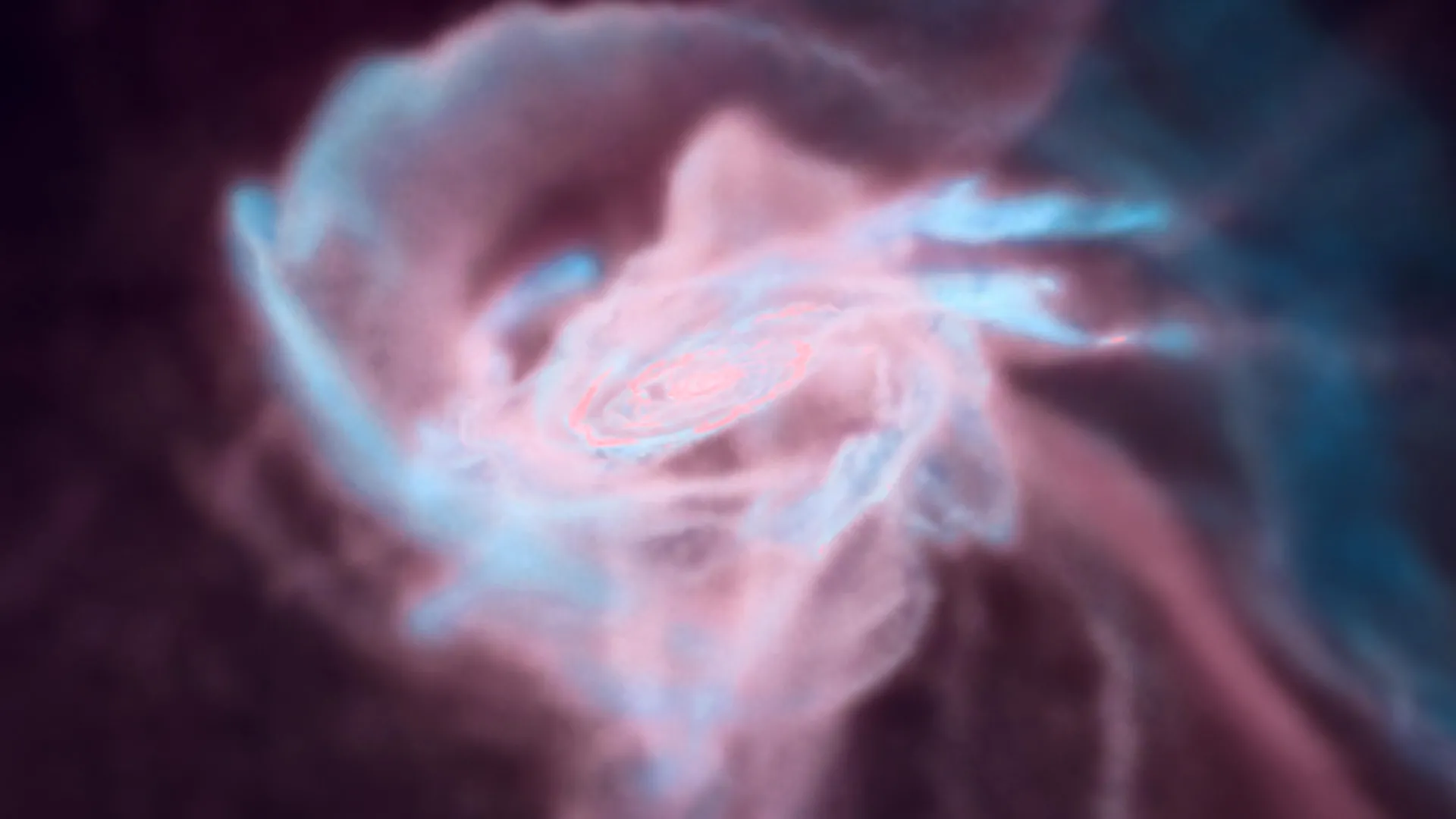
The new simulations, run on supercomputers, tracked the formation and growth of black holes in the early universe under conditions different from today. Researchers found that extreme radiation in the young cosmos could have created unusually massive black hole seeds. Rather than starting from stellar-mass remnants around 10 solar masses, these seeds began much larger, perhaps 100,000 times the Sun's mass or more.
The dense gas surrounding these seeds accelerated their growth dramatically. In the early universe, galaxies contained far more concentrated gas than they do now. Black holes orbiting within this gas-rich environment could accrete material at rates 20 to 50 times faster than the rate observed in local universe black holes today. Over just a few hundred million years, a massive seed could grow into a billion-solar-mass black hole.
When researchers compared their simulations to JWST observations of the Little Red Dots, the match proved striking. The simulated objects displayed the same infrared colors, brightness levels, and physical characteristics as the mysterious sources Webb detected. The heavy obscuration in the simulations matched the observations. The sizes and masses aligned with what astronomers inferred from the data.
The research addresses one of modern astronomy's central puzzles. JWST has detected supermassive black holes in galaxies formed just 300 to 500 million years after the Big Bang. These observations contradicted models predicting that such massive objects needed billions of years to assemble. If the Little Red Dots represent rapidly growing black hole seeds, they bridge that gap.
The findings remain provisional. Spectroscopic confirmation of the Little Red Dots is still underway. Some objects may not be black holes but other extreme phenomena. Additional observations from JWST and other telescopes will test whether the simulations accurately capture reality.
The work demonstrates how modern computational tools can test hypotheses about the distant universe. Rather than waiting for impossible direct observations, researchers model thousands of scenarios and compare predictions to actual data. When simulations and observations align closely, confidence in the underlying physics increases substantially.