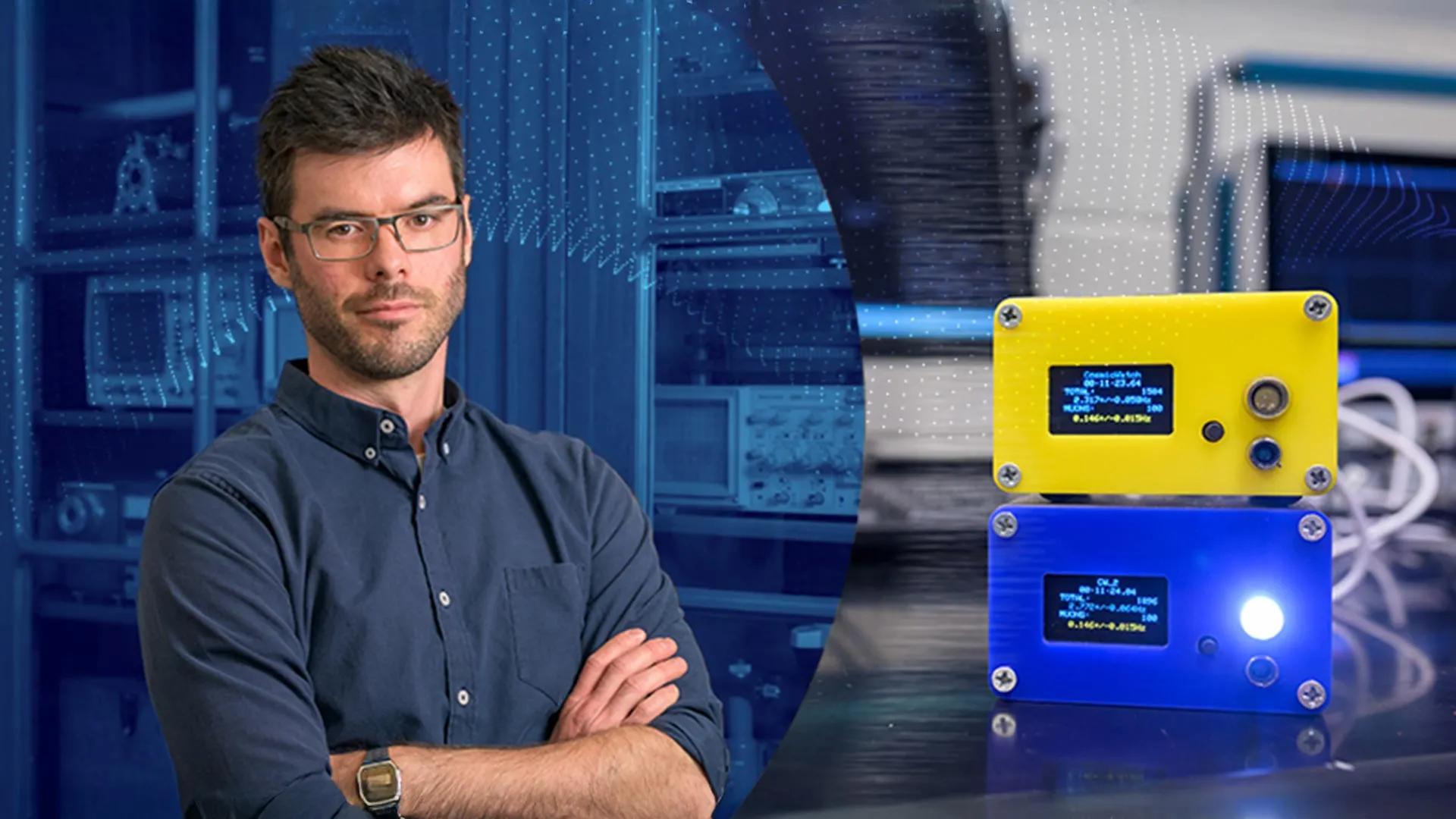
# Budget Cosmic Particle Detector Opens New Windows on High-Energy Physics
A $100 pocket-sized detector can now reveal the stream of cosmic particles constantly streaming through Earth and human bodies. The innovation, which originated as a student physics project, now plays a role in major experiments, balloon missions, and potential future spacecraft deployments.
Cosmic rays, high-energy particles from space, bombard Earth's atmosphere continuously. They collide with air molecules and generate showers of secondary particles, including muons, that rain down on the planet's surface. Most pass through buildings and bodies without interaction, but detecting them requires sophisticated instruments that typically cost thousands or millions of dollars. This new detector changes that equation entirely.
The detector's core principle involves scintillation, a process where particles excite atoms in certain materials, causing them to emit light. When a muon passes through the detector's crystal or plastic scintillator, it produces a faint flash. Photomultiplier tubes or silicon photomultipliers amplify this signal to measurable levels. The elegance lies in its simplicity and accessibility. At $100, the device becomes affordable for educational institutions, citizen science initiatives, and resource-limited research groups.
The project's journey from classroom to legitimate research tool demonstrates how constraint breeds innovation. Student researchers identified unnecessary complexity in conventional cosmic ray detectors and engineered a more efficient alternative. Their design proved capable of detecting muons with reliability comparable to expensive instruments, though with somewhat lower sensitivity. The breakthrough attracted attention from major research institutions seeking cost-effective detection networks.
Current applications include balloon-borne experiments that measure cosmic ray flux at various altitudes and latitudes. Researchers use multiple detectors positioned across geographic regions to map cosmic ray distributions and study how Earth's magnetic field deflects incoming particles. This distributed sensing approach would be prohibitively expensive with traditional detectors but becomes practical with the $100 design. Several institutions now deploy dozens of units simultaneously, creating data-rich networks previously impossible to maintain.
Space agencies explore applications for future missions. Detecting cosmic rays aboard spacecraft serves dual purposes. It helps characterize the radiation environment that astronauts encounter during long-duration missions and provides real-time measurements of space weather effects. The compact size and low cost make multiple detector arrays feasible on single spacecraft, improving spatial resolution of cosmic ray detection.
Educational impact extends beyond research applications. Physics educators use these detectors to teach particle physics and radiation detection in classroom settings. Students construct and operate instruments that contribute actual data to published research. This hands-on engagement with real scientific tools contrasts sharply with simulations or demonstrations relying on pre-recorded data.
The detector does have limitations. Its sensitivity falls short of specialized research instruments designed for specific particle types or energies. The silicon photomultipliers used in modern versions cost more than original designs but offer improvements in reliability and signal processing. Energy resolution remains lower than laboratory-grade devices, restricting certain analyses.
Future development focuses on improving sensitivity without sacrificing affordability. Researchers explore alternative scintillation materials and optical configurations that enhance light collection. Miniaturization efforts aim to reduce the device to truly pocket-sized dimensions without performance compromise. Integration with smartphone-based readout systems could further democratize cosmic ray detection.
This detector exemplifies how physics problems yield to creative engineering. By eliminating unnecessary complexity, researchers created an instrument that extends cosmic ray science to institutions and scientists previously priced out of the field. The democratization of particle detection tools opens new pathways for distributed research networks and educational enrichment in physics.