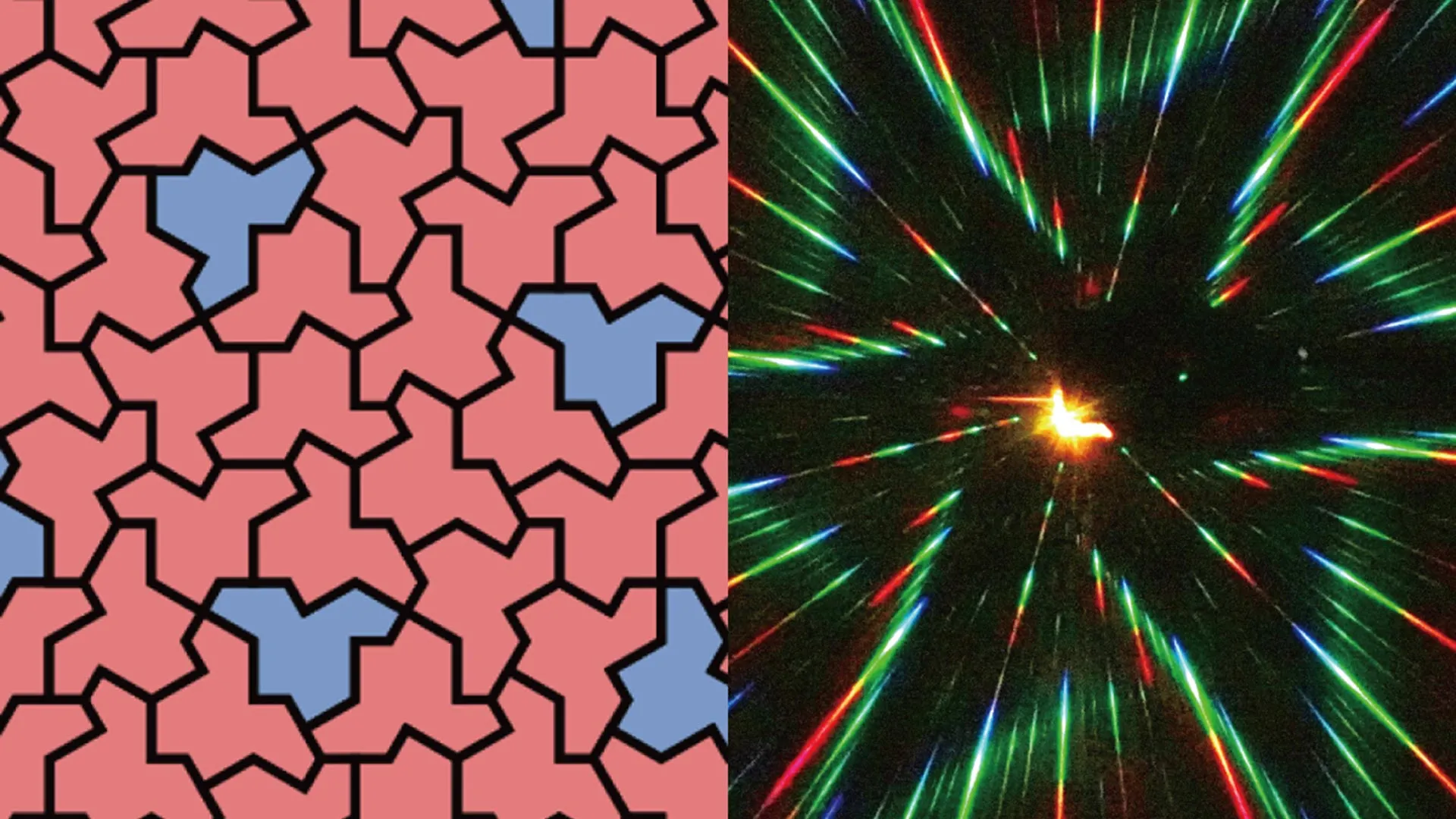
# Mathematical Shape Reveals Unexpected Light-Twisting Properties
Researchers have discovered that an aperiodic tiling pattern long studied for its mathematical properties can manipulate light in surprising ways. The shape, known as an aperiodic monotile or "einstein" tile (from the German "ein stein" meaning "one stone"), exhibits previously unknown optical behaviors that could revolutionize light control technologies.
The einstein tile gained prominence in 2023 when mathematicians finally solved a decades-old puzzle. David Smith, Joseph Myers, Craig Kaplan, and Chaim Goodman-Strauss announced the discovery of a single shape that could tile an infinite plane without ever repeating itself. This breakthrough resolved what became known as the "einstein problem" in mathematics. Now, physicists have uncovered an entirely different application for this geometric form.
The new research reveals that the einstein tile can manipulate light into chiral patterns, meaning the light exhibits handedness or asymmetry that cannot be superimposed on its mirror image. This property emerges from the tile's unique geometry and arrangement, allowing it to twist light's polarization in unconventional ways. The researchers demonstrated that light passing through or reflecting off arrangements of these tiles exhibits optical activity not typically observed in conventional materials.
The chiral light-twisting ability operates at scales that could enable practical applications. Unlike many exotic optical phenomena confined to laboratory conditions, these patterns appear accessible for real-world engineering. The discovery opens pathways for developing advanced optical devices that rely on precise polarization control, a critical component in telecommunications, medical imaging, quantum computing, and spectroscopy.
Polarization control stands at the heart of modern optical technology. Scientists currently use specialized materials like liquid crystals and birefringent crystals to manipulate light's polarization state. The einstein tile offers a geometric alternative that may prove more versatile or efficient in certain applications. The tile's aperiodic nature itself matters here. Unlike regular periodic patterns that repeat, aperiodic tilings create spatial variations that influence how light propagates through them, generating unexpected optical responses.
The research bridges two traditionally separate fields. Mathematical tiling theory, long considered pure mathematics without practical applications, intersects with photonics and optical engineering. This convergence reflects a broader pattern in science where abstract mathematical structures reveal physical utility.
Several limitations merit attention. The current research likely involved theoretical modeling or controlled laboratory demonstrations using prototype arrangements. Scaling these effects to practical devices requires engineering solutions for manufacturing and integration. The efficiency of light manipulation and the range of optical frequencies over which the effect operates remain unclear from available information.
Future work will likely focus on optimizing the tile arrangements for specific optical applications. Researchers may investigate how different materials, sizes, and orientations of einstein tiles affect their light-twisting properties. Integration with existing optical systems presents another frontier, potentially combining einstein tiles with traditional optical components to enhance overall device performance.
The discovery underscores how mathematical insights can yield unexpected physical applications. The einstein tile's journey from a century-long unsolved puzzle to a practical optical tool demonstrates the unpredictable value of pure mathematical research.