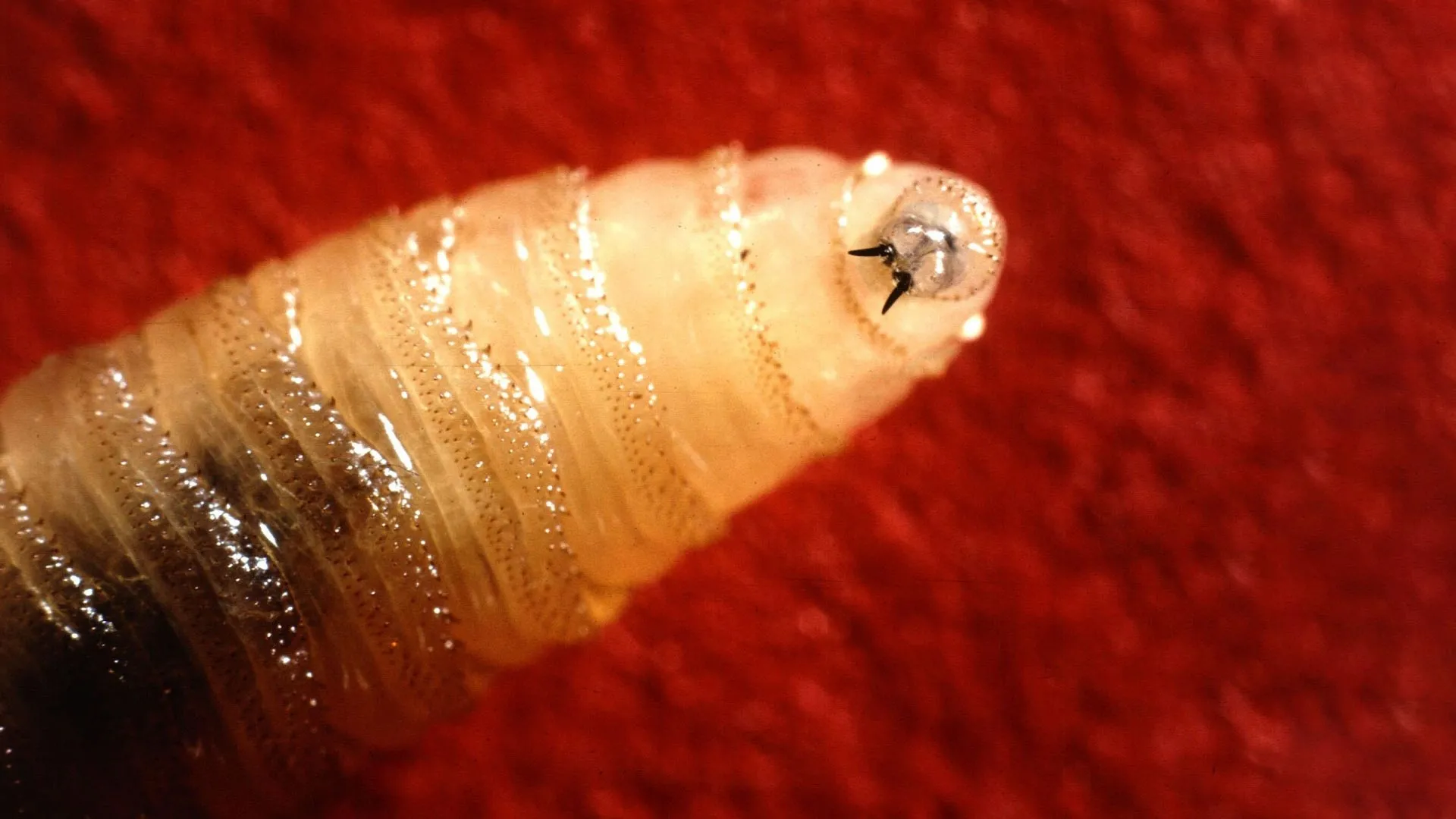
# Flesh-Eating Parasite Returns to U.S. After Decades of Eradication Success
The New World screwworm, a parasitic fly larva that burrows into living flesh and consumes tissue from the inside, has reestablished itself in the United States after nearly four decades of absence. The pest now threatens livestock, wildlife, domestic animals, and potentially humans as it spreads northward from its current stronghold in the southern states.
Researchers at UC San Diego have developed a new tracking system designed to forecast where the parasite will strike next and help contain its expansion. Simultaneously, federal and state officials are reviving the integrated pest management strategy that successfully eradicated the screwworm from the continental U.S. in the 1980s and 1990s.
The New World screwworm (Cochliomyia hominivorax) belongs to a family of parasitic flies endemic to Central and South America. Adult females lay eggs in open wounds on warm-blooded animals. Within hours, the eggs hatch into larvae that tunnel into living tissue, feeding on muscle and organs while emitting a distinctive putrid odor. Untreated infections frequently prove fatal, particularly in livestock.
The U.S. achieved screwworm eradication through the Sterile Insect Technique (SIT), a method involving mass production and release of radiation-sterilized male flies. When sterile males mate with wild females, no viable offspring result, gradually collapsing wild populations. This approach worked so well that screwworm disappeared from Florida, the Southwest, and all other U.S. territories by the early 1990s.
The parasite's recent return stems partly from climate change and increased trade with affected regions. Warmer winters allow populations to survive in southern Florida and Texas longer than previously possible. Human-assisted transport of infected animals also contributes to range expansion.
UC San Diego's tracking system leverages climate and ecological data to map suitable habitat and predict screwworm movement patterns. This intelligence helps authorities pre-position sterile flies and allocate quarantine resources before infestations spread into new territories. Early detection and rapid response prove essential for preventing the parasite from establishing permanent populations across wider geographic areas.
Federal agencies, including the U.S. Department of Agriculture (USDA) and the Florida Department of Agriculture and Consumer Services, have already begun releasing millions of sterilized screwworms in containment zones. The effort represents one of the largest SIT campaigns undertaken since the original eradication push. Texas, Arizona, and other at-risk states have activated emergency response protocols.
Veterinarians emphasize the importance of wound care on livestock and wildlife. Any animal with unexplained wounds, swelling, or discharge requires immediate inspection. In humans, infestation remains rare but can occur through infected wounds or mucous membranes. No vaccine exists for screwworm infection, making prevention and early detection the only viable defenses.
The screwworm's return underscores how invasive species eradication requires sustained vigilance. Decades of success can erode public and institutional memory about why such programs matter. Budget constraints and shifting political priorities often undermine long-term biosecurity efforts. This particular crisis offers a test case for whether coordinated regional approaches can contain a re-emerging pest before it metastasizes across the continent once again.