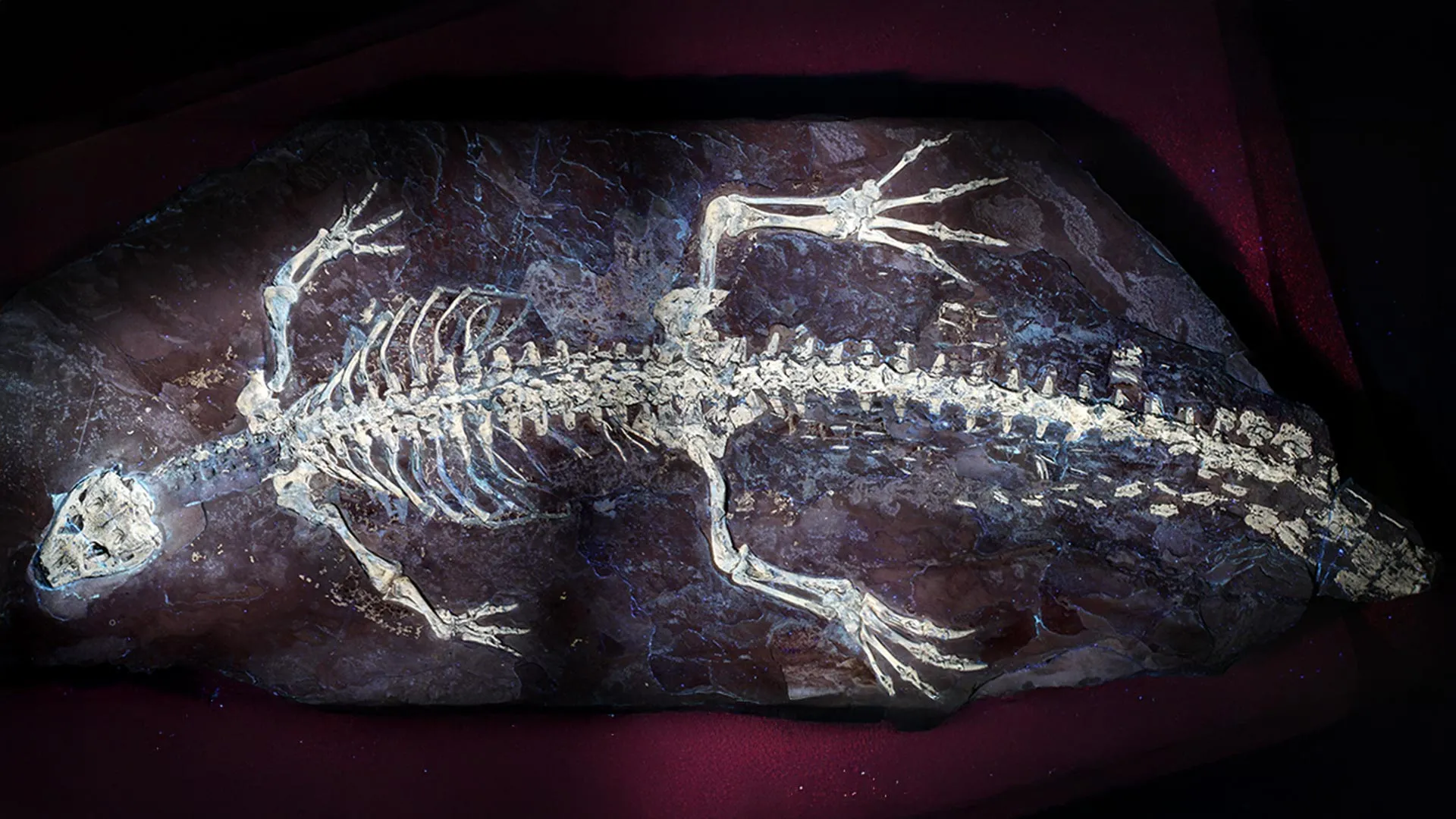
# UV Light Reveals Possible Ancient Camouflage on 125-Million-Year-Old Crocodile Fossil
Researchers using ultraviolet imaging have discovered alternating bands on a 125-million-year-old crocodile fossil that may represent the oldest known color pattern in a crocodylomorph, the group that includes modern crocodiles and alligators. The striped pattern on the creature's tail emerged only under UV light, invisible to standard visual inspection of the specimen.
The fossil belongs to a crocodylomorph from the Early Cretaceous period and preserves far more than just bone. The specimen retained impressions of skin, sensory organs, and respiratory structures that have rarely survived fossilization. When paleontologists exposed the tail region to ultraviolet wavelengths, the alternating bands became visible, suggesting they once carried pigments that absorbed or reflected specific light frequencies differently than surrounding tissue.
Such striped tail patterns appear in modern crocodilians and function in multiple ways. They may serve as camouflage in dappled freshwater environments where light filters through vegetation and water. They can also communicate social information during intraspecific interactions, with pattern intensity and visibility playing roles in dominance signaling and mating displays. The 125-million-year-old pattern hints that these behavioral and ecological functions operated similarly in ancient crocodylomorphs.
The preservation of this coloration represents an extraordinary window into the visual presentation of extinct animals. Most fossils preserve only skeletal and sometimes soft tissue structure. Color patterns vanish almost universally within hours or days after death as bacteria decompose pigment-bearing cells and minerals alter their chemistry. Fossilization typically erases all trace of original coloration, leaving scientists to infer appearance from living relatives or comparative anatomy.
This discovery joins a growing catalog of ancient color recoveries made possible by advanced imaging techniques and chemical analysis. Researchers have previously identified colors in dinosaur feathers, fossilized insects preserved in amber, and ancient cephalopods. Each recovery depends on preservation of the molecular structures that originally created color. In this crocodile specimen, UV imaging revealed patterns too faint for human eyes under normal light but still retained in the fossilized tissues.
The research underscores the value of applying multiple analytical methods to museum specimens that may have been studied repeatedly under conventional examination. Many fossils sit in collections for decades or centuries before new technologies render previously invisible details visible. UV fluorescence imaging, originally developed for geological and medical applications, has become a standard tool in paleontology for revealing hidden structures and patterns.
The specimen also contained impressions of sensory organs, likely including integumentary sensory structures that allowed the animal to detect vibrations and pressure changes in its aquatic environment. The preserved respiratory features suggest how gas exchange functioned in early crocodylomorphs, potentially informing models of their metabolic rates and activity levels compared to modern species.
This early Cretaceous crocodylomorph provides a snapshot of how these reptiles looked and functioned 125 million years ago. The alternating bands on its tail may have helped it blend into dappled water while hunting, much as modern crocodiles use similar patterns today. The discovery reinforces that some animals preserved the essential visual elements of their appearance across tens of millions of years of geological time, offering paleontologists rare opportunities to see the past not just as skeletons, but as living, colored animals.