# Venus's Hidden Cloud Absorber Gets New Constraints From Light Analysis
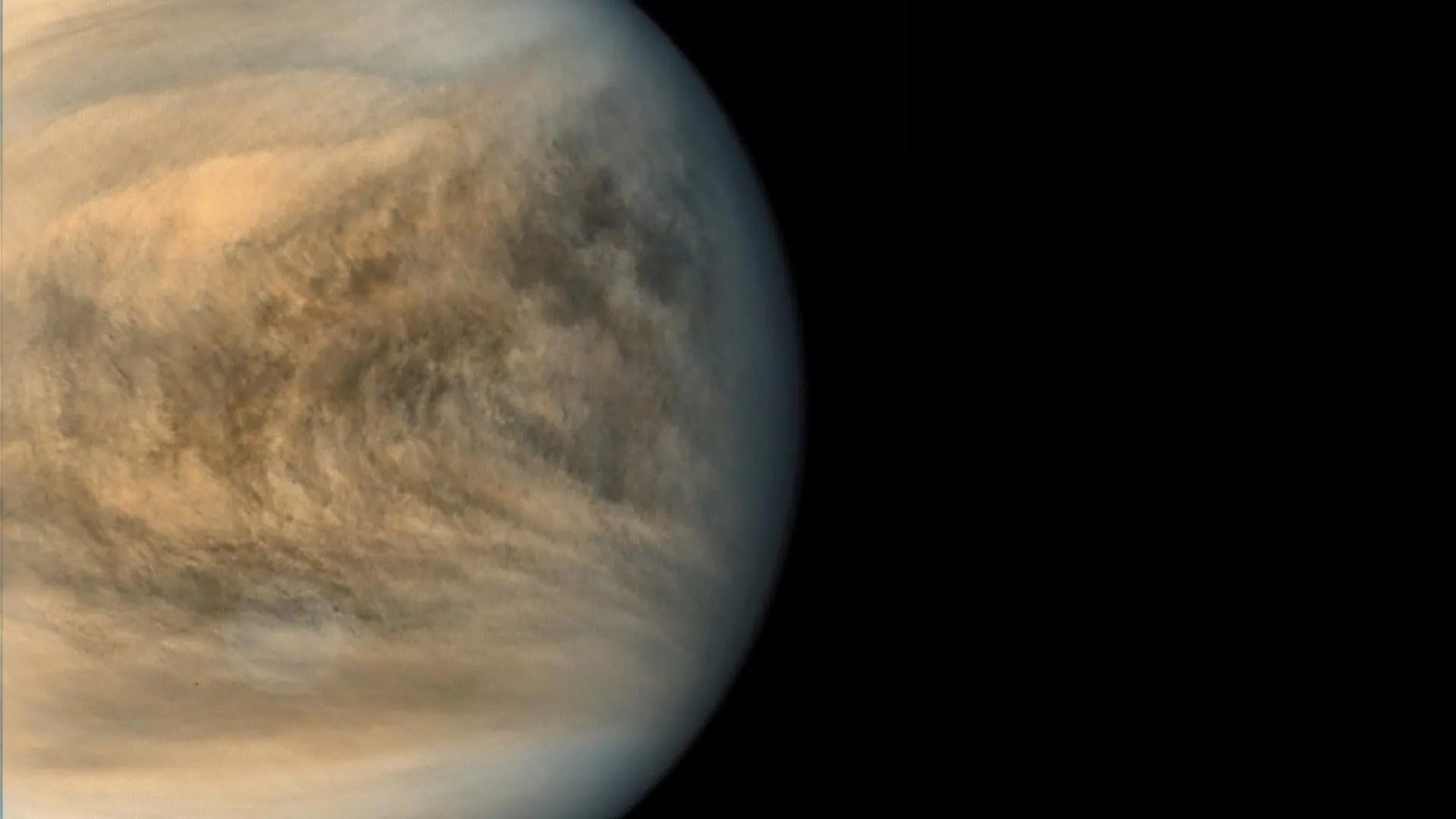
Venus presents one of planetary science's most stubborn riddles. The planet's sulfuric acid clouds reflect sunlight brilliantly in visible wavelengths, appearing pale yellow and cream-colored. Yet when observed in ultraviolet light, dramatic dark patches crisscross the cloud tops like cosmic fingerprints. For over a century, scientists have puzzled over what creates these ultraviolet-absorbing patterns. Now researchers have calculated precise constraints on how strongly this unknown material must absorb light, dramatically narrowing the list of candidates.
The new analysis reveals critical absorption thresholds that the mystery substance must meet. This work fundamentally changes how scientists evaluate potential explanations. Previous theories ranged widely across organic compounds, sulfur-based chemicals, and exotic possibilities. The absorption measurements now eliminate some contenders entirely while elevating others as far more plausible.
The dark patterns in ultraviolet light cover roughly 60 percent of Venus's cloud tops and change appearance over days and weeks. This dynamic behavior suggests the absorber responds to atmospheric chemistry or photochemistry. The ultraviolet "dark side" of Venus represents a major compositional puzzle because even trace amounts of an extremely efficient absorber could produce the observed patterns. Alternatively, larger quantities of a weaker absorber might explain the data.
Researchers employed radiative transfer modeling to calculate exactly how much light absorption these cloud features require. By examining how ultraviolet radiation penetrates through the Venusian atmosphere and clouds, scientists determined strict boundaries on the absorber's optical properties. This computational approach translates observational data from existing spacecraft into quantitative absorption coefficients.
The implications extend beyond academic curiosity. Understanding Venus's cloud chemistry bears directly on biosignature detection in exoplanet atmospheres. If Venus harbored microbial life in its upper clouds, as some researchers have speculated based on phosphine detections, that life might produce organic compounds that absorb ultraviolet light. Alternatively, purely chemical processes could generate the observed patterns through reactions involving sulfur, chlorine, or other elements abundant in Venus's toxic atmosphere.
Future missions to Venus will test these refined constraints. NASA's upcoming DAVINCI mission and ESA's EnVision spacecraft carry instruments capable of collecting spectroscopic data with unprecedented precision. These observations could directly identify the absorber's chemical fingerprint through absorption and emission patterns across multiple wavelengths.
The new absorption calculations also provide context for the phosphine controversy. Previous detections of phosphine in Venus's clouds sparked debate about potential biological origins, though abiotic explanations remain viable. Understanding the ultraviolet-absorbing material could illuminate broader questions about Venus's atmospheric chemistry and whether exotic biosignatures might exist there.
This work exemplifies how remote sensing and modeling converge to solve planetary mysteries. By constraining the physical properties of invisible constituents, scientists create falsifiable predictions that spacecraft observations can confirm or refute. The path forward requires combining theoretical absorption modeling with direct chemical analysis from robotic explorers.