# Supermassive Black Hole Winds Pack 100 Times More Punch Than Expected
Astronomers using Japan's XRISM X-ray satellite have measured the winds ejected from a supermassive black hole and found them roughly 100 times more powerful than previous estimates suggested. The discovery fundamentally changes how scientists understand the cosmic reach of black holes and their ability to reshape entire galactic neighborhoods.
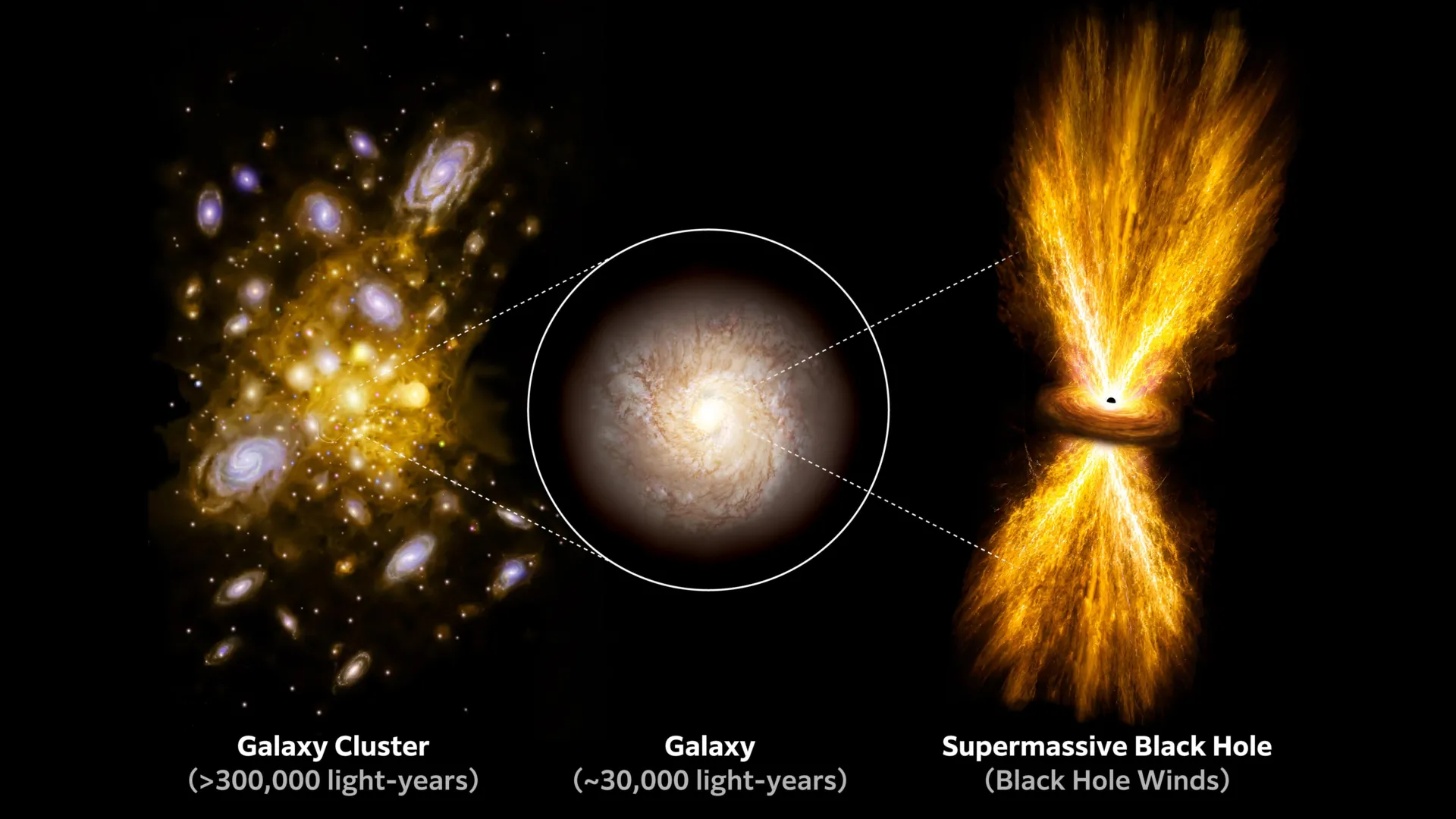
The research team observed turbulence and winds propagating outward for approximately 300,000 light-years from the black hole, extending well beyond the boundaries of its host galaxy. To put this scale in perspective, the Milky Way spans about 100,000 light-years across. The energy released by these black hole winds rivals several billion supernova explosions, making them among the most energetic phenomena in the universe.
XRISM, the X-ray Imaging Spectroscopy Mission, launched in early 2023 as a joint venture between the Japan Aerospace Exploration Agency, NASA, and other international partners. The satellite carries instruments capable of measuring X-ray emissions with unprecedented precision. By analyzing the X-ray signatures of hot gas surrounding the black hole, researchers could calculate wind speeds and energies that ground-based telescopes could not detect with sufficient accuracy.
Black holes actively feeding on material generate intense radiation as matter spirals inward toward the event horizon. This radiation creates outflows of gas moving at speeds approaching thousands of kilometers per second. Scientists have long known these winds exist, but the XRISM data revealed the winds carry far more kinetic energy than models predicted. The finding explains observations of galaxy clusters that showed disrupted gas patterns far too extensive to match with previously calculated black hole wind energies.
The implications extend across astrophysics. Black hole winds inject enormous quantities of heat and momentum into the intergalactic medium, affecting star formation rates in surrounding galaxies. When a black hole's winds are powerful enough, they can suppress new star birth across regions containing billions of stars. This process, called quenching, helps explain why some galaxies stop forming stars while others continue producing them.
The specific black hole system studied has not been explicitly named in initial reports, though XRISM has already examined numerous active galactic nuclei since beginning observations. Researchers continue analyzing data from the mission to measure additional supermassive black holes and refine models of how often such extreme wind events occur.
One limitation of the current work involves distinguishing between winds directly launched from the black hole itself versus turbulence generated secondarily as those winds plow through surrounding gas. XRISM's spectroscopic capabilities help address this challenge, but observations of multiple systems across different cosmic epochs will strengthen conclusions about how universal this 100-fold energy boost truly is.
Future observations with XRISM and upcoming X-ray telescopes like Athena, set to launch in the early 2030s, will map black hole winds in greater detail. These missions promise to transform understanding of how supermassive black holes shape galaxies throughout cosmic history.