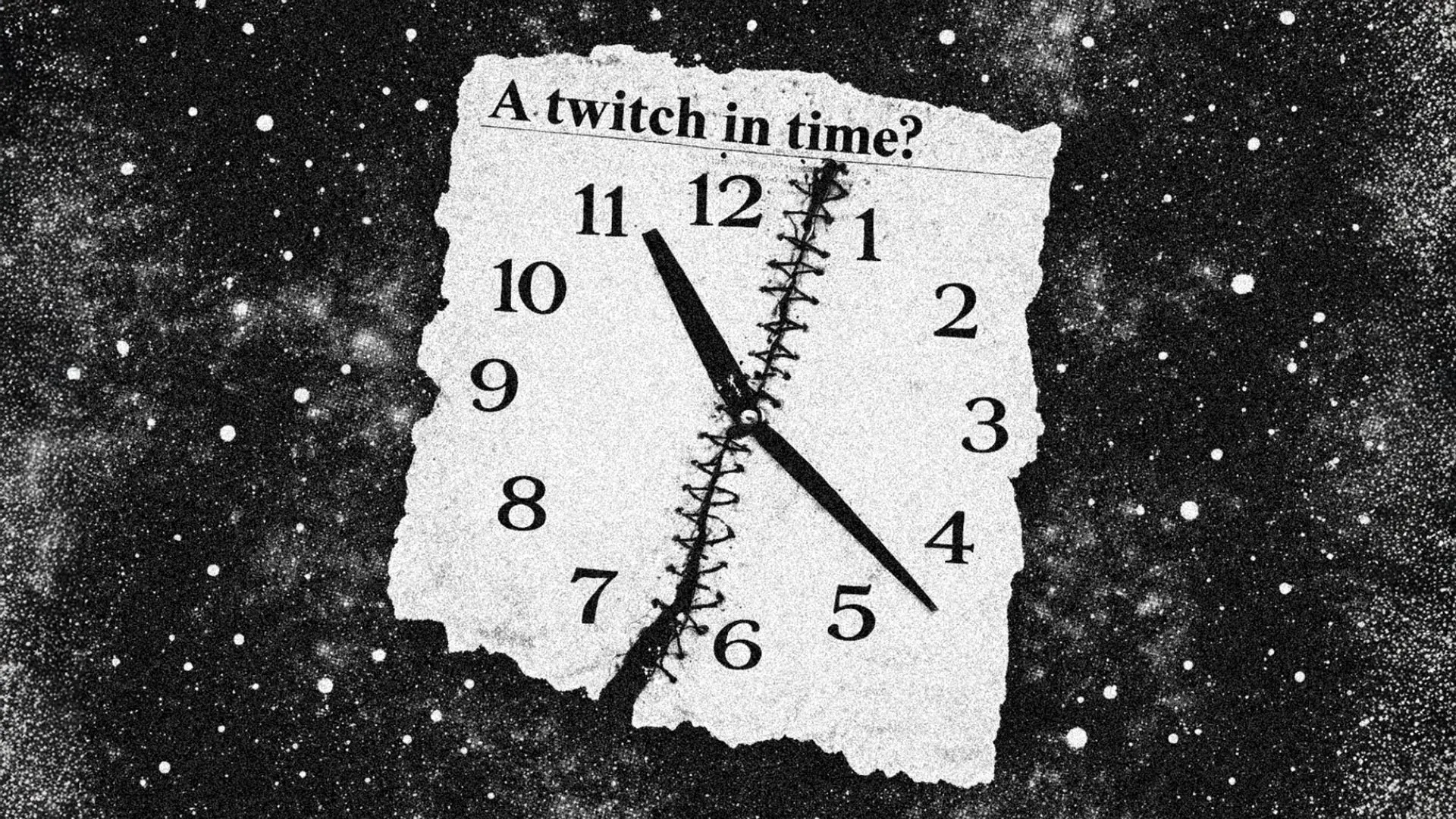
Physicists have detected evidence suggesting time itself contains fundamental uncertainty at the quantum level, a finding that could reshape how scientists understand the relationship between quantum mechanics and gravity.
The discovery emerges from unconventional quantum theories proposing that time has intrinsic imprecision, similar to how Heisenberg's uncertainty principle limits simultaneous knowledge of a particle's position and momentum. This temporal uncertainty would impose a physical ceiling on clock precision that no instrument could ever exceed, regardless of engineering sophistication.
The effect remains extraordinarily small, existing far below the sensitivity threshold of current measurement technology. Even the most precise atomic clocks humanity has built operate nowhere near the scale where this quantum timing blur becomes detectable. Yet the theoretical framework points to something profound: time may not be the smooth, infinitely divisible continuum that classical physics assumes.
This work bridges three cornerstone areas of modern physics that have historically resisted unification. Quantum mechanics governs subatomic particles. General relativity explains gravity and spacetime. The two frameworks produce contradictory predictions when applied to extreme conditions like those inside black holes or at the universe's birth. A theory accommodating temporal uncertainty could help resolve these longstanding tensions by suggesting that spacetime itself operates with quantum limitations.
The research builds on decades of work in quantum gravity research. Loop quantum gravity and string theory both propose radical reimagining of spacetime structure. Some formulations suggest spacetime becomes granular at the Planck scale, the smallest meaningful unit of length (about 10^-35 meters). Temporal uncertainty fits naturally into this framework, implying that even time itself fragments into discrete quanta at sufficiently small scales.
The detection method and specific experimental setup remain unclear from available information, though the work likely involves sophisticated mathematical analysis comparing theoretical predictions with precision measurements from existing atomic clocks or gravitational wave detectors. Scientists may have identified subtle statistical signatures in experimental data that align with quantum timing uncertainty predictions. Alternatively, they may have derived new constraints from observations of quantum systems that indirectly reveal temporal uncertainty properties.
The practical implications extend beyond fundamental physics. If confirmed through future high-precision experiments, temporal uncertainty would necessitate revising frameworks for timekeeping, navigation systems relying on atomic clock precision, and experimental designs requiring extreme temporal resolution. GPS systems and quantum computing applications could eventually require updated theoretical models accounting for this effect.
However, the finding remains speculative pending independent verification and theoretical refinement. The magnitude of the effect and methods for detecting it at accessible scales require further development. Scientists must rule out whether observed anomalies stem from genuine temporal uncertainty or from measurement limitations, systematic errors, or gaps in current experimental calibration.
Future experiments with next-generation atomic clocks and gravitational wave detectors may push sensitivity close enough to test these predictions. Such confirmation would rank among physics' most profound discoveries, establishing time as a quantum property woven fundamentally into reality's fabric rather than a classical parameter. The potential connection between quantum mechanics and gravity through temporal uncertainty opens new pathways for developing unified physical theories that eluded physicists for generations.