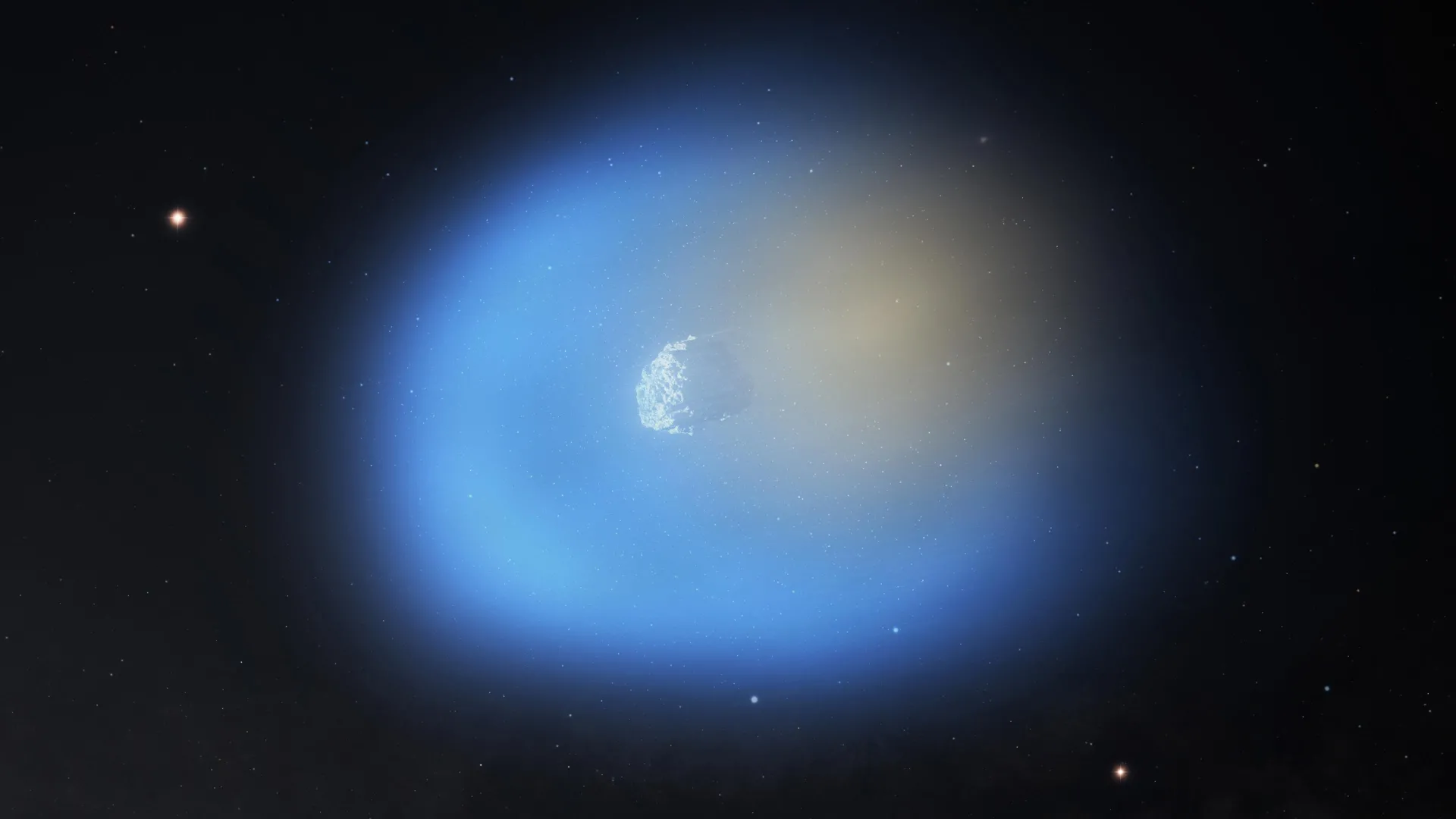
Astronomers discovered that interstellar comet 3I/ATLAS harbors unusually high concentrations of methanol, offering a rare window into the chemical composition of material from beyond our solar system. Observations from the Atacama Large Millimeter/submillimeter Array (ALMA) revealed that the comet's methanol levels far exceed what scientists typically find in solar system comets, indicating the object formed in an alien planetary system with fundamentally different conditions.
The discovery carries weight because methanol serves as a chemical fingerprint. Its abundance reflects the temperature, density, and composition of the material from which a comet coalesced. When the methanol-rich comet 3I/ATLAS entered our solar system, it brought evidence of an environment quite unlike the protoplanetary disk that birthed our own comets billions of years ago. This makes 3I/ATLAS a traveling sample from another star's planetary neighborhood.
ALMA's observations revealed an additional phenomenon. Tiny icy grains orbiting the comet were actively releasing methanol into space, functioning like miniature comets themselves. This process, called sublimation, occurs as solar radiation heats the icy material. The detection of these methanol-rich grains provided astronomers with an unexpectedly detailed chemical map around the comet, essentially turning the region into a natural laboratory for studying interstellar composition.
Only a handful of interstellar objects have visited our solar system. The first, 1I/'Oumuamua, arrived in 2017 and sparked intense scientific scrutiny. 3I/ATLAS followed in 2024, making these objects precious subjects for research. Each visitor carries chemistry encoded from its home stellar system, but most pass through too rapidly or are too distant for thorough analysis. The methanol discovery proved fortunate timing.
The research team used ALMA's sensitivity to detect specific molecular signatures across a broad range of frequencies. This capability let them map methanol concentrations and identify the tiny grain emissions. The findings appear consistent with 3I/ATLAS originating in a relatively cool region of its home system, possibly the outer reaches of an alien protoplanetary disk similar to the Kuiper Belt beyond Neptune.
Understanding how different star systems produce comets refines astronomers' models of planetary formation. Methanol levels help determine formation temperature, which constrains what kind of star system could have created 3I/ATLAS. A warmer origin zone would produce a methanol-poor comet, while the observed abundance points to cooler conditions. This tells scientists something about the thermal structure and age of 3I/ATLAS's birthplace.
The discovery also highlights limitations in studying distant objects. Astronomers cannot return samples or conduct laboratory experiments on interstellar comets. They must extract every possible measurement during brief windows of observation. ALMA's detection of methanol-releasing grains demonstrated that even passive observations can yield rich chemical details if instruments are sensitive enough.
Future interstellar visitors may not receive such detailed scrutiny. The timing of 3I/ATLAS's passage and its brightness made comprehensive ALMA observations feasible. Each interstellar comet represents a one-time opportunity to gather data from alien planetary systems. The methanol findings from 3I/ATLAS establish a baseline for comparing chemistry across different stars and understanding how planetary systems vary throughout the galaxy.