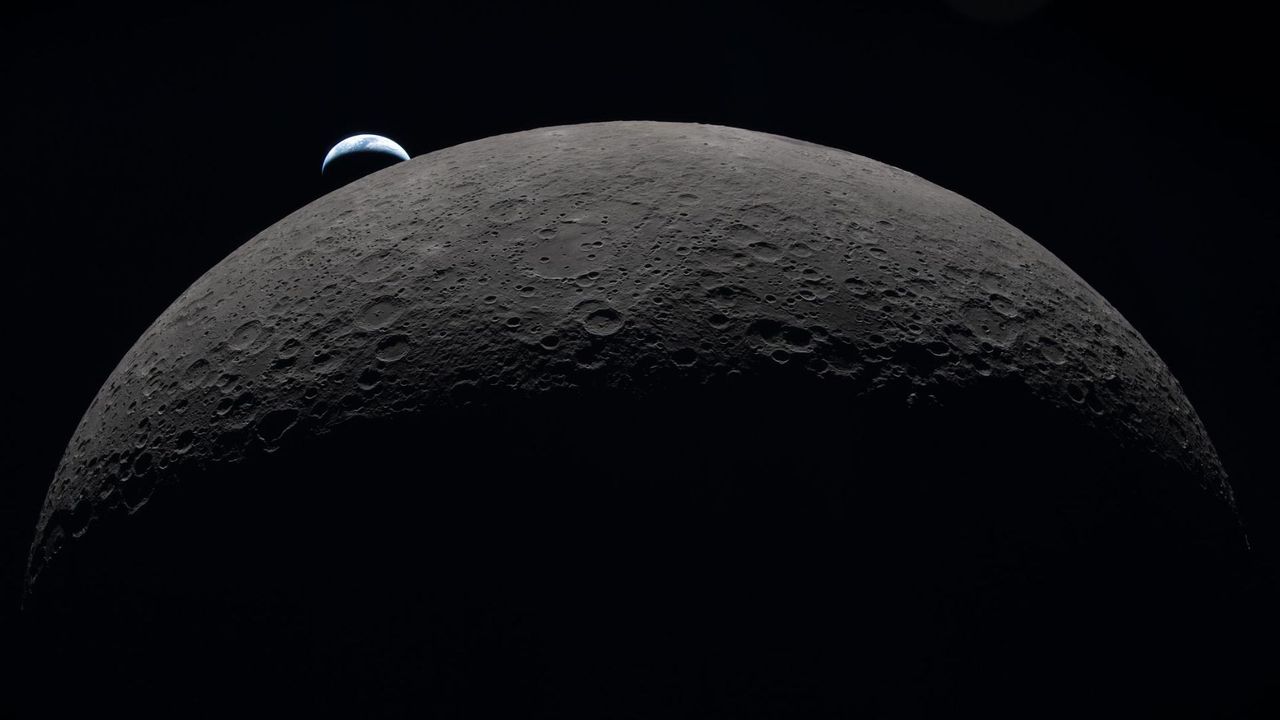
# Earth's Moon May Have Formed in Just Five Hours After Giant Impact
Scientists have refined one of astronomy's oldest mysteries: how long it took for the moon to coalesce after a Mars-sized object crashed into Earth roughly 4.5 billion years ago. New research suggests the entire process happened in as little as five hours, a dramatic compression of earlier estimates that ranged from months to years.
The work emerges from sophisticated computer simulations tracking the aftermath of the giant impact hypothesis, the leading scientific explanation for lunar origin. Around 4.51 billion years ago, an object called Theia collided with the proto-Earth at an oblique angle. The impact vaporized both bodies and ejected material into orbit, where it rapidly coalesced into the moon.
Researchers ran N-body simulations following the collision's immediate aftermath. These models tracked how debris particles merged under mutual gravity. The simulations revealed that within roughly five hours, enough material had accumulated and compressed to form a body matching the moon's observed mass and orbital characteristics.
Earlier models, developed decades ago with less computational power, suggested the accretion process unfolded over extended periods. Those estimates reflected limitations in processing speed and resolution. Modern supercomputing allows researchers to track millions of particles with far greater precision, revealing that the gravitational assembly happened much faster than previously thought.
The five-hour formation window carries physical implications. Rapid accretion means intense internal heating from gravitational compression and impacts. A moon that coalesces in hours rather than weeks or months would retain more of its initial thermal energy. This affects our understanding of lunar differentiation, the process where heavier elements sink to the core and lighter materials float outward to form the crust.
Scientists used data from lunar samples returned by Apollo missions and China's Chang'e missions to constrain their models. Chemical composition and isotope ratios from these samples provide benchmarks for testing formation scenarios. The rapid assembly timescale aligns reasonably well with the observed internal structure of the moon.
This research connects to broader questions about planetary system formation. How quickly do planetary-scale objects assemble from debris disks? Do all moons form through similar rapid processes, or does the mechanism vary? Understanding Earth's moon provides a foundation for interpreting exoplanet systems and the diversity of moons around planets in other star systems.
The work also refines our picture of early Earth's conditions. A moon forming in hours means Earth's surface likely experienced extreme heating and possibly re-melting during and shortly after accretion. This constrains models of when Earth's core solidified and when magnetic fields emerged, questions linked to the planet's long-term habitability.
The study represents progress in lunar science through improved computational methods, not necessarily revolutionary new observations. The giant impact hypothesis remains well-supported by multiple lines of evidence. What has shifted is our precision about the timeline, moving from an uncertain span of months or years to a tighter estimate measured in single-digit hours.
Future missions to the moon may refine these estimates further. Sample collection from the lunar far side and interior subsurface could reveal additional compositional details about formation conditions and timing.