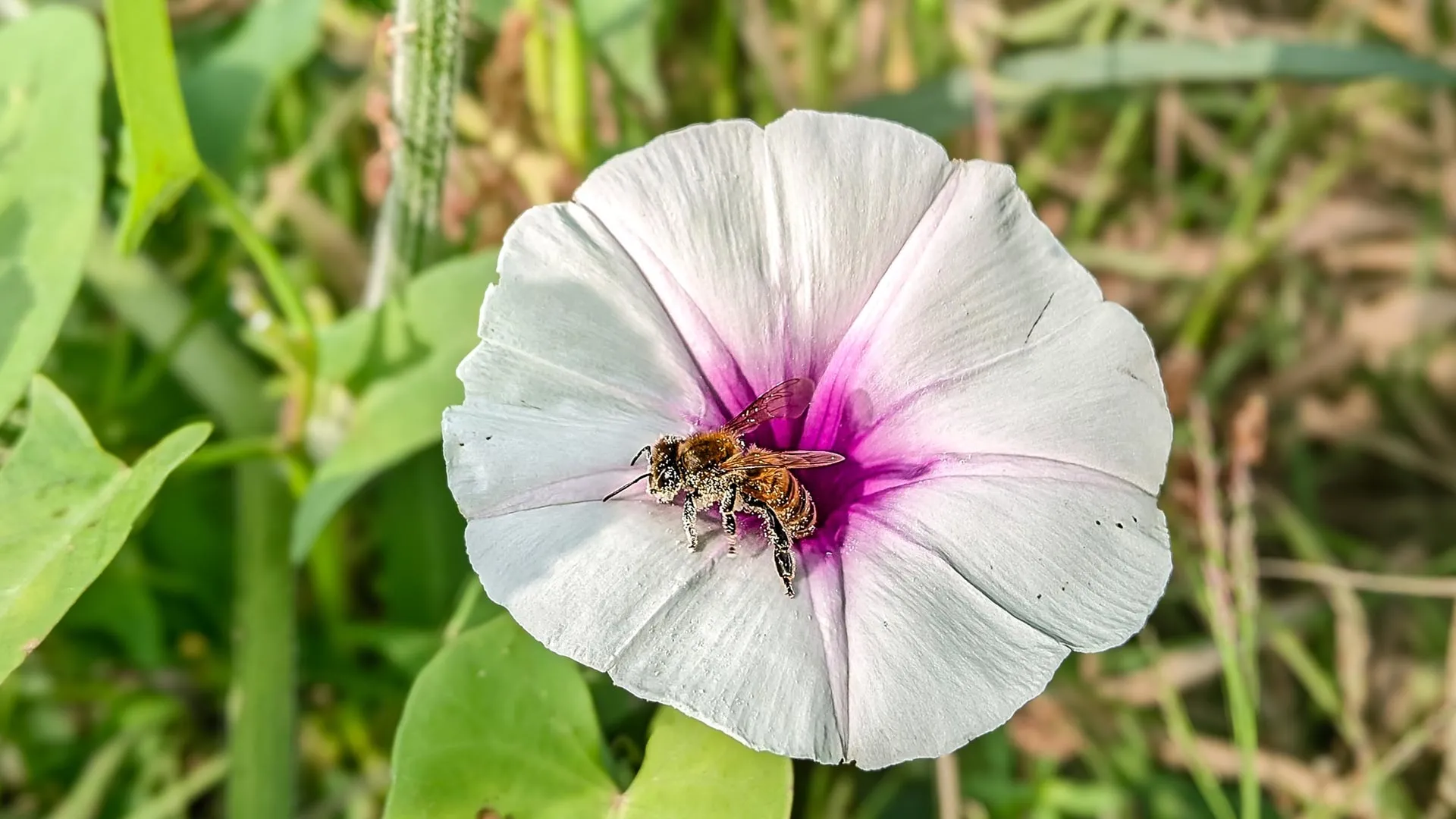
# Plants Caught Between Climate and Pollinator Crisis, Evolution Slowing Sharply
Morning glories are evolving in the wrong direction for survival, caught between two deadly pressures. A new study reveals that these flowering plants have dramatically slowed their evolutionary response to climate change, even though genetic diversity remains abundant in their populations.
Researchers tracking morning glory populations over nine years observed a startling collapse in adaptation rates. The plants' capacity to evolve favorable traits for warming conditions dropped by 96 percent. This decline occurred despite no apparent loss of the genetic raw material needed for evolution to proceed, pointing to a deeper conflict within the plants' survival strategies.
The culprit appears to be pollination pressure. As global temperatures rise and disrupt pollinator populations, morning glories face competing evolutionary demands. Traits that help plants tolerate heat and drought may conflict with traits that attract the increasingly scarce bees and other pollinators these plants depend on for reproduction. The plants cannot optimize for both simultaneously.
This research exposes a hidden cost of environmental change that extends beyond simple adaptation. Evolution requires not just genetic variation but the right ecological context. Morning glories possess the genes needed to become more drought-resistant or heat-tolerant, yet something is preventing those beneficial variants from spreading through populations. The evolutionary brake appears to be natural selection favoring pollinator appeal over climate resilience.
The implications extend far beyond morning glories. Thousands of flowering plant species face similar pollinator declines driven by habitat loss, pesticide use, and disrupted ecological networks. If plants must choose between attracting dwindling pollinators or adapting to rapid temperature swings, many may fail at both. Reproduction depends on successful pollination, so even heat-hardy plants cannot pass on their genes if pollinators abandon them.
The study adds to growing evidence that species face cascading environmental crises simultaneously rather than one at a time. Single-stressor research has long dominated biology, examining how plants respond to drought alone or pollinator loss alone. Reality operates differently. Multiple threats create evolutionary conflicts where solutions to one problem worsen another.
The nine-year window matters. Nine years is long enough to observe evolutionary change in short-lived plants, yet the 96 percent decline in adaptation suggests this pattern is not recent but established. Morning glories may already be experiencing this trade-off, with populations potentially accumulating pollinator-attracting genes while falling behind on climate adaptation.
Researchers did not identify the specific genes involved in this evolutionary conflict, leaving open questions about whether the trade-offs are fundamental or contingent. Some genetic variants might serve both functions simultaneously. Future work could reveal whether selective breeding or assisted gene flow might help populations escape this evolutionary bind.
The findings challenge restoration and conservation strategies that assume evolution provides automatic solutions. Reintroducing plants to degraded habitats or helping species migrate to cooler zones may fail if plants cannot simultaneously adapt to new climates and maintain pollinator relationships. Conservation efforts may need to explicitly manage pollinator populations alongside plant populations to prevent evolutionary stasis.
Morning glories represent a canary in the coal mine for flowering plants globally. Their slowing evolution demonstrates that genetic potential alone does not guarantee survival when multiple environmental pressures conflict.