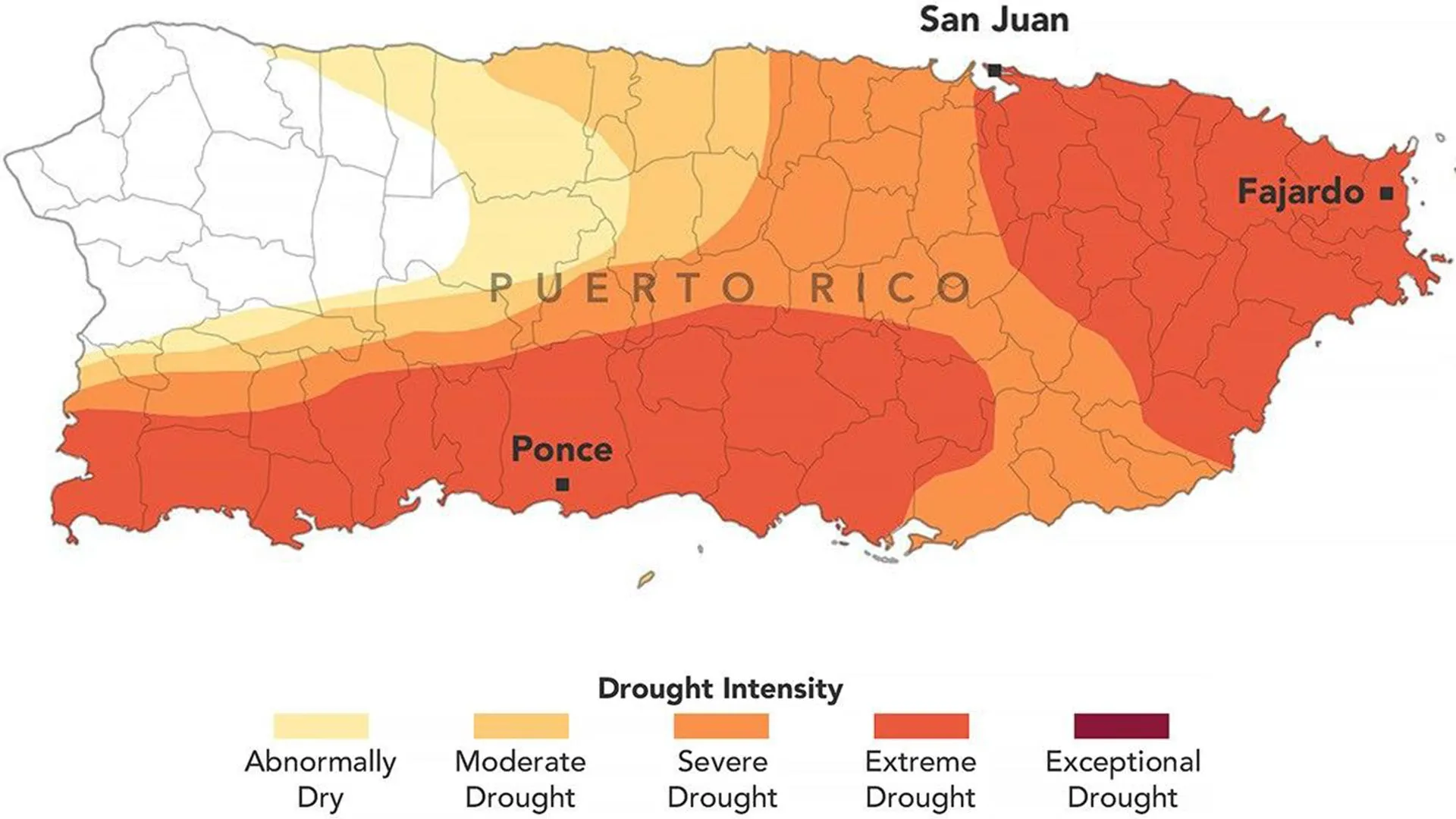
Puerto Rico is experiencing one of its most severe droughts in recent memory, with extreme drought conditions now covering nearly half the territory as of late August. The crisis has escalated rapidly, transforming what should have been a wet season into a water emergency that has prompted both local and federal disaster declarations.
The scale of the drought is staggering. Three-quarters of Puerto Rico sits in at least moderate drought conditions, according to current drought monitoring data. The extreme drought zone, affecting 44 percent of the island, represents the most critical tier of water stress. Some regions have received less than 20 percent of their typical rainfall for this period, creating a precipitation deficit that threatens the island's water supply infrastructure.
The consequences ripple across multiple sectors. Municipal water systems have implemented rationing across Puerto Rico, limiting household and business access to water during a period when demand typically peaks due to summer heat. Agricultural producers face mounting losses as crops wither and ranchers struggle with depleted forage supplies. Livestock operations depend on hay and fresh pasture for animal feed, and many ranchers report critically low reserves.
Puerto Rico's geography and climate normally provide abundant rainfall, particularly during the Atlantic hurricane season and the wet season that runs through fall. The island's water cycle depends on consistent precipitation to recharge underground aquifers and surface reservoirs that supply the Puerto Rico Electric Power Authority and the Puerto Rico Aqueduct and Sewer Authority (PRASA), the primary utilities serving the territory's 3.2 million residents.
This drought arrives at a vulnerable moment for Puerto Rico's infrastructure. The island continues recovery from Hurricanes Irma and Maria in 2017, which caused extensive damage to water systems and power grids. Aging aqueduct networks lose significant water through leaks before it reaches consumers, reducing system efficiency even in normal conditions. The current crisis exposes these infrastructure weaknesses, as utilities lack sufficient storage and distribution capacity to weather extended dry periods.
Climate variability in the Caribbean has shifted in recent years. Drought patterns have become more frequent and intense, driven by broader atmospheric circulation changes affecting the Atlantic tropics. Scientists monitor indices like sea surface temperature anomalies and high-altitude wind patterns to track developing dry spells months in advance, yet prediction remains imperfect for event magnitude.
Federal disaster declarations unlock additional resources from the Federal Emergency Management Agency (FEMA) and other U.S. government agencies to support response efforts. Local authorities have activated emergency protocols including water truck deliveries to affected communities, public information campaigns on conservation, and coordination with the National Guard for distribution support.
The economic impact extends beyond immediate water access. Tourism, a major revenue source, faces potential constraints if water rationing affects hotels and attractions. Agricultural exports decline as production falls. Energy generation at hydroelectric facilities diminishes if reservoir levels drop below operational thresholds, potentially forcing greater reliance on diesel-powered generators that increase electricity costs.
Farmers and ranchers report losses mounting daily as pasture conditions deteriorate and water for livestock becomes scarce. The agricultural sector, which employs thousands across Puerto Rico's rural areas, faces potential long-term productivity impacts if drought persists through fall months.