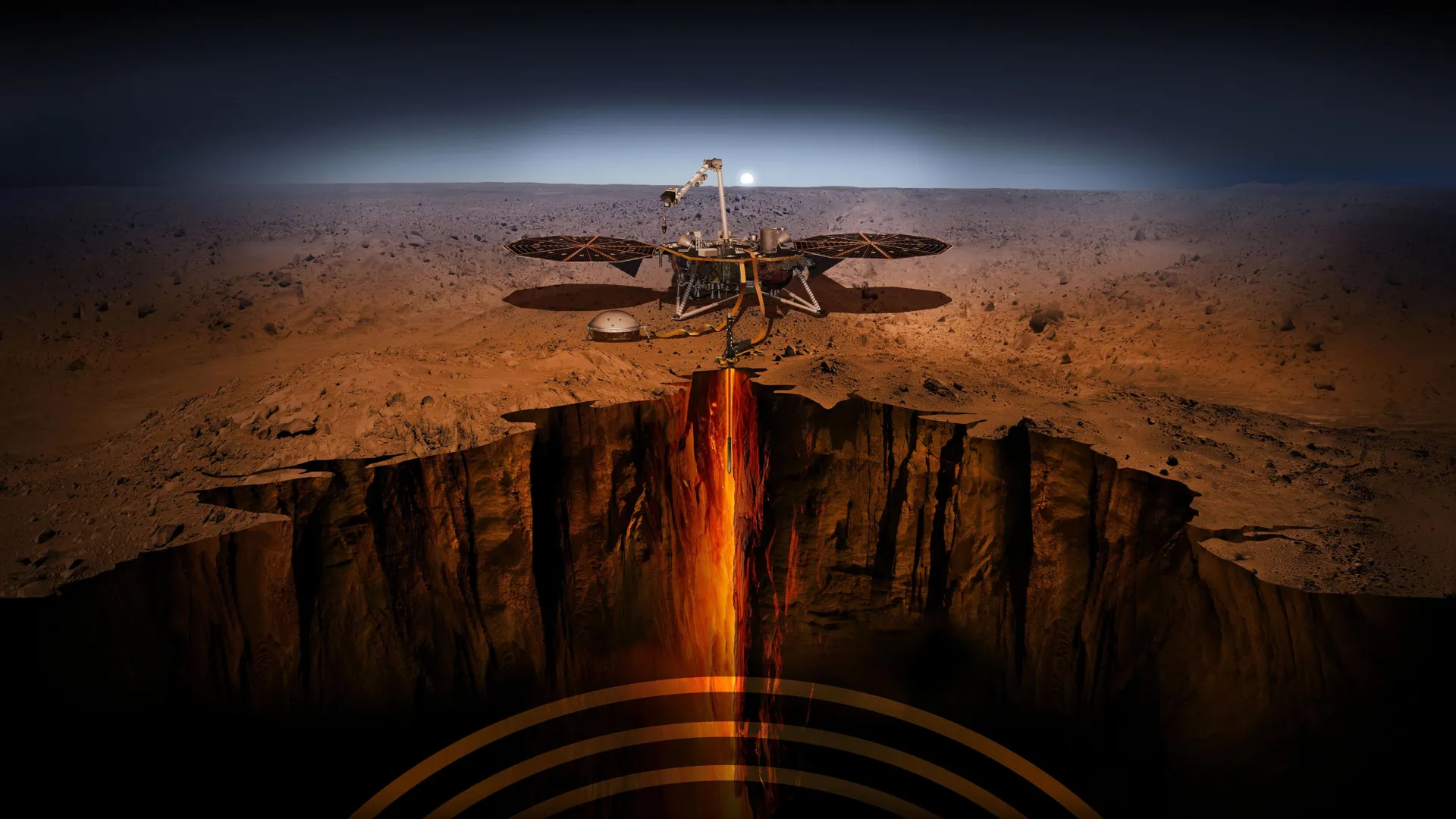
Scientists using seismic data from NASA's InSight lander detected vast subsurface magma systems beneath Mars that fundamentally reshape understanding of how planetary crusts develop without Earth-like plate tectonics.
The research team analyzed seismic waves traveling through the Martian interior, finding evidence that molten rock repeatedly cycled and evolved through the crust across distances spanning hundreds to thousands of kilometers. These magmatic systems operated at depths well below the surface, creating complex geological structures previously thought impossible on Mars given its static, non-tectonically active nature.
The InSight lander, which operated on Mars from 2018 until 2022, provided unprecedented seismic data through its Seismic Experiment for Interior Structure instrument. Researchers examined how seismic waves behaved as they passed through different crustal layers, detecting signatures consistent with large-scale magma reservoirs and crustal recycling processes. The findings suggest Mars underwent more dynamic interior evolution than scientists previously recognized.
Earth's plate tectonics create complex crustal composition through the collision, subduction, and recycling of lithospheric plates. Magma generated at plate boundaries creates new crust while old material descends into the mantle. Mars lacks this active tectonic system, leading researchers to assume its crust remained geologically simpler. This new evidence indicates that even without plate tectonics, ancient Mars possessed mechanisms for substantial magmatic differentiation and crustal evolution.
The discovery carries implications for understanding planetary habitability. Magmatic systems drive volcanic activity, outgassing of atmospheric components, and hydrothermal circulation that could have supported microbial life. Ancient Mars had a thicker atmosphere and liquid water on its surface, conditions partially maintained by extensive interior volcanism. The detection of these vast magma systems suggests Mars maintained geothermal gradients and chemical cycling that might have supported biological processes in subsurface environments.
The research also illuminates how rocky planets develop crustal complexity through mechanisms beyond plate tectonics. Venus, which lacks plate tectonics but shows evidence of widespread volcanism and crustal recycling, may operate through similar magmatic processes. Understanding Martian crustal evolution provides a framework for interpreting crustal structures on other tectonically inactive worlds.
Limitations remain in the interpretation. InSight operated at a single location, limiting the spatial resolution of subsurface imaging. Future Mars missions carrying seismic networks would provide better three-dimensional crustal mapping. The age and active status of these magma systems require additional investigation. Some structures may be billions of years old, while others could represent more recent activity.
The findings emerged from analysis of quakes recorded during InSight's mission, with researchers using seismic tomography techniques to construct models of crustal composition and structure. The work demonstrates that static planets possess dynamic internal histories, challenging assumptions that only tectonically active worlds achieve geological complexity. This research opens new directions for interpreting planetary evolution across the solar system and potentially exoplanets with similar compositions.