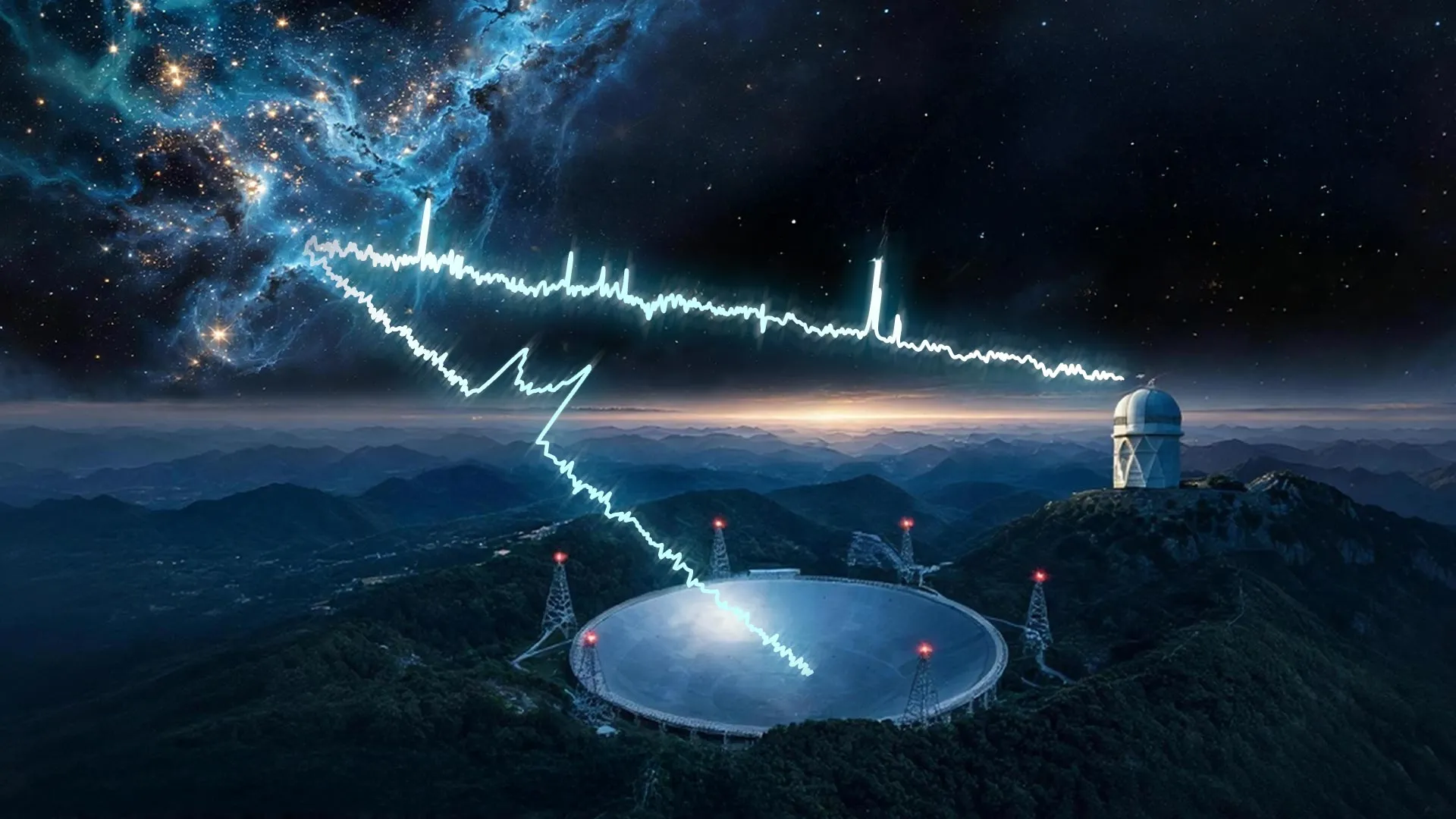
Star formation in the universe has collapsed to just 40 percent of its peak rate over the past 4.5 billion years, yet astronomers have discovered an unexpected puzzle: the raw material needed to build stars remains abundant. Researchers using China's FAST radio telescope and data from 2.5 million galaxies observed by DESI found that neutral hydrogen, the fuel that powers star birth, has declined far less than the dramatic plunge in actual star formation.
The team measured a stark divergence. Star formation rates dropped by roughly 60 percent since the universe reached its peak stellar production roughly 4.5 billion years ago. By contrast, neutral hydrogen levels fell by only about 30 percent over the same timeframe. This disconnect reveals that the universe's slowdown in manufacturing new stars stems not from depleted fuel supplies but from something else entirely.
The finding challenges conventional models. Astronomers previously assumed that star formation and hydrogen availability tracked together closely. Deplete the gas, and stars stop forming. But the new observations prove this simple relationship breaks down at cosmic scales. The universe contains sufficient neutral hydrogen to sustain star formation at historical rates, yet the process has genuinely stalled.
FAST, the Five-hundred-meter Aperture Spherical Telescope located in southwest China, enabled this discovery by detecting faint radio emissions from neutral hydrogen across vast cosmic distances. DESI, the Dark Energy Spectroscopic Instrument, contributed detailed measurements of galaxy properties for millions of systems. Combined, these datasets painted the clearest picture yet of how hydrogen supplies and star birth have evolved together and apart.
Researchers now face a compelling question: if hydrogen abundance did not trigger the slowdown, what did? Several mechanisms compete for explanation. Galaxies may have grown less efficient at converting available gas into stars. Supermassive black holes lurking at galaxy centers might suppress star formation through feedback mechanisms that heat or eject gas before it can collapse into new stars. Environmental factors within galaxy clusters could impede the process. Molecular hydrogen, the cold-temperature form that directly seeds star birth, may have become scarcer even as neutral hydrogen persists.
The work also hints at cosmic evolution timescales. The universe reached peak star formation roughly 4.5 billion years ago, near the era when the solar system itself formed. Since then, the cosmos has progressively cooled and aged. Galaxies have evolved from chaotic, gas-rich systems prone to vigorous star birth into more stable, structured arrangements where star formation occurs at moderate rates.
This research matters for understanding galaxy evolution and the universe's trajectory. If astronomers can pinpoint the actual brakes on star formation, they refine models of how galaxies transition from young to old. The findings also clarify what factors limit habitable planet formation across cosmic time, since rocky worlds orbit young stars born during peak star-making epochs.
Future work will probe the molecular hydrogen puzzle more rigorously and examine whether black hole feedback or environmental quenching dominates the slowdown. The discovery opens new research directions that merge radio astronomy's gas-detection capabilities with spectroscopic surveys tracking galaxies themselves.