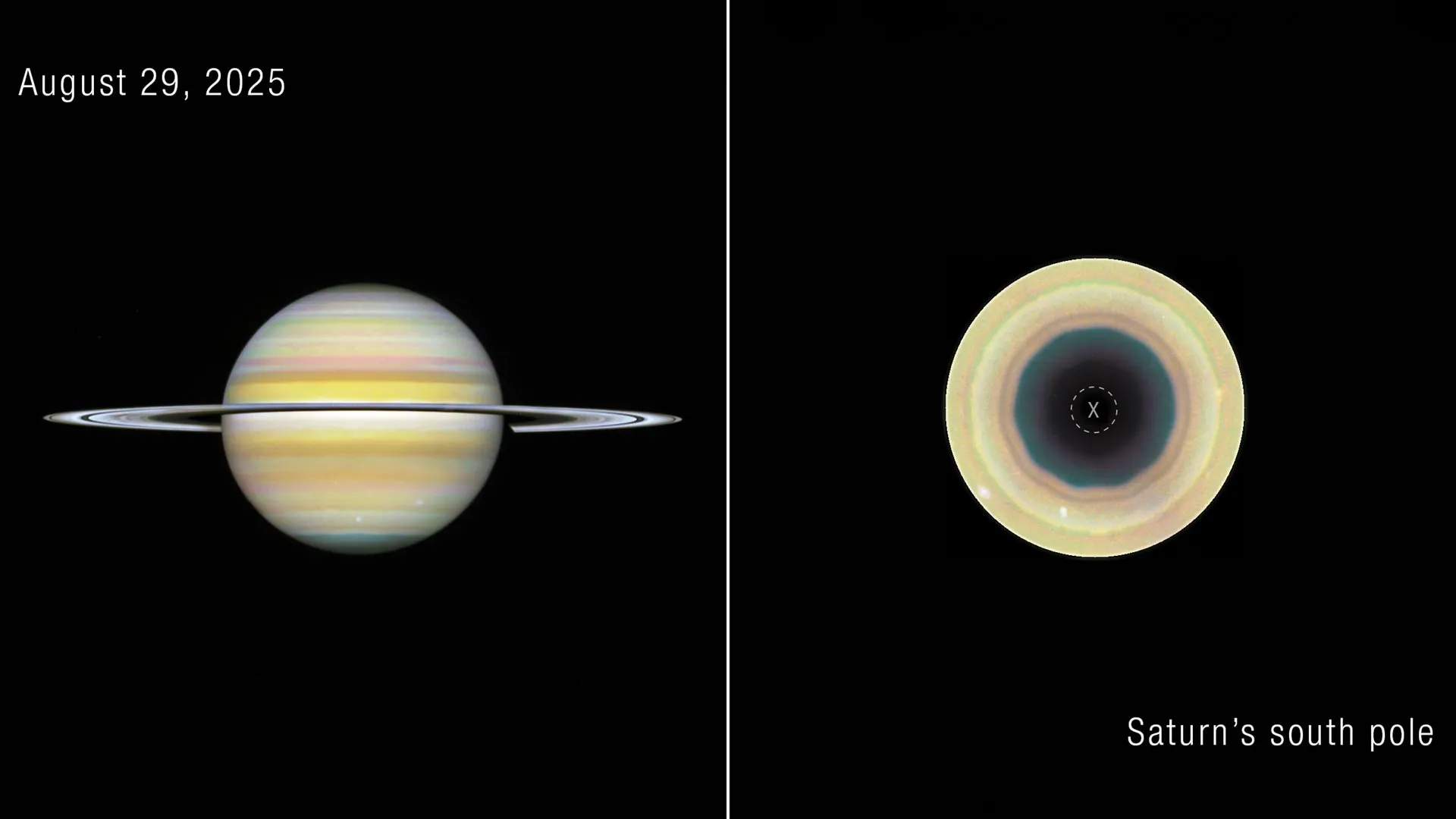
NASA scientists have discovered a colossal 10-sided atmospheric structure circling Saturn's south pole, marking an unexpected addition to the gas giant's collection of polar phenomena. The decagon, detected using the Hubble Space Telescope, creates a striking complement to Saturn's well-documented northern hexagon, a six-sided pattern that has persisted for at least 40 years.
The decagon appears to be a recent arrival in Saturn's atmosphere. Data from Hubble observations indicate the structure emerged only within the past several years and continues to intensify. Researchers remain uncertain about the mechanism that triggered its formation or whether it will stabilize into a long-term feature like its hexagonal counterpart.
Saturn's hexagonal storm at the north pole has captivated planetary scientists since its discovery by the Voyager 1 spacecraft in 1981. The structure spans roughly 30,000 kilometers across and maintains a remarkably stable shape despite the violent wind speeds that characterize the region. Scientists have developed models explaining how rotating fluid dynamics can produce such regular geometric shapes, but Saturn's atmosphere has offered few other examples to test these theories.
The newly detected decagon operates at different atmospheric depths than the hexagon, according to preliminary analysis. This distinction raises questions about whether separate mechanisms generate different polygon shapes or whether a unified process produces variable outputs depending on atmospheric conditions. The 10-sided structure rotates at a different rate than the hexagon and appears confined to a narrower latitude band around the pole.
Researchers conducting this study worked with archival Hubble data spanning multiple years, allowing them to track the decagon's emergence and growth pattern. The team plans to continue systematic observations through Hubble's ongoing mission to monitor how the structure evolves. These repeated measurements could reveal critical information about the decagon's lifetime and whether it shares characteristics with the more established hexagon.
The discovery underscores how little remains known about giant planets' atmospheric behavior. Saturn's complex weather patterns develop at scales difficult to observe from Earth and present puzzles that terrestrial meteorology cannot fully explain. The geometric precision of these polar structures suggests underlying physical laws governing atmospheric circulation in ways scientists are still working to understand completely.
Future observations may incorporate data from other instruments and space missions. The James Webb Space Telescope could potentially detect the decagon at infrared wavelengths, offering additional perspectives on its thermal properties and composition. Combining observations across multiple wavelengths typically yields deeper insights into atmospheric dynamics than single-instrument data.
The decagon's sudden appearance after decades of hexagonal dominance raises broader questions about planetary stability and change. Whether this represents normal variability in Saturn's pole or signals a shift in the planet's atmospheric regime remains open. Continued monitoring over years or decades will ultimately determine whether the decagon persists, transforms, or dissipates entirely.