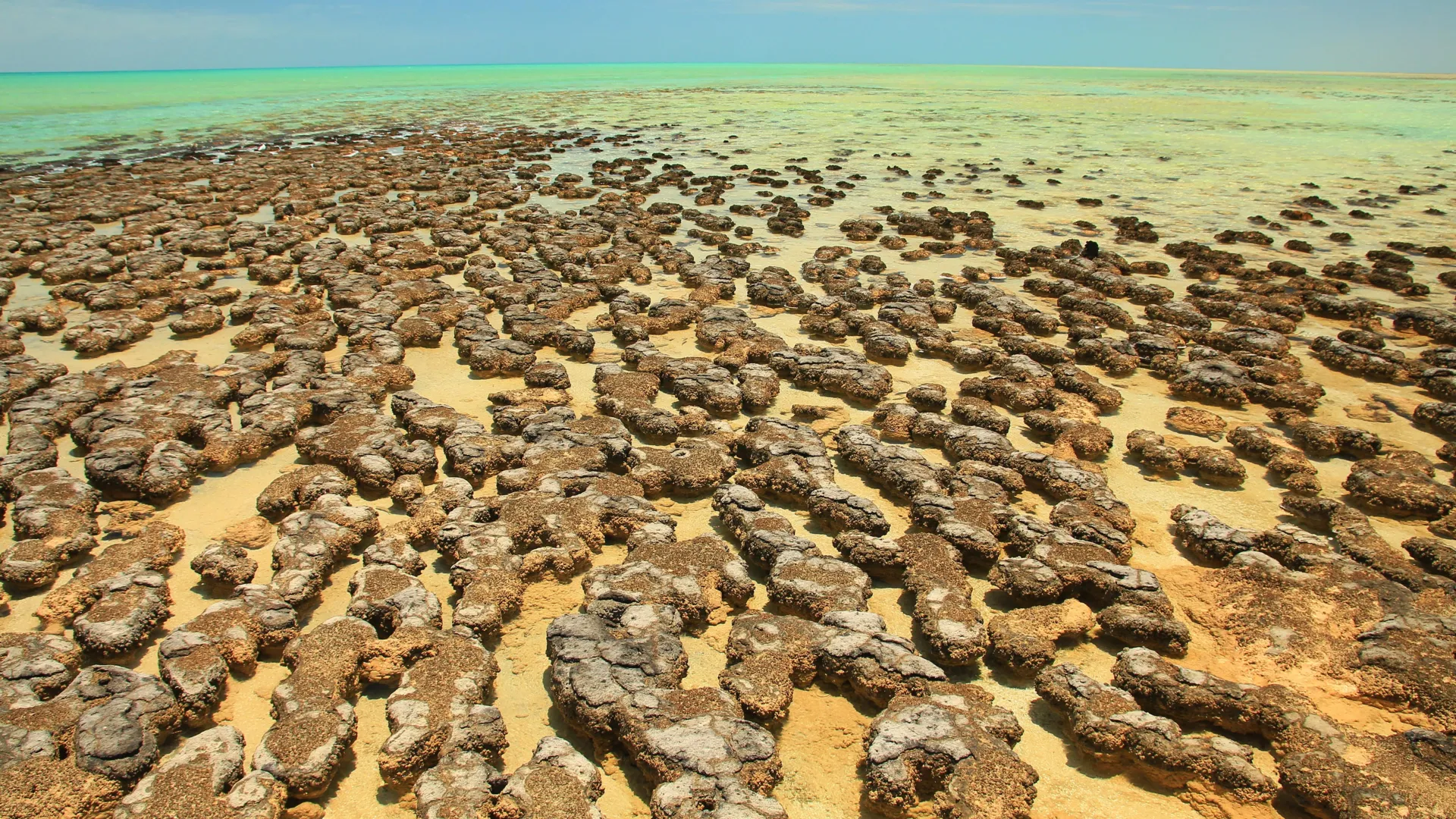
Researchers have documented what may be the earliest known partnership between two fundamentally different types of microorganisms, offering fresh insight into how complex life emerged on Earth billions of years ago.
The discovery centers on an Asgard archaeon living within stromatolites, which are layered rock structures built by microbial communities. Scientists obtained the first direct visual evidence of an Asgard archaeon physically attached to a bacterium, with the two organisms actively exchanging nutrients and chemical compounds. These images represent a breakthrough in understanding ancient microbial interactions that likely shaped the origin of eukaryotic cells, the type of complex cells that make up all plants, animals, and fungi.
Stromatolites serve as natural laboratories for studying primitive life. These formations have existed for over 3 billion years, making them among Earth's oldest known fossils. They continue to host living microbial communities that operate much as their ancient ancestors did, offering researchers a window into conditions that prevailed during the planet's early history.
The Asgard archaea represent a particularly important research target. Discovered less than two decades ago, these microorganisms exhibit unusual characteristics that blur the line between simple and complex life. Scientists previously theorized that Asgard archaea may have been direct ancestors of eukaryotes or played a central role in eukaryotic evolution. The physical evidence now supports this hypothesis by demonstrating that Asgard archaea engage in the type of metabolic cooperation thought necessary for eukaryotic cells to develop.
The partnership observed in the stromatolite community represents what scientists call syntrophy: a symbiotic relationship where organisms exchange metabolic byproducts to mutual benefit. Billions of years ago, researchers theorize that similar arrangements between archaeal and bacterial partners may have gradually transformed into the first eukaryotic cells. The archaeon would have eventually engulfed the bacterial partner, creating an ancestor of the mitochondrion, the energy-generating organelle found in modern eukaryotic cells.
Obtaining direct images of this relationship required sophisticated microscopy and genetic analysis techniques. Researchers identified the microbes within their natural stromatolite environment rather than isolating them in laboratory cultures, which preserves the authenticity of their interaction and behavior. This approach yields more reliable data about how these organisms actually function in real ecological contexts.
The findings carry limitations worth noting. A single observation of one partnership does not prove that this exact mechanism repeatedly generated eukaryotic cells throughout Earth's history. Environmental conditions, chemical availability, and evolutionary pressures differed vastly between ancient stromatolite communities and modern ones. Additionally, eukaryotic evolution involved numerous transformations across millions of years, and this partnership represents just one stage of a vastly more complex process.
Still, the research provides the most direct evidence to date that Asgard archaea maintained the type of intimate associations necessary for the endosymbiotic events that birthed eukaryotic life. Future studies of stromatolite communities may reveal additional partnerships and interactions that illuminate the transition from simple to complex life on Earth. This work underscores how examining microbial communities in their native environments continues to reshape scientific understanding of life's deepest history.