# Search for Exotic Particle Reveals Two Unexpected Subatomic Structures
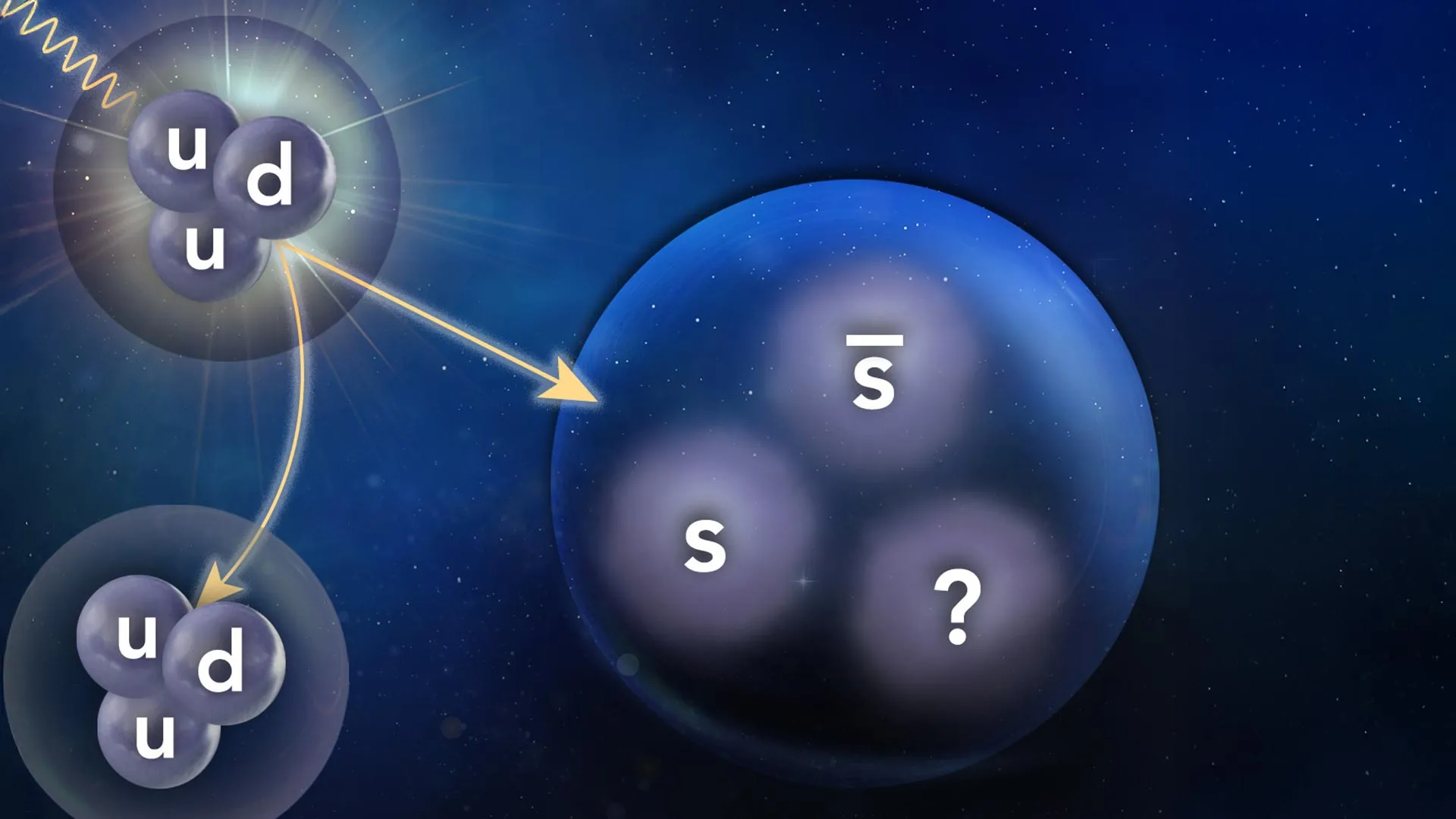
Physicists hunting for one exotic particle have stumbled upon evidence for two entirely different structures, expanding the menagerie of bizarre states formed from quarks and gluons. The discovery provides new clues about how the fundamental building blocks of matter assemble in unconventional ways.
Researchers conducting experiments at a high-energy physics facility detected signals consistent with two previously unknown XYZ states, a family of exotic hadrons that defy traditional particle classification schemes. Unlike conventional hadrons made of two or three quarks, XYZ states exhibit unusual internal structures that remain poorly understood.
The team searched data from collisions of particles looking for one target particle, but the analysis revealed excess events at two distinct mass values. These signatures matched predictions for exotic hadronic states rather than standard particles. The findings expand the roster of confirmed or candidate XYZ particles, which have become increasingly common in experimental particle physics over the past two decades.
"These structures reveal new possibilities for how quarks and gluons can combine," according to statements from the research group. Previous discoveries of XYZ states have challenged the conventional quark model, which predicted only limited types of bound states. The new detections suggest even richer complexity in the subatomic world.
XYZ states can take several forms. Some behave like tetraquarks containing four quarks held together by gluons. Others resemble pentaquarks with five quarks. Still others may represent bound states of conventional hadrons. The exact composition of most XYZ particles remains unknown, making each new discovery valuable for constraining theoretical models.
The research team analyzed collision events recorded over several years, using sophisticated statistical methods to distinguish genuine signals from background noise. The presence of two distinct peaks in their mass spectrum provided confidence that the structures represented real particles rather than statistical fluctuations. The team estimated the probability that these signals arose by chance at less than one in ten million.
This discovery demonstrates how modern particle physics often advances through serendipity. Experiments designed to study one phenomenon frequently yield unexpected results that open new research directions. The teams running high-energy physics experiments continuously scan their data for novel structures, enabling discoveries that wouldn't occur in targeted searches alone.
Understanding XYZ states matters because they reveal fundamental limits and possibilities in how nature constructs matter from its most basic constituents. Quarks cannot exist in isolation due to a phenomenon called color confinement, so they always bind with other quarks and gluons. The conventional model predicted specific combinations would form stable particles, yet nature produces additional exotic states that theorists must now accommodate within revised frameworks.
Future experiments will aim to measure properties of these newly discovered structures with greater precision. Scientists will determine the masses, widths, and decay patterns of these particles, providing information about their internal composition. Additional searches at particle colliders running at higher energies may reveal related particles and help establish the full spectrum of possible exotic hadrons.
The findings reinforce that the particle physics landscape remains incompletely mapped. Even as accelerators push toward higher energies and greater sensitivity, the subatomic realm continues yielding surprises that reshape our understanding of fundamental physics.