# Laser-Pushed Solar Sails Face Unexpected Drag Barrier at Near-Light Speeds
Researchers have identified a previously overlooked physical barrier for spacecraft propelled by laser-driven solar sails. The problem emerges at roughly 75 percent of light speed, where relativistic effects cause scattered photons to generate drag that opposes the sail's motion.
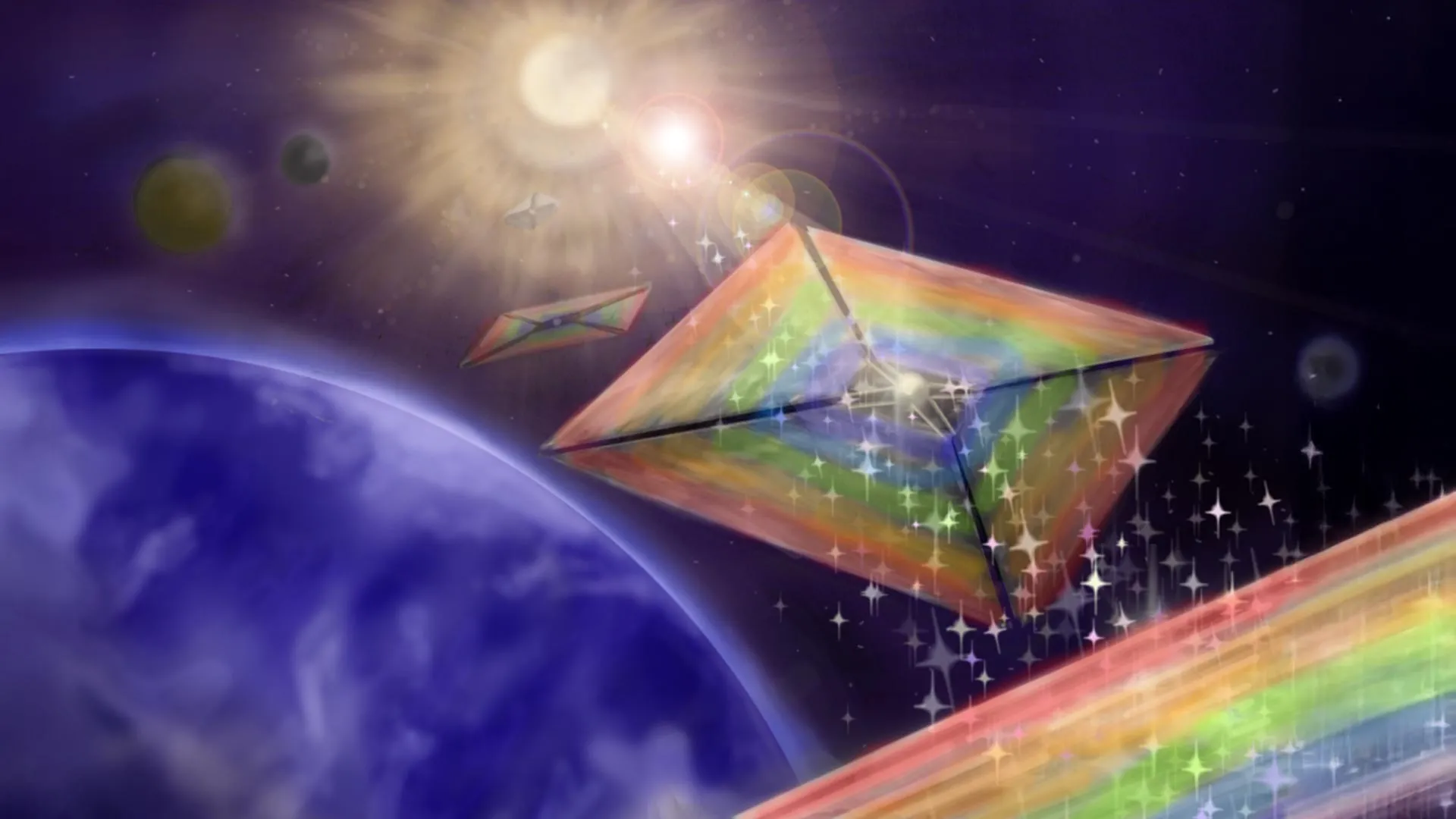
Solar sail propulsion works by reflecting photons from a powerful laser beam. The momentum transfer from billions of photons hitting a reflective surface creates thrust without requiring fuel. This concept has attracted serious attention from scientists and engineers seeking methods to reach distant stars within reasonable timeframes. Projects like Breakthrough Starshot have proposed using laser arrays to accelerate small probes toward Alpha Centauri at speeds exceeding 20 percent of light speed.
The new analysis reveals that as spacecraft approach 75 percent of light speed, relativistic mechanics produces a counterintuitive effect. Photons that scatter off the sail or miss it entirely begin to interact with the craft in ways that create a net braking force. This occurs because relativistic aberration concentrates photons into a narrower beam relative to the spacecraft's reference frame. Some scattered photons then travel at angles that push back against the sail's motion rather than adding to it.
The effect resembles radiation drag observed in other contexts, but researchers had not thoroughly evaluated it for laser-pushed sails at relativistic velocities. As spacecraft accelerate closer to light speed, they encounter increasing numbers of scattered photons approaching them head-on. These forward-scattered photons exert a decelerating force that grows stronger the faster the sail travels.
This creates a practical speed limit for laser sail propulsion. Beyond the 75 percent threshold, the physics becomes increasingly unfavorable. The drag accelerates non-linearly, meaning that reaching 80 percent of light speed requires disproportionately more laser power than reaching 75 percent. At 90 percent of light speed, the drag becomes severe enough that some laser configurations might struggle to maintain acceleration at all.
The research has implications for mission planning. Any interstellar probe relying solely on laser acceleration would need to reach its cruising speed before drag becomes unmanageable, then coast toward its destination. Alternatively, mission designers could deploy additional laser arrays stationed at intermediate points in space to provide continued acceleration boosts, though this raises enormous engineering and logistical challenges.
The findings also highlight how relativity introduces complications that classical physics ignores. Engineers designing conventional spacecraft ignore relativistic effects because rocket-powered craft operate at speeds where such effects remain negligible. But proposals for interstellar travel operate in a regime where Einstein's equations become fundamental constraints rather than minor corrections.
Some spacecraft concepts attempt to work around this limitation by combining laser sails with other propulsion methods or by using different sail geometries that might reduce scattering. Others explore whether powerful electromagnetic fields could shield the sail from scattered photons.
The discovery underscores that reaching other star systems presents multiple physics challenges beyond simply building a powerful laser. Each proposed solution encounters unexpected obstacles when examined rigorously. Understanding these barriers now allows researchers to develop more realistic mission architectures that account for relativistic drag rather than discovering this limitation after committing resources to construction.