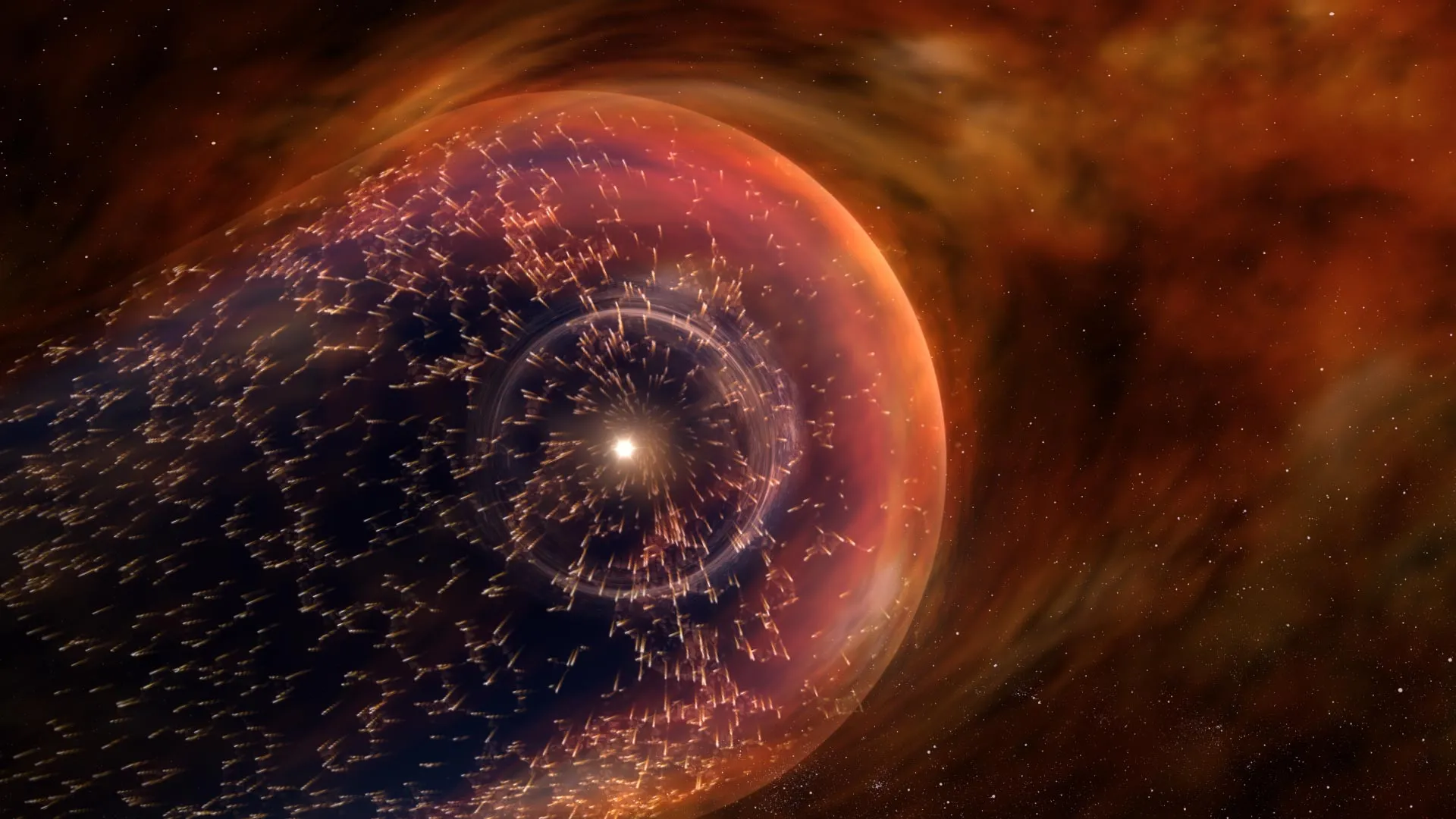
Earth's magnetic field may have vanished for extended periods millions of years ago, leaving the planet exposed to intense solar radiation and cosmic particles. New NASA-funded research now suggests this loss of protection coincided with the Sun's journey through dense galactic regions, fundamentally reshaping Earth's climate history.
The studies, which combine solar physics with paleoclimate data, reveal that Earth's climate responds to two solar phenomena operating on vastly different timescales. First, the Sun experienced violent superflares during its youth billions of years ago, ejecting enormous amounts of energy into space. Second, the Sun travels through the Milky Way's dense molecular clouds roughly every 100 to 200 million years, altering the interstellar medium surrounding our solar system.
These galactic passages matter because they change how effectively the Sun's magnetic field shields Earth from cosmic radiation. When the Sun moves through denser regions of space, the increased particles compress the Sun's magnetosphere, allowing more radiation to reach Earth's atmosphere. This scenario helps resolve a fundamental paradox in Earth's history: the "faint young Sun problem."
Four billion years ago, the Sun burned 25 to 30 percent less brightly than today. Yet geological evidence shows Earth harbored liquid water and possibly early life during this period. If the Sun was dimmer, Earth should have been a frozen snowball. The research suggests that during certain epochs, Earth's magnetic field weakened or disappeared entirely, allowing the Sun's violent outbursts and charged particles to reach the upper atmosphere and trigger a warming effect through chemical reactions in the stratosphere.
Researchers analyzed isotope ratios and geological markers locked in ancient rocks to determine when Earth's magnetic field varied. They cross-referenced these records with models of the Sun's galactic orbit and solar activity patterns. The work builds on decades of paleomagnetic research but adds a new dimension by integrating solar variability with Earth's position in the galaxy.
The implications extend beyond pure astronomy. Understanding how solar protection fluctuates over geological timescales provides context for evaluating modern climate change. Today's magnetic field remains robust, and solar variability contributes only marginally to recent warming trends. However, the research demonstrates that solar influences operated powerfully in Earth's deep past, when other factors like atmospheric composition and planetary configuration differed radically.
The studies also illuminate why early Mars lost its protective magnetic field while Earth retained one. Mars sits closer to the Sun and likely experienced more intense radiation pressure during galactic passages. Its smaller size meant its core cooled faster, shutting down the dynamo process that generates magnetic fields. Earth's larger mass maintained internal heat longer, preserving magnetism through most critical periods.
Future research will refine models of the Sun's past trajectory through the galaxy and improve precision on when Earth's magnetic field fluctuated. Space-based missions continue measuring solar output and the magnetosphere's structure, providing data that constrains these historical reconstructions. Understanding these cycles offers crucial perspective on how planetary habitability depends on the interplay between cosmic and stellar environments.