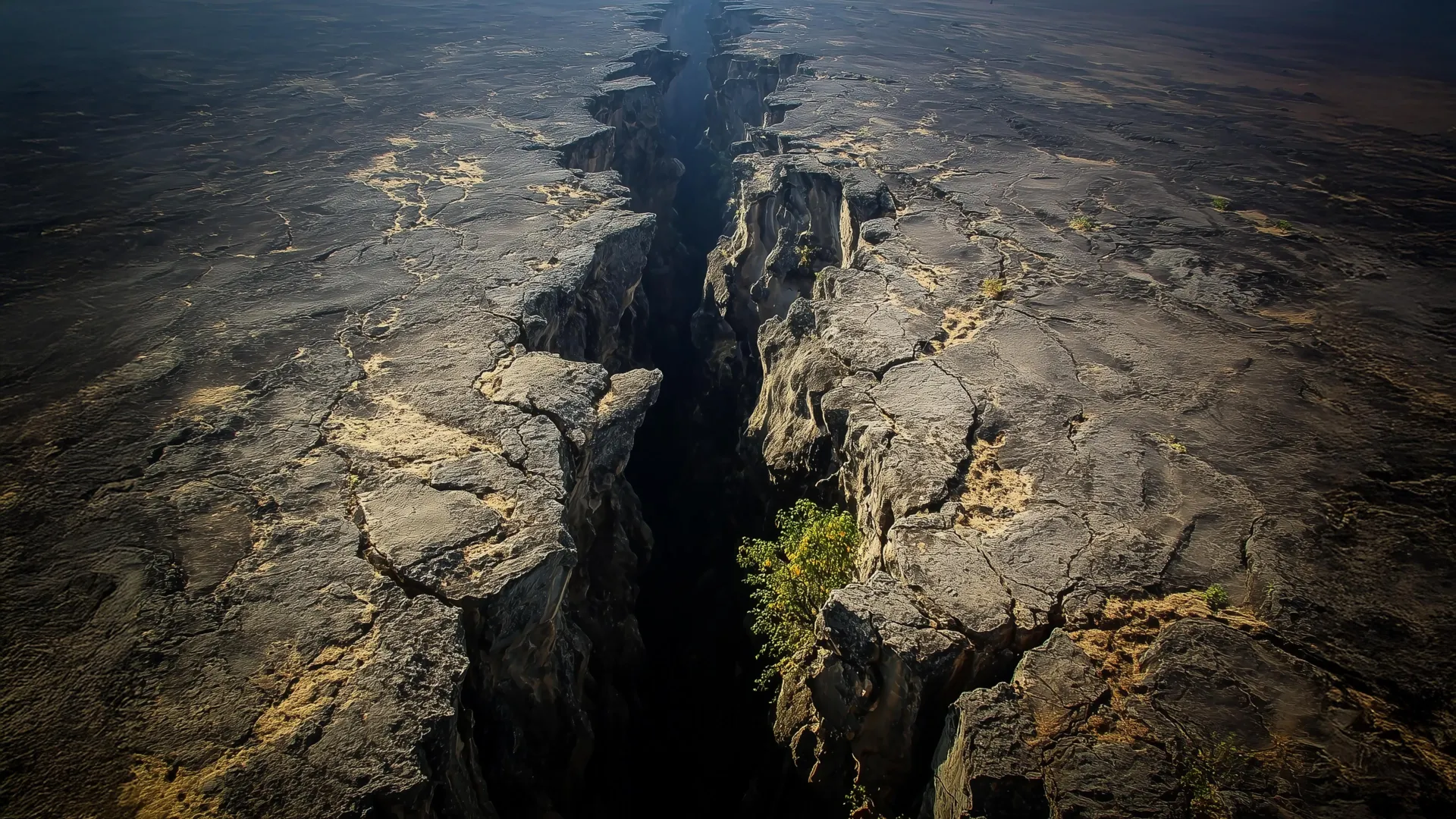
A colossal plume of hot material rising from Earth's mantle beneath Africa drives the ongoing breakup of the continent, according to new research examining the East African Rift. Scientists have mapped this massive upwelling of rock that originates deep within the planet and found it exerts powerful forces on surface geology across a vast region.
The East African Rift spans roughly 6,000 kilometers from the Afar Triangle in Ethiopia down through Kenya and Tanzania to Mozambique. Along this zone, the African tectonic plate is actively splitting apart, a process that occurs over millions of years. Researchers observed that the rift does not move uniformly. Some segments advance rapidly while others remain relatively stable, creating a pattern that previous models could not fully explain.
The mantle plume operates as a massive heat engine. Hot rock material ascends from the deep interior of Earth, potentially originating near the core-mantle boundary. As this plume rises toward the surface, it heats surrounding rock and reduces its density. The heated material expands and pushes the overlying crust upward, literally lifting the continent at the rift's location. This uplift from below combines with horizontal pulling forces from plate tectonics to split the lithosphere.
What makes this discovery particularly revealing is how it resolves contradictions in previous understanding. Shallow models of plate tectonics alone could not account for all observed deformation patterns. By incorporating the deep mantle plume into their analysis, researchers now explain why certain sections of the rift experience more intense stress and why the continent's topography varies so dramatically along the fault zone.
The team employed sophisticated geophysical imaging techniques to visualize the plume's structure. Seismic tomography, which uses earthquake waves traveling through Earth to create three-dimensional models, revealed the plume's exact location and shape. Gravity measurements and other geophysical data confirmed the presence of this anomalously hot material beneath the surface.
The discovery has implications beyond African geology. It demonstrates how mantle plumes influence continental breakup on a global scale. Similar processes likely operated when other supercontinents fragmented in Earth's distant past. Understanding these deep mantle dynamics improves models of how continents form, move, and eventually separate.
The East African Rift marks an early stage of continental rifting. In tens of millions of years, if current movements continue, the rift may widen into an ocean basin, separating eastern Africa from the rest of the continent. The mantle plume's sustained activity means this geological process will continue incrementally, reshaping Africa's geography across geologic timescales.
This research bridges two previously separate fields of Earth science. Deep mantle geodynamics and surface plate tectonics emerge not as competing explanations but as interdependent systems working in concert. The mantle plume provides the foundational energy driving Africa's slow separation, while surface processes determine how that deep energy gets expressed in earthquakes, volcanic activity, and crustal deformation visible to scientists at the surface.