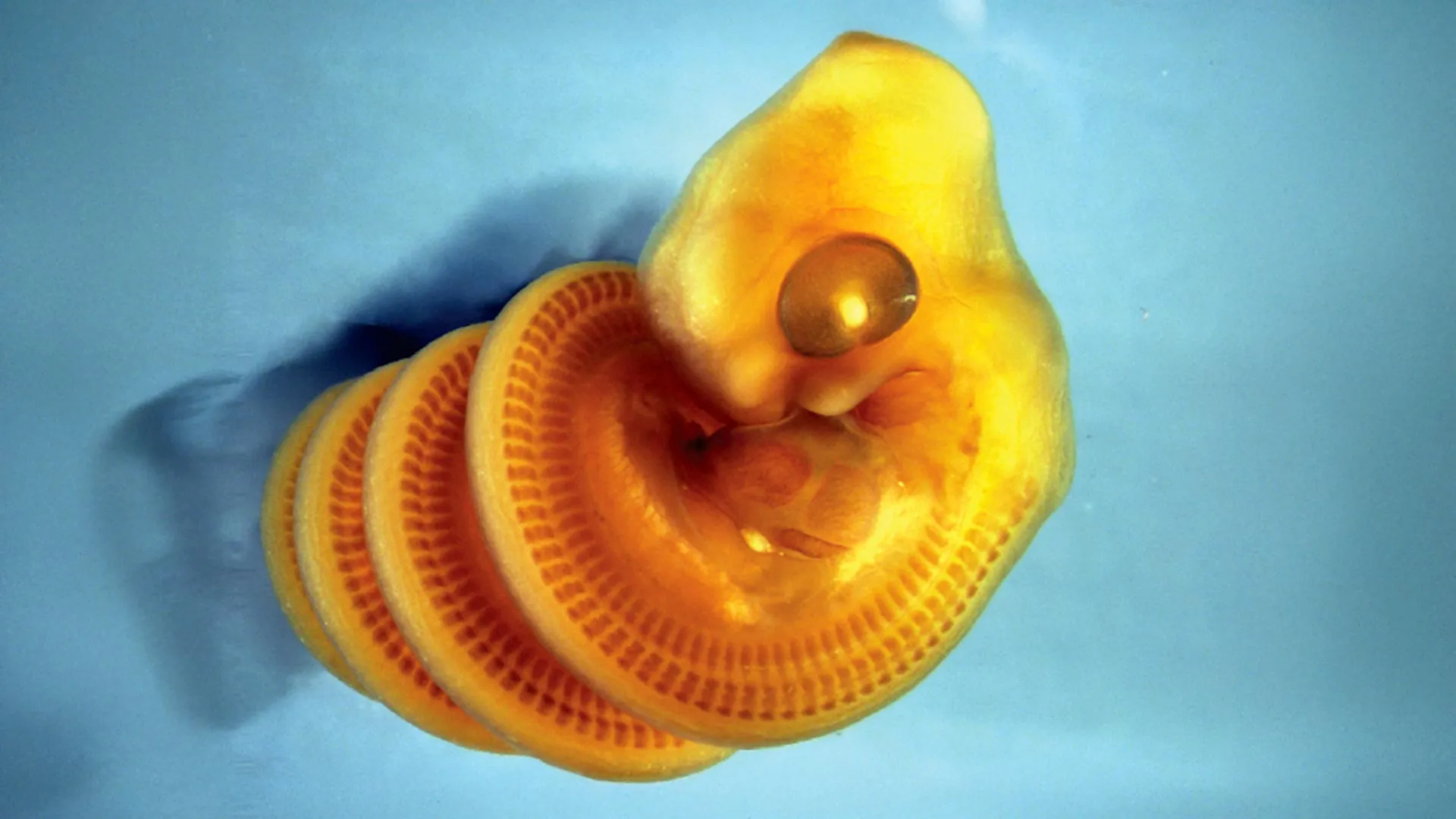
Snake embryos spiral because their bodies grow faster than their digestive systems, creating mechanical tension that forces the developing organisms to buckle inside their eggs. Researchers studying more than 900 embryos identified this growth mismatch as the driving force behind the characteristic right-handed coil that distinguishes snake development from most other vertebrates.
The team used computed tomography scans to visualize the internal anatomy of developing snake embryos, revealing how differential growth rates between body tissues and the gut create a physical constraint. As the embryo lengthens, the slower-growing digestive system acts like an internal tether, preventing uniform straightening. This mechanical incompatibility forces the elongating body to fold and twist into the spiral configuration observed in nearly all snake species.
This discovery resolves a longstanding question in developmental biology. While scientists knew that snake embryos consistently adopted a right-handed spiral pattern, the underlying mechanism remained unclear. Previous explanations lacked the anatomical detail and experimental evidence to account for why this specific geometry emerged so reliably across different snake species.
The research employed quantitative analysis of embryonic growth trajectories across the sample of over 900 specimens. Researchers measured growth rates in different tissue compartments and used three-dimensional imaging to track how spatial constraints influenced embryo positioning within the egg. This combination of large-scale observation and high-resolution imaging provided the evidence needed to establish causation rather than mere correlation.
The findings have broader implications for understanding vertebrate development. Growth rate differentials between organ systems drive morphogenesis in many organisms. The snake embryo case demonstrates how simple mechanical forces arising from differential growth can produce complex, species-typical body configurations without requiring explicit genetic instructions for spiral formation. The spiral emerges as a consequence of basic physical laws acting on biological material.
This principle operates across developmental biology. The heart loops in specific directions, the intestines coil predictably, and neural tissues fold in characteristic patterns partly because of how different regions grow at different rates. Understanding these mechanical drivers helps researchers distinguish between developmental processes that require precise genetic control versus those that arise naturally from physical constraints and growth dynamics.
The work also carries relevance for evolutionary biology. The universality of right-handed spirals in snake embryos suggests that once this growth pattern became established early in snake evolution, subsequent natural selection reinforced it. Mutations producing left-handed spirals might face developmental disadvantages or reduced fitness, maintaining the right-handed configuration across millions of years of evolution.
Future research could extend these findings to other coiled embryos and explore whether the same mechanical principles explain spiraling in other species. The technique of combining large sample sizes with advanced imaging could reveal hidden mechanics in other developmental systems where the driving forces remain obscure. Understanding how physical constraints shape animal form contributes to broader knowledge of how genomes translate into bodies.