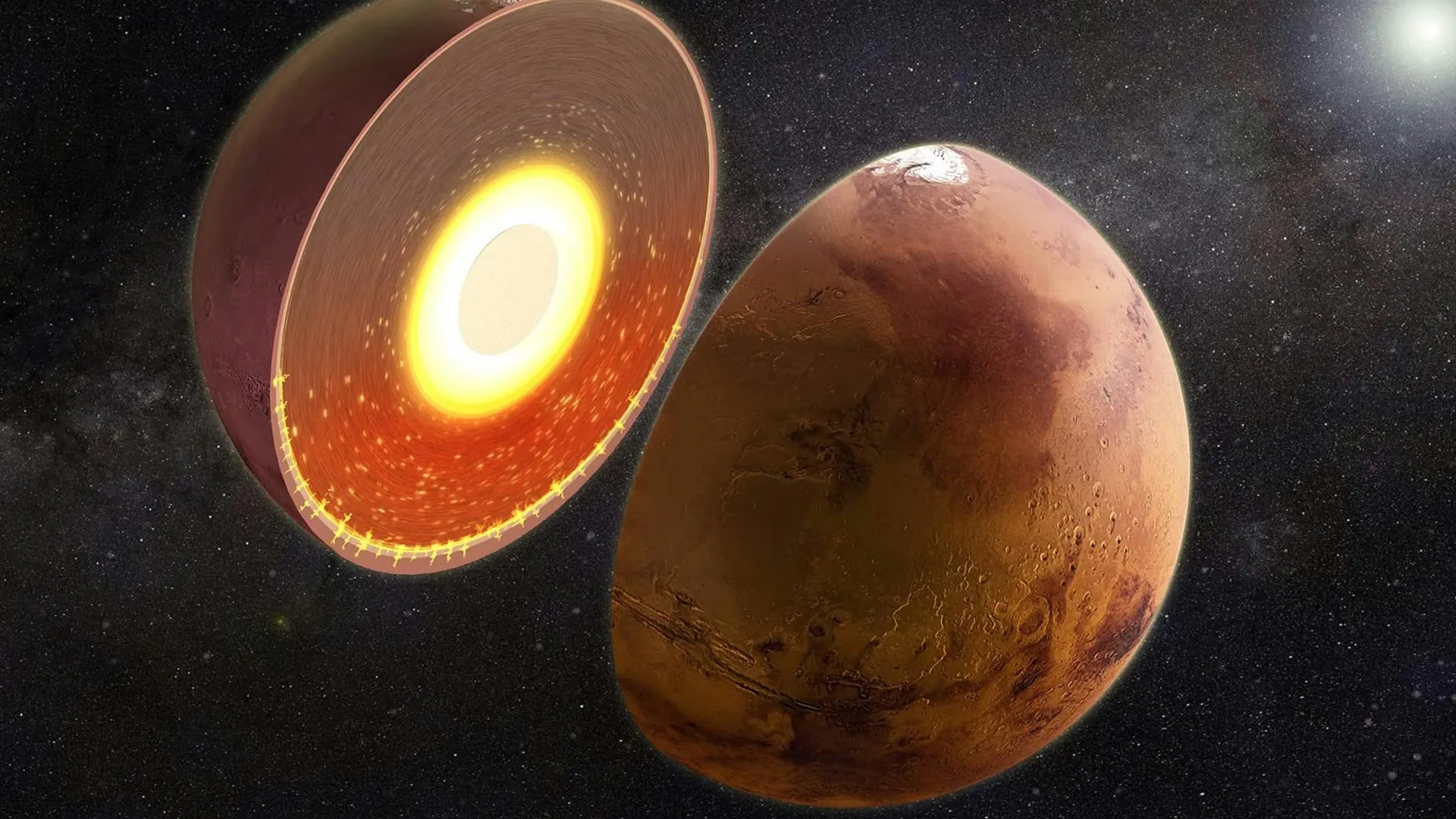
Scientists have detected a dramatic temperature divide buried deep within Mars, with the planet's southern interior potentially hundreds of degrees hotter than its northern region and partially molten in places. The finding emerges from analysis of seismic data and thermal measurements, revealing an internal heat anomaly that challenges previous models of Martian geology.
The discovery addresses a puzzle that has perplexed planetary scientists for decades. Mars exhibits a striking asymmetry in its magnetic field, with strong magnetization concentrated in the southern hemisphere while the north remains largely non-magnetic. This new thermal mapping provides a plausible mechanism for that asymmetry. Hotter interior material in the south would have prevented the planet's magnetic field from solidifying uniformly, leaving the northern crust magnetically "dead" while southern regions preserved stronger crustal magnetism from Mars' ancient dynamo.
Researchers analyzed data collected by NASA's InSight lander, which deployed seismometers on the Martian surface from 2018 to 2022 before dust accumulation ended its mission. The lander detected hundreds of marsquakes, allowing scientists to map the interior structure by measuring how seismic waves traveled through different rock layers. Combined with thermal models and gravity data, these observations revealed the existence of a large plume of hot material rising through Mars' mantle, concentrated beneath the southern highlands.
The partial melting documented in the southern interior also explains anomalies in Mars' seismic signature. Molten rock absorbs and attenuates seismic waves differently than solid material, producing distinctive patterns that researchers identified in the InSight data. This discovery opens new perspectives on Martian volcanic and tectonic activity, suggesting the southern hemisphere remains more geologically dynamic than previously understood.
The heat anomaly carries implications for Mars' ancient habitability and water cycle. Geothermal heating from a hotter interior could have sustained subsurface liquid water longer than in the north, creating potentially habitable environments for microbial life. The uneven internal heat distribution may have influenced where water pooled, flowed, and froze billions of years ago, shaping the planet's hydrological history and determining which regions hosted conditions favorable for life.
This asymmetry likely developed early in Mars' history. The planet's magnetic field shut down roughly 4 billion years ago, possibly due to a giant impact that altered the core's convection patterns or simply because the core cooled too quickly to sustain a dynamo. The thermal divide emerging from this study suggests that even as global magnetic activity ceased, regional variations in interior heat set the stage for the deeply asymmetrical planet we observe today.
The research underscores how seismic science transforms planetary exploration. InSight's brief operational window yielded data dense enough to revolutionize understanding of Mars' interior, demonstrating the value of long-term geophysical monitoring even on distant worlds. Future Mars missions carrying improved seismometers could refine these thermal maps further and potentially detect ongoing convection in the Martian mantle.