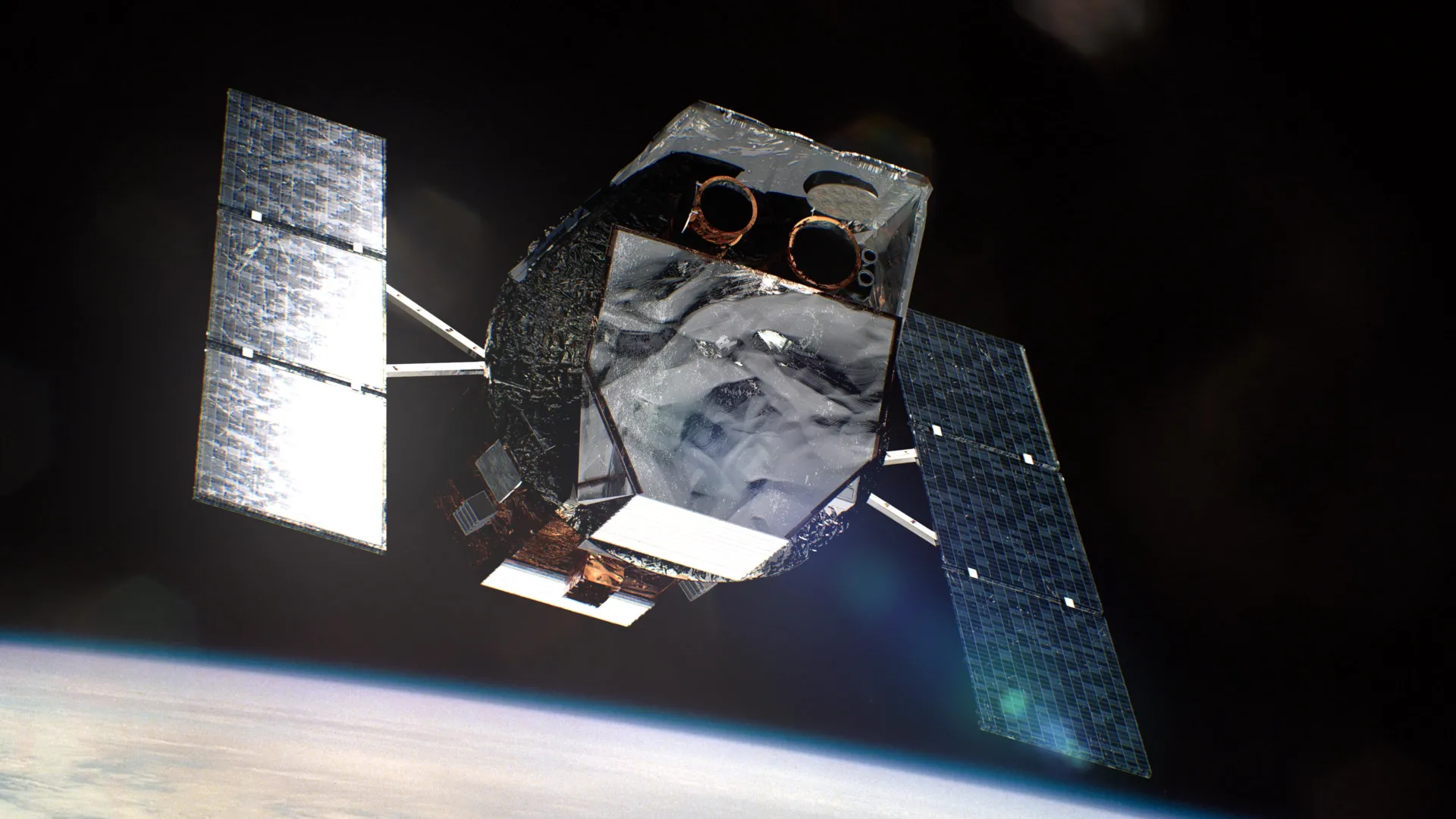
NASA has restored two telescopes aboard the aging Swift gamma-ray observatory after technical failures halted a commercial rescue mission designed to extend the spacecraft's life. The setback leaves Swift operating on borrowed time, with scientists estimating the observatory has roughly one to two months before it descends below the minimum altitude needed for scientific work.
Swift launched in 2004 with a nominal five-year mission. The spacecraft has far exceeded that timeline, becoming one of astronomy's most productive instruments for studying gamma-ray bursts, neutron stars, and other violent cosmic events. Its longevity stems from careful stewardship and the lack of a viable replacement, but two decades of operations have taken their toll.
The observatory orbits at roughly 600 kilometers altitude. Atmospheric drag in low Earth orbit acts as a constant brake, slowly pulling spacecraft downward. Swift's decay accelerated faster than mission planners anticipated, prompting NASA to contract with Axiom Space to perform the first commercial satellite servicing mission. An Axiom spacecraft was supposed to rendezvous with Swift and boost it to a higher, more stable orbit around 700 kilometers.
That mission encountered unspecified technical problems, leaving Swift stranded at a sinking altitude. NASA engineers restored the Burst Alert Telescope and X-ray Telescope to operation after the interruption, but the core problem remains unresolved. Without an orbital boost, gravitational drag will eventually pull Swift low enough that accumulated heat during atmospheric entry destroys its instruments and scientific capability.
The Swift Gamma-Ray Burst Mission represents a joint effort between NASA, the UK Science and Technology Facilities Council, the Italian Space Agency, and the Polish Academy of Sciences. Its instruments detect sudden bursts of gamma rays across the cosmos, often originating from supernovae or colliding neutron stars. Swift's rapid response capabilities have enabled astronomers worldwide to observe the afterglows of these events across multiple wavelengths, yielding discoveries about stellar death and extreme physics.
The observatory has cycled through multiple scientific campaigns. Early mission phases focused on cataloging gamma-ray burst characteristics. Later phases expanded into monitoring active galactic nuclei, tracking gravitational wave events detected by ground-based observatories, and studying transient phenomena throughout the high-energy universe. Swift's data archive now contains millions of observations spanning decades of cosmic activity.
The mission's extended life has created dependencies in the astronomical community. Thousands of researchers have built follow-up observations around Swift's alerts. Ground-based observatories worldwide maintain standing arrangements to point their instruments when Swift detects events. The loss of Swift would create a gap in gamma-ray monitoring that no current observatory fills as effectively.
NASA has not announced contingency plans if Swift falls below operational altitude within the projected timeline. The agency faces difficult choices about deorbiting procedures. A controlled descent differs substantially from uncontrolled reentry, which could scatter debris across populated areas. Mission planners likely have months to evaluate options, but the window narrows daily.
The situation underscores broader challenges in space sustainability. Low Earth orbit increasingly hosts aging satellites operated well beyond original design lifespans. Swift's potential loss highlights the vulnerability of critical infrastructure to atmospheric dynamics and the importance of orbital servicing capabilities as missions accumulate in vulnerable altitudes.