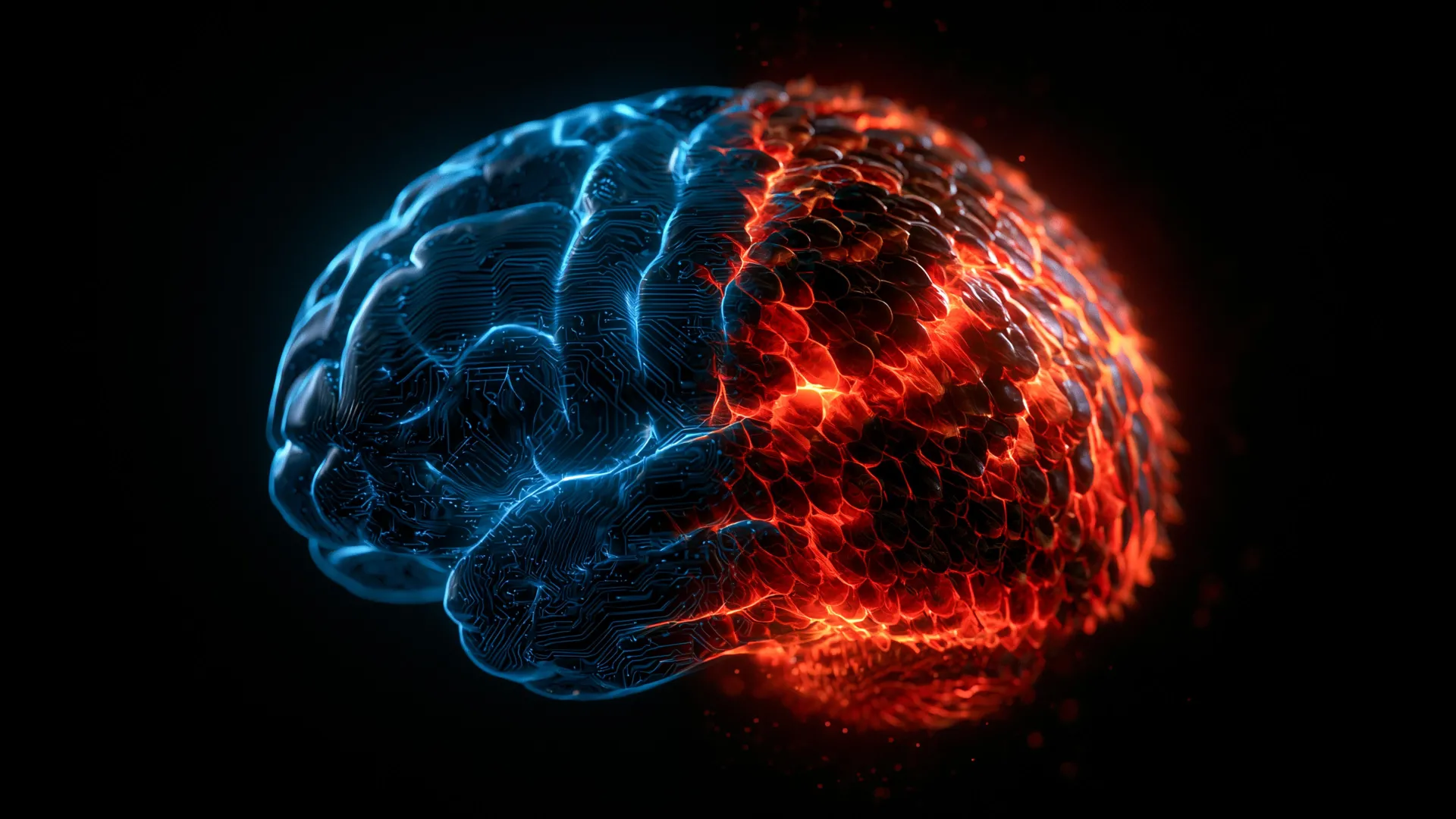
The triune brain model, which has dominated neuroscience education for seven decades, rests on a misleading foundation, according to new research challenging one of biology's most entrenched ideas.
Since Paul MacLean proposed the concept in the 1950s, the triune brain theory suggested that human brains evolved by layering new structures atop an ancient "reptilian brain" responsible for survival instincts. This hierarchical model positioned emotion and reasoning in intermediate layers, with the prefrontal cortex as the seat of rational thought sitting on top. The framework shaped how scientists, educators, and the public understood brain development and human behavior.
The emerging research reveals a far more complex evolutionary story. Rather than adding layers like geological strata, evolution appears to work through a trade-off mechanism. Different animal lineages possess two fundamentally different wiring styles, and brain evolution selectively expands one type while reducing the other depending on ecological pressures and survival demands.
This finding reframes how neuroscientists should interpret neural organization across species. The old model assumed that modern humans possessed all three brain layers functioning in hierarchical cooperation, with rational thought restraining primitive impulses. The new understanding suggests instead that evolution continuously reorganizes neural architecture by prioritizing certain connection types over others, creating distinct functional profiles rather than a cumulative system.
The implications extend beyond academic neuroscience. The triune brain concept has influenced clinical psychology, criminal justice, education, and management training. Legal arguments have invoked it to explain aggressive behavior as emanating from the primitive reptilian brain. Educational approaches assumed that emotional regulation required suppressing "lower" brain functions. These applications rested on anatomical assumptions that now require revision.
The research builds on comparative neuroanatomy studies examining brain structure across reptiles, birds, mammals, and primates. Rather than finding evidence that modern brains contain preserved reptilian structures in their cores, scientists observed that different species maintain different ratios of neural organization. Some lineages prioritized certain connection patterns that others reduced or reorganized entirely. This suggests evolution works more like renovating a building than constructing it floor by floor.
Understanding brain evolution through competing rather than accumulating systems opens new research directions. It suggests that behavioral differences between species reflect optimizations for particular niches rather than differences in cognitive hierarchy. A reptile's brain organization represents an evolutionary solution to its environmental challenges, not a primitive precursor requiring upgrading.
The myth's persistence reflects how influential early models become embedded in popular understanding. Even as neuroscientists gathered contradictory evidence, the intuitive hierarchy of the triune brain remained dominant in textbooks and cultural narratives. Updating this understanding requires not just new research, but concerted effort to reshape how the field communicates about brain evolution.
Moving forward, neuroscience departments face decisions about updating curricula that have long presented the triune brain as foundational truth. Publishers must revise neuroscience textbooks. The legal and clinical fields that adopted triune brain reasoning for decades will need to reconsider those applications. This correction demonstrates how scientific understanding progresses not always through revolutionary discoveries, but sometimes through fundamental re-examination of assumptions so old they calcified into accepted fact.