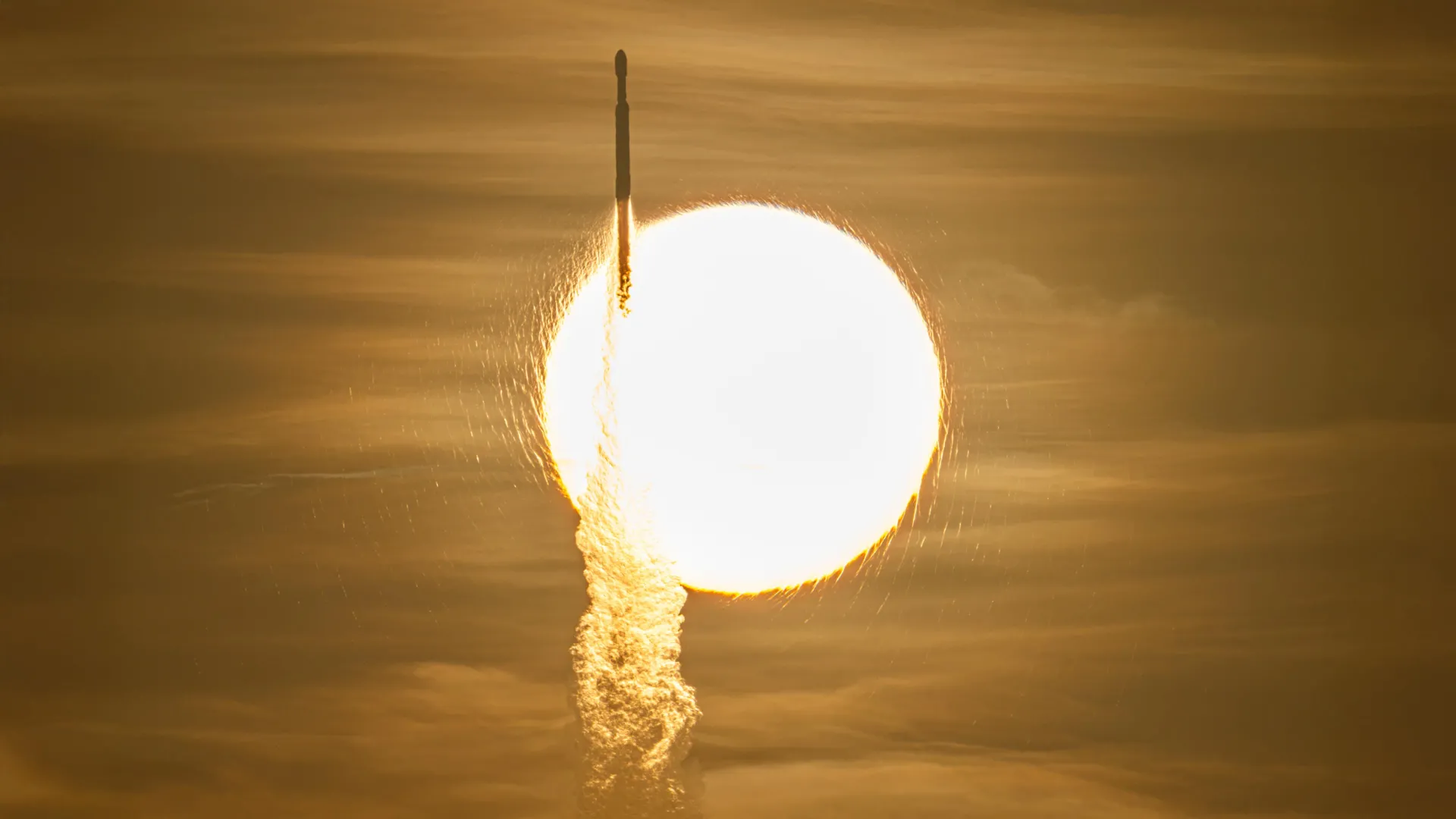
NASA's Roman Space Telescope has begun its journey to Lagrange Point 2, a gravitational equilibrium location one million miles from Earth. The observatory will conduct the deepest and widest surveys of the universe undertaken to date, targeting three cosmic mysteries that have eluded astronomers for decades: dark matter, dark energy, and the prevalence of distant exoplanets.
Roman operates at survey speeds approximately 1,000 times faster than the Hubble Space Telescope. This dramatic acceleration in observational capacity stems from Roman's wide-field imaging capabilities and advanced detector technology. The telescope will generate 1.4 terabytes of data daily, requiring ground-based teams to process and analyze information at unprecedented rates.
The mission addresses fundamental questions about the universe's composition and fate. Dark matter comprises roughly 85 percent of the matter in the cosmos yet remains invisible to direct observation. Dark energy, the mysterious force accelerating the universe's expansion, constitutes approximately 68 percent of the universe's total energy content. Current physics cannot fully explain either phenomenon. Roman's survey approach will map the large-scale structure of the universe across billions of light-years, allowing astronomers to trace how dark matter and dark energy have shaped cosmic evolution over billions of years.
Beyond dark sector studies, Roman will execute an exoplanet microlensing survey of unprecedented scope. Gravitational microlensing occurs when a star's gravity bends light from a distant background star, magnifying its brightness. If an exoplanet orbits the foreground star, it creates subtle brightness fluctuations that reveal the planet's mass and orbital properties. Roman's sensitivity will enable detection of exoplanets across vast swaths of the galactic plane, including Earth-mass worlds in habitable zones around distant stars.
The telescope's infrared imaging capabilities complement its survey speed. Operating in infrared wavelengths, Roman penetrates cosmic dust clouds that obscure visible light, revealing stellar populations and galactic structures hidden from optical telescopes. The instrument's 2.4-meter primary mirror matches Hubble's diameter but incorporates newer optical designs that maximize light collection across a much wider field of view.
L2 represents an optimal location for space telescopes. Located opposite the Sun from Earth, L2 allows Roman to maintain a consistent thermal environment by positioning its sunshield continuously between the spacecraft and the Sun. This geometry prevents thermal fluctuations that degrade image quality. The orbit requires minimal fuel expenditure to maintain once Roman reaches L2.
The mission builds on decades of cosmological observations while extending capabilities dramatically. Hubble discovered cosmic acceleration in 1998, work that earned the Nobel Prize in Physics in 2011. Roman will characterize this acceleration with orders of magnitude greater precision, measuring how the expansion rate has changed throughout cosmic history.
Data processing and analysis will present operational challenges. The 1.4 terabyte daily data stream necessitates sophisticated automated pipelines to identify targets, flag anomalies, and extract scientifically relevant information. Astronomers will receive processed datasets enabling immediate discovery of unexpected cosmic phenomena.
Roman represents a generational leap in wide-field astronomy. Its combination of survey speed, sensitivity, and data volume promises revelations about dark matter distribution, dark energy's properties, and the prevalence of potentially habitable worlds. The mission will operate for at least five years, potentially extending longer depending on fuel reserves and hardware performance.