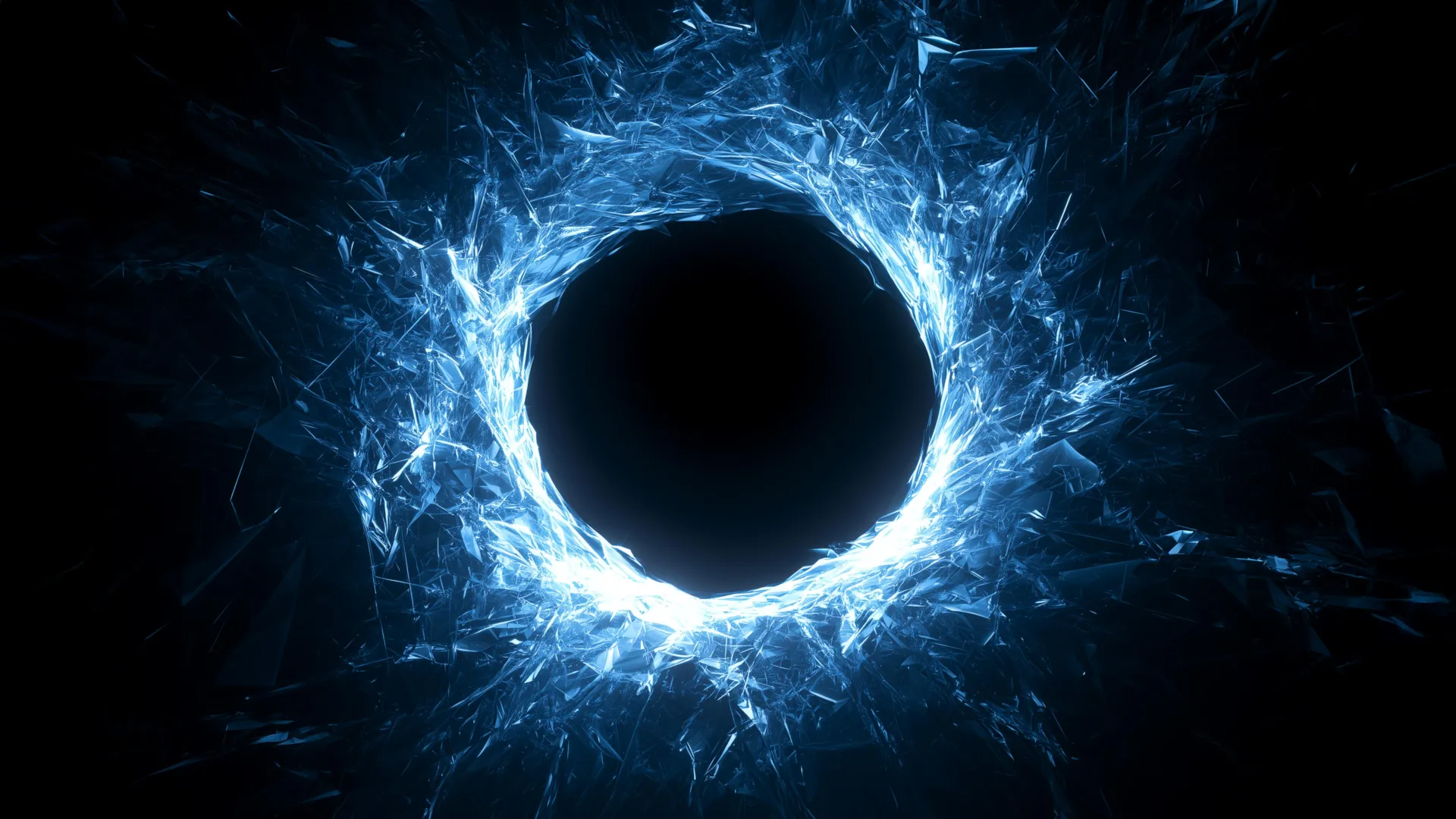
Physicists have discovered a mathematical framework describing an exotic "spacetime crystal" capable of undergoing a dramatic phase transition into a microscopic black hole with minimal energy perturbation. The finding emerges from a theoretical analysis published in peer-reviewed physics literature, employing unconventional mathematical techniques involving higher-dimensional space constructs to model the phenomenon.
The research team exploited a mathematical trick using infinitely many dimensions to characterize this unstable spacetime structure. Rather than existing stably in nature, the spacetime crystal occupies a precarious state where small energy fluctuations determine whether it dissolves harmlessly or collapses catastrophically into a black hole. This binary outcome represents a phase transition analogous to water freezing or boiling at critical temperatures, except operating at quantum scales with gravitational consequences.
The theoretical breakthrough opens new avenues for studying primordial black holes, the hypothetical tiny black holes theorized to have formed during the Big Bang from quantum fluctuations and density variations in the early universe. Researchers also see applications for understanding microscopic black holes produced in high-energy physics experiments or through quantum gravity effects. Both categories remain poorly understood experimentally, making theoretical tools increasingly valuable.
Spacetime crystals themselves represent a conceptual extension of time crystals, exotic quantum states where matter exhibits periodic structure in time rather than space. Traditional crystals repeat their atomic patterns spatially; time crystals break time translation symmetry by oscillating indefinitely without energy input. By analogy, spacetime crystals combine spatial and temporal ordering into a unified geometric structure. Their mathematical existence hinges on solutions to Einstein's general relativity equations, the framework governing gravity and large-scale spacetime geometry.
The infinitely-dimensional mathematical trick employed here likely involves an AdS/CFT correspondence or related holographic duality from theoretical physics. These mathematical techniques establish deep connections between gravitational theories in higher-dimensional spaces and quantum field theories in lower dimensions. By projecting the problem into infinitely many dimensions, physicists can sometimes extract solutions intractable in conventional formulations. This approach has become standard in theoretical work exploring quantum gravity and black hole physics over the past two decades.
The practical implications remain theoretical at present. These spacetime crystals almost certainly cannot be created in laboratories or observed naturally in accessible regions of the universe. The instability preventing their stable existence also prevents experimental verification. Yet the mathematical structure itself may encode universal principles about phase transitions, energy thresholds, and collapse mechanisms relevant to actual black hole formation under extreme conditions.
The research contributes to the growing body of theoretical work on black hole thermodynamics, entropy, and quantum effects near event horizons. Understanding how matter and spacetime can undergo abrupt transitions between distinct states informs broader questions in quantum gravity. If gravitational physics truly exhibits such sharp transitions at quantum scales, the implications for early universe cosmology and potential black hole formation through laboratory experiments merit further investigation.