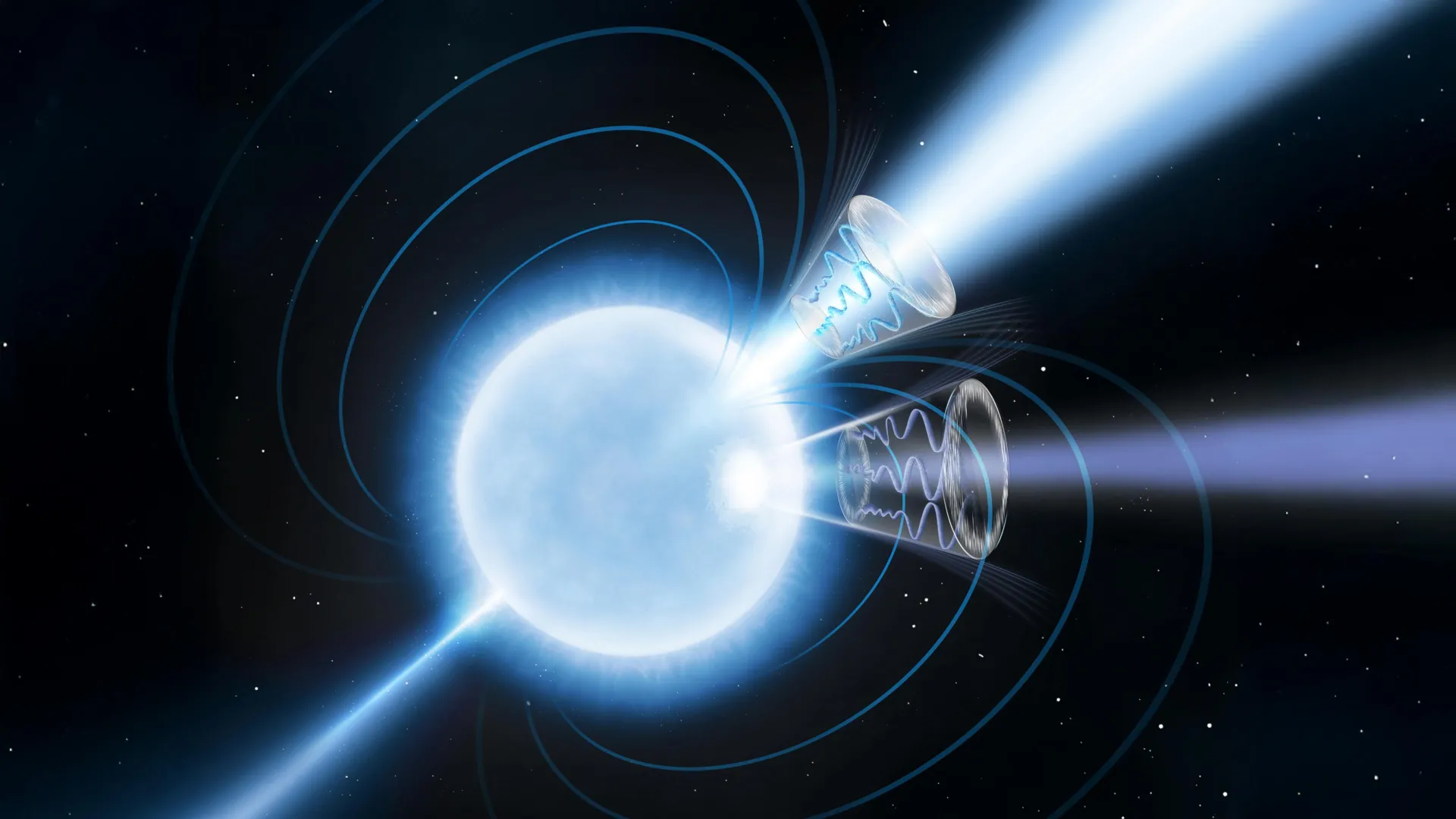
Researchers analyzing light from an extraordinarily powerful magnetar have detected signatures of a quantum effect that Werner Heisenberg predicted in 1936. The observation suggests that supposedly empty space possesses properties capable of altering light's behavior, offering the first potential evidence of vacuum birefringence.
The magnetar at the center of this discovery emits one of the strongest magnetic fields known to exist. When photons from this object travel through space toward Earth, they apparently interact with quantum fluctuations in the vacuum. Heisenberg's prediction describes how intense electromagnetic fields can cause the vacuum itself to become birefringent, meaning it splits light into different polarization states at different speeds. This phenomenon arises because the vacuum teems with virtual particle pairs that constantly blink in and out of existence.
The team detected this effect by measuring the polarization of light arriving from the magnetar. Vacuum birefringence would rotate the light's polarization in a specific way that differs from known astrophysical processes. The researchers found evidence matching Heisenberg's theoretical prediction with a confidence level that suggests the detection reaches statistical importance.
This result carries profound implications for fundamental physics. The vacuum is not truly empty but filled with quantum fields and virtual particles. If vacuum birefringence occurs as predicted, it confirms a cornerstone prediction of quantum electrodynamics, the framework describing how light and charged particles interact. The discovery also opens pathways to testing other exotic properties of the quantum vacuum.
Several factors make magnetars ideal laboratories for studying such effects. Their magnetic fields reach strengths of 10 to the 15th gauss or higher, compared to Earth's magnetic field of roughly 0.5 gauss. Neutron stars that produce these fields compress the entire mass of the Sun into an object the size of a city. Their extreme conditions create environments where quantum effects normally too feeble to measure become observable.
The research team extracted archival observations from existing astronomical databases rather than conducting new observations. This approach allowed them to analyze data collected previously without dedicated observing time. The magnetar they studied sits thousands of light-years from Earth, making direct laboratory verification impossible.
Some physicists caution that alternative explanations for the polarization data require elimination before declaring definitive confirmation. Dust or magnetic fields in the interstellar medium could theoretically produce similar patterns. The researchers addressed these concerns by examining how the polarization changed across different wavelengths and comparing predictions from competing hypotheses.
If confirmed through additional observations, this work would represent the first direct experimental evidence for vacuum birefringence. Future studies of other magnetars or compact objects could either strengthen or challenge this finding. Space-based telescopes with enhanced polarimetric capabilities may provide more sensitive measurements of these subtle quantum effects.
The detection demonstrates how extreme cosmic objects serve as natural laboratories for quantum physics. Conditions so violent and intense that they cannot be recreated on Earth allow scientists to test fundamental theories under circumstances impossible to achieve experimentally. Magnetars thus occupy a unique role in modern astrophysics, revealing secrets about the quantum nature of reality itself.