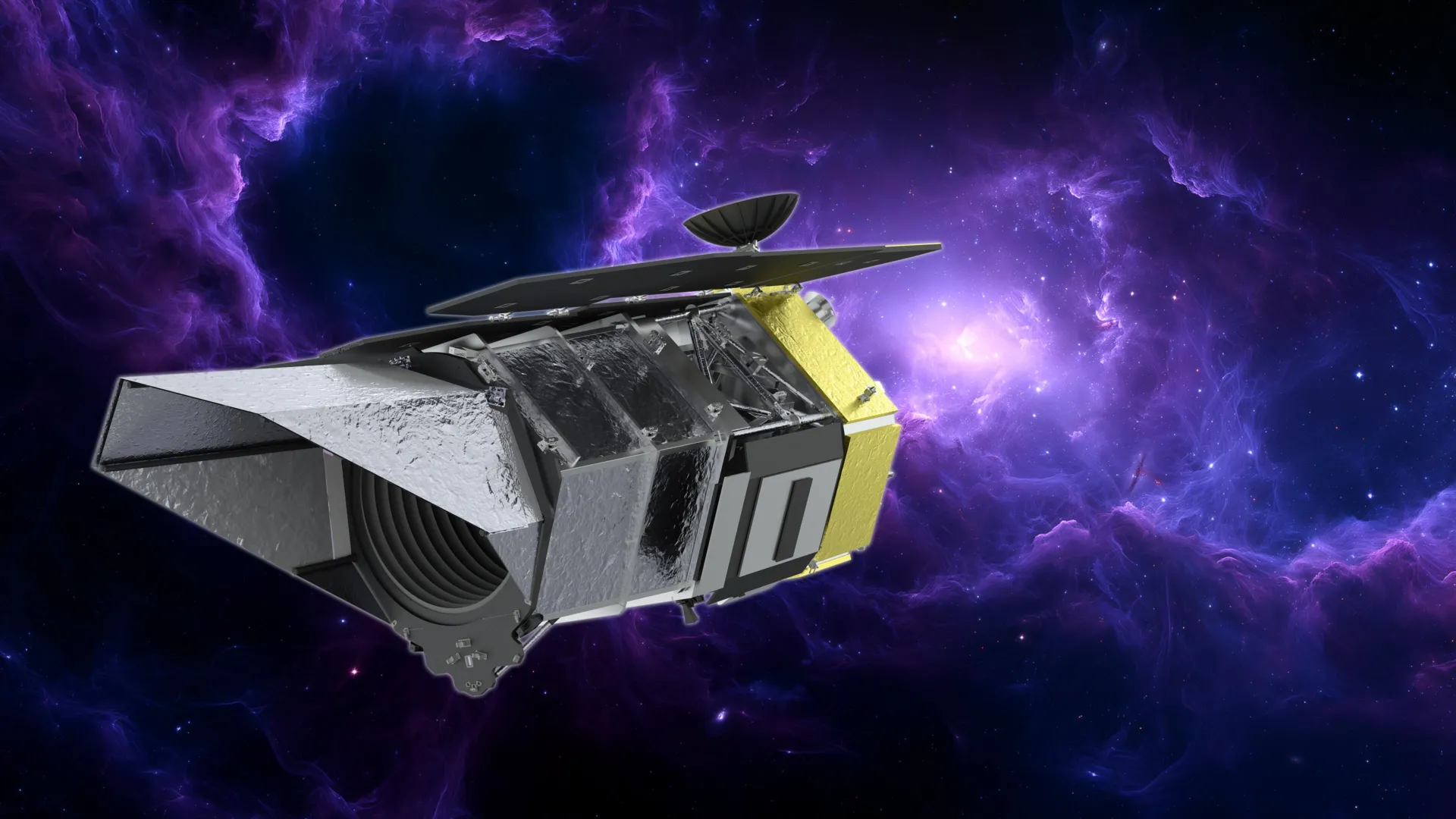
NASA's Roman Space Telescope will launch with capabilities that fundamentally reshape how astronomers survey the universe. The instrument combines the optical precision of the Hubble Space Telescope with a field of view 100 times broader, enabling scientists to image vast cosmic regions in sharp detail.
The Roman telescope, named after physicist Nancy Grace Roman, represents a generational leap in space-based astronomy. While Hubble excels at examining small patches of sky with extraordinary clarity, Roman trades some depth for breadth. Its wide field of view spans 0.28 square degrees, compared to Hubble's 0.026 square degrees. For context, that's roughly equivalent to viewing an area the size of the full moon versus a postage stamp.
This design change enables several transformative science objectives. Exoplanet detection ranks among the telescope's primary missions. The instrument will use gravitational microlensing, a technique where a foreground star's gravity bends light from a distant object, magnifying background stars and revealing orbiting planets. Roman's wide-angle capability allows it to monitor millions of stars simultaneously, catching the subtle brightness dips that betray hidden worlds. Astronomers project the telescope could identify thousands of exoplanets, including potentially Earth-mass planets in habitable zones around distant stars.
Beyond planets, Roman will map the universe's large-scale structure with unprecedented efficiency. The telescope will catalog billions of galaxies across cosmic history, tracing how the universe evolved over billions of years. This galactic census provides crucial data for understanding cosmic expansion and testing theories about how galaxy clusters form and evolve.
Dark energy and dark matter, the universe's most mysterious components, represent another frontier. Roman's observations will help cosmologists measure how cosmic expansion accelerated over time, constraining theoretical models of dark energy. The telescope's wide surveys enable detection of gravitational lensing patterns imprinted by dark matter across enormous sky regions, revealing how this invisible substance distributes through the cosmos.
Technical specifications reflect the engineering complexity required. Roman carries a 2.4-meter primary mirror, identical in size to Hubble's reflector, yet achieves superior light-gathering capability through advanced detector technology. The spacecraft's infrared instruments operate at temperatures colder than the primordial cosmic microwave background, enabling detection of faint, distant objects.
NASA plans for Roman to launch in the mid-2020s and operate for at least five years at the Sun-Earth L2 Lagrange point, approximately one million miles from Earth. This orbital location provides thermal stability and shield from solar radiation.
The mission complements rather than replaces existing observatories. Hubble's narrow, deep-field observations probe the earliest galaxies and finest stellar details. The James Webb Space Telescope examines the infrared universe with exquisite sensitivity. Roman's strength lies in efficient, comprehensive surveys that identify targets for follow-up observation by other facilities.
Astronomers anticipate Roman will generate vast datasets requiring advanced computational analysis. The survey approach mirrors successful ground-based surveys like the Sloan Digital Sky Survey, which revolutionized cosmology through systematic mapping of millions of objects.