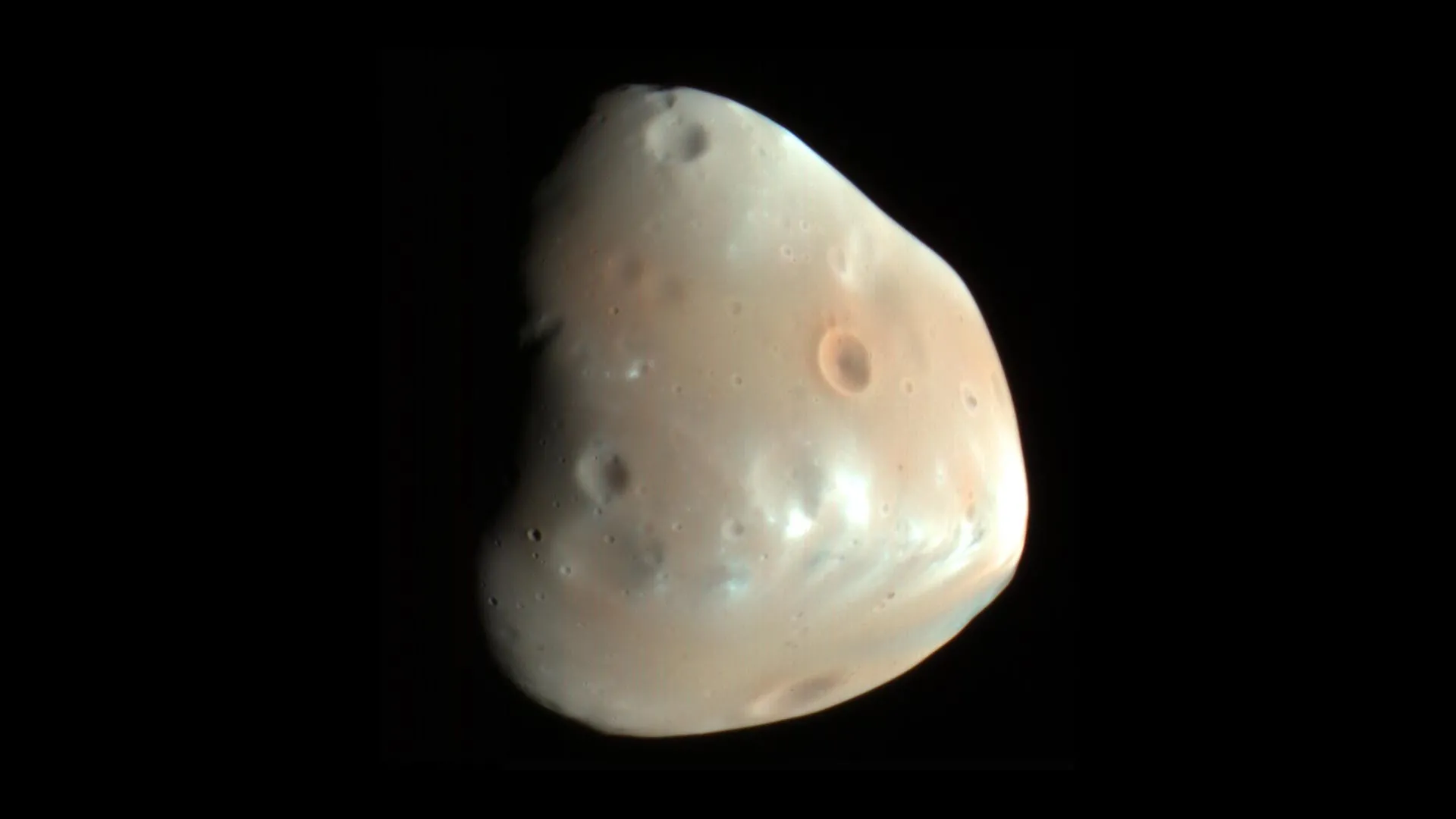
A single asteroid impact billions of years ago may solve two long-standing puzzles about Deimos, the smaller of Mars's two moons, according to new research presented by the European Space Agency's Hera spacecraft mission.
The mystery centers on Deimos's unusual geography. The moon displays a massive depression on its southern hemisphere that scientists have struggled to explain. Equally puzzling is Deimos's unexpectedly smooth surface, covered in fine dust rather than the cratered, rocky terrain typical of small moons exposed to billions of years of micrometeorite bombardment.
Researchers ran impact simulations proposing that a roughly 320-meter asteroid struck Deimos at an oblique angle rather than head-on. This scenario, described in recent computational models, would generate enough energy to excavate a large depression while hurling debris across the entire moon's surface. Crucially, the angled trajectory would dissipate energy gradually, preventing the impact from shattering the fragile moon into pieces.
"The simulations show that this single impact could simultaneously create the southern depression and redistribute regolith across the surface," the research indicates. The redistributed material would explain the unusually uniform dust coverage observed across Deimos today.
ESA's Hera spacecraft, designed to study asteroid deflection and planetary defense, provided fresh observational data supporting this theory. The probe's instruments revealed that Deimos possesses a surprisingly porous internal structure, making it remarkably fragile. This porosity matters. A more solid moon struck by a 320-meter impactor might have shattered. Deimos's sponge-like composition allowed it to absorb the impact's energy through compression and deformation rather than catastrophic breakup.
The findings reshape understanding of small celestial bodies. Deimos measures only about 12 kilometers across, making it one of the solar system's tiniest moons. Such small objects typically experience heavy cratering from constant micrometeorite impacts over geological timescales. Yet Deimos displays minimal cratering, a discrepancy the impact-plus-regolith-redistribution model resolves. Surface dust generated during the ancient impact would gradually cover older crater scars, creating the smooth appearance observed today.
The research also carries implications for planetary defense strategies. Understanding how small, porous bodies respond to impacts helps scientists refine models for deflecting potentially hazardous asteroids. The porosity factor proves especially important. Solid asteroids and porous ones absorb impacts differently, affecting the force required to alter their trajectories.
Deimos orbits Mars at 23,463 kilometers from the planet's center, completing one orbit every 30.3 hours. This tidal lock means the same hemisphere always faces Mars, similar to how our Moon behaves relative to Earth. The moon's origin remains debated. Some scientists propose Deimos formed alongside Mars as part of the same planetary system. Others argue it's a captured asteroid. The new impact scenario does not definitively resolve this question but constrains when and how Deimos acquired its current physical characteristics.
Future observations from Hera and complementary data from other missions will refine impact models further. Understanding Deimos's composition, internal structure, and impact history contributes to broader knowledge of small-body formation and evolution throughout the solar system.