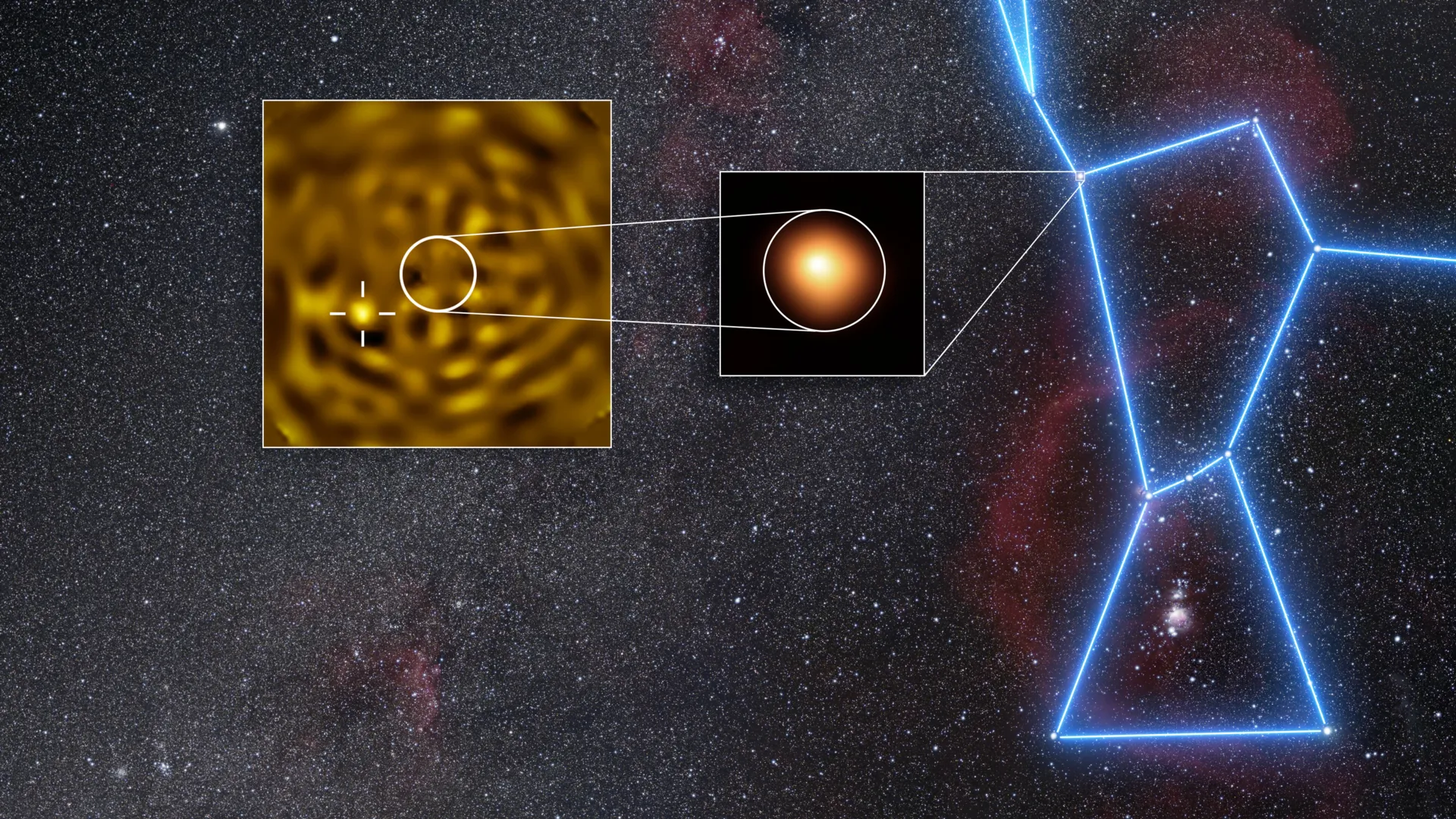
Astronomers have resolved a century-long mystery surrounding Betelgeuse, the red supergiant star in the constellation Orion, by directly imaging its hidden companion star for the first time. The discovery emerges from observations using advanced interferometry techniques that combine light from multiple telescopes to achieve unprecedented resolution.
The companion star orbits Betelgeuse at a relatively close distance, and its presence explains several puzzling behaviors of the primary star. Betelgeuse undergoes irregular brightness fluctuations that have long confounded researchers, dimming and brightening in patterns that single-star models could not fully account for. The gravitational interaction between Betelgeuse and its companion appears responsible for some of these variations, offering a physical mechanism for brightness changes that previously seemed erratic.
The discovery carries implications for predicting when Betelgeuse will explode as a supernova. Betelgeuse represents one of the closest supergiant stars to Earth at roughly 430 light-years away, making it the nearest candidate for a nearby supernova within astronomical timescales. When it does explode, the event will briefly rival the brightness of the full moon and potentially be visible in daylight. The companion star's orbital dynamics could influence the timing and nature of this eventual explosion, affecting how the supernova unfolds.
Researchers deployed infrared interferometry, a technique that links data from separate telescopes to create an effective aperture far larger than any single instrument. This method achieves angular resolution that ground-based telescopes cannot match otherwise. The clarity obtained through interferometry finally allowed direct detection of the companion after decades of theoretical predictions and indirect evidence.
The companion star itself surprises astronomers with its mass. Rather than being a smaller, inconsequential partner, it possesses substantial stellar mass that produces genuine gravitational effects on Betelgeuse's outer atmosphere and behavior. This substantial mass explains why the companion's influence proves so pronounced despite the vast size difference between the red supergiant primary and its orbiting partner.
Previous attempts to detect Betelgeuse's companion through spectroscopy and photometry provided tantalizing hints but lacked the resolution to produce direct confirmation. The companion occasionally caused subtle shifts in Betelgeuse's spectral lines and contributed to intensity variations, but these indirect signatures proved insufficient for definitive proof. Modern interferometric equipment finally closed this observational gap.
The timing of this discovery arrives as Betelgeuse draws renewed attention from the astronomical community. In late 2019 and early 2020, Betelgeuse experienced an unprecedented dimming event that captured public and professional interest. Some observers speculated the star approached imminent collapse, though subsequent observations showed the dimming resulted from dust emission rather than core instability. Understanding the companion's role in Betelgeuse's variability helps contextualize such dramatic changes within a more complete physical picture.
Future observations will map the companion's orbit with greater precision and measure its properties more thoroughly. This refined data will feed into models predicting Betelgeuse's remaining lifespan and the eventual supernova characteristics. The resolution of this century-old question demonstrates how modern astronomical tools can unlock secrets that eluded previous generations of researchers, even as they raise new questions about how binary star systems evolve and interact.