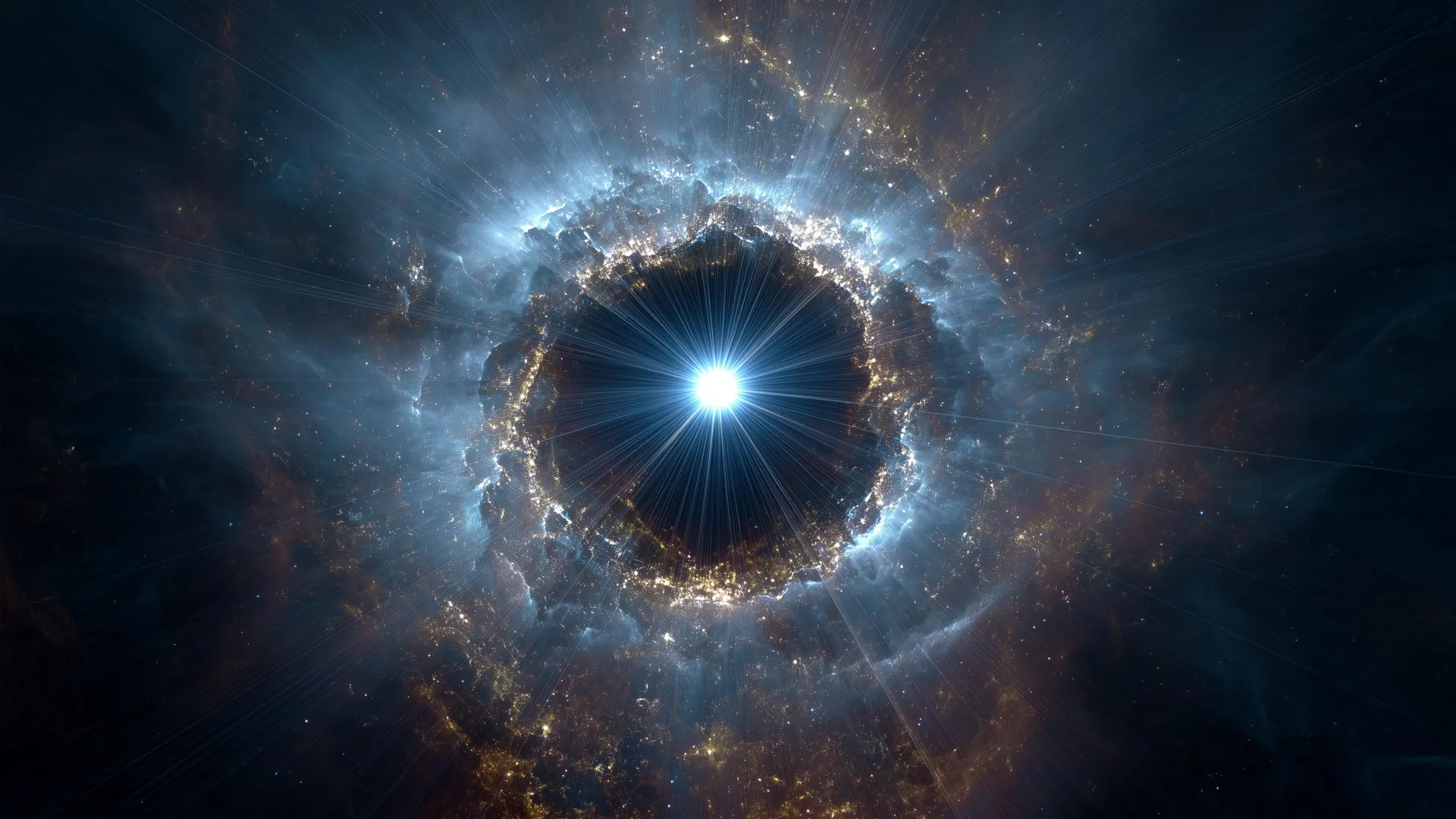
Scientists have detected a pervasive hum of gravitational waves rippling through the cosmos, and a new theory suggests this ancient signal may originate from dark stars that formed just 100 million years after the Big Bang.
The gravitational-wave background, first observed by pulsar timing arrays in 2023, represents a low-frequency rumble distinct from the sharp spikes caused by merging black holes and neutron stars. This persistent signal remained unexplained until researchers began exploring connections to the Universe's earliest epochs.
Dark stars represent a theoretical class of objects that could have emerged during cosmic dawn, when the first stars ignited. Unlike ordinary stars powered by nuclear fusion, dark stars would derive energy from dark matter annihilation, allowing them to grow to extreme masses. A single dark star could reach billions of solar masses while remaining relatively compact, potentially collapsing into supermassive black holes far more massive than current theories predict should exist so early in cosmic history.
This pathway solves a longstanding puzzle. The supermassive black holes observed at the centers of galaxies in the early Universe appear impossibly large given the time available for them to grow through conventional merger processes. Dark stars collapsing into supermassive black holes offer an alternative formation mechanism that bypasses this timeline problem.
When dark stars and their black hole descendants merge, they generate gravitational waves. The accumulated signal from billions of such mergers occurring over cosmic time would create precisely the type of background hum astronomers now detect. This continuous gravitational-wave background differs fundamentally from isolated merger events, forming a diffuse noise floor rather than discrete detectable signals.
Researchers analyzing this hypothesis note that dark stars could comprise a previously undetected component of dark matter itself. If dark matter particles accumulate inside stellar objects and annihilate to produce energy, dark stars become self-sustaining engines powered by the Universe's most abundant form of matter. The connection transforms dark matter from a mysterious invisible substance into an active participant in early cosmic evolution.
Current gravitational-wave detection relies on pulsar timing arrays, which monitor radio signals from distant neutron stars called millisecond pulsars. Slight timing variations in pulsar signals reveal gravitational waves passing through space. The Laser Interferometer Gravitational-Wave Observatory (LIGO) and other ground-based detectors currently operate at frequencies too high to capture the background hum, though next-generation instruments like the Einstein Telescope and Cosmic Explorer may eventually resolve individual sources within the background.
The theory remains speculative. Confirming dark stars as the source requires independent evidence supporting their existence or detecting characteristic signatures in the gravitational-wave background's frequency spectrum. Researchers must also account for competing explanations, including contributions from other early Universe phenomena.
Nevertheless, the hypothesis opens fresh avenues for investigating cosmic dawn. By analyzing the gravitational-wave background's properties, astronomers gain an unprecedented window into the first billion years of cosmic history, a period largely hidden from conventional electromagnetic observations. Dark stars, if real, would represent nature's most efficient mechanism for converting dark matter into the seeds of supermassive black holes that dominated early galaxies.