# Newton's 300-Year-Old Law Just Passed Its Biggest Test Yet
Researchers testing gravitational theory across the largest scales of the universe found that Newton's law of universal gravitation holds up with extraordinary precision, even when stretched across hundreds of millions of light-years separating galaxy clusters. The finding challenges alternative theories that propose modifications to gravity itself and reinforces the leading explanation that dark matter accounts for the universe's missing mass.
The study examined how gravity influences galaxy clusters separated by enormous cosmic distances. Rather than observing these systems locally, teams measured gravitational effects at scales that previous tests could not reach. Newton's inverse-square law, formulated in 1687, predicts that gravitational force decreases proportionally to the square of the distance between objects. Einstein's general relativity, published in 1915, provided a more sophisticated description of gravity as the curvature of spacetime, but Newton's equations remain accurate in most practical applications.
The research strengthens Einstein's framework while simultaneously weakening Modified Newtonian Dynamics (MOND) and other alternative gravity theories. MOND proposes that gravitational physics breaks down at very large scales, potentially eliminating the need for dark matter entirely. If MOND were correct, gravity would behave differently across cosmic voids than Newton and Einstein predicted. The new data does not support this scenario.
For nearly a century, astronomers have recognized a fundamental problem: galaxies rotate too quickly and galaxy clusters move too fast for the visible matter they contain to explain the gravitational effects observed. The missing gravitational pull appears to come from unseen mass. This "dark matter" remains one of physics' deepest mysteries. It comprises roughly 85 percent of all matter in the universe but does not emit, absorb, or reflect light. Scientists have proposed various dark matter candidates, from weakly interacting massive particles to primordial black holes.
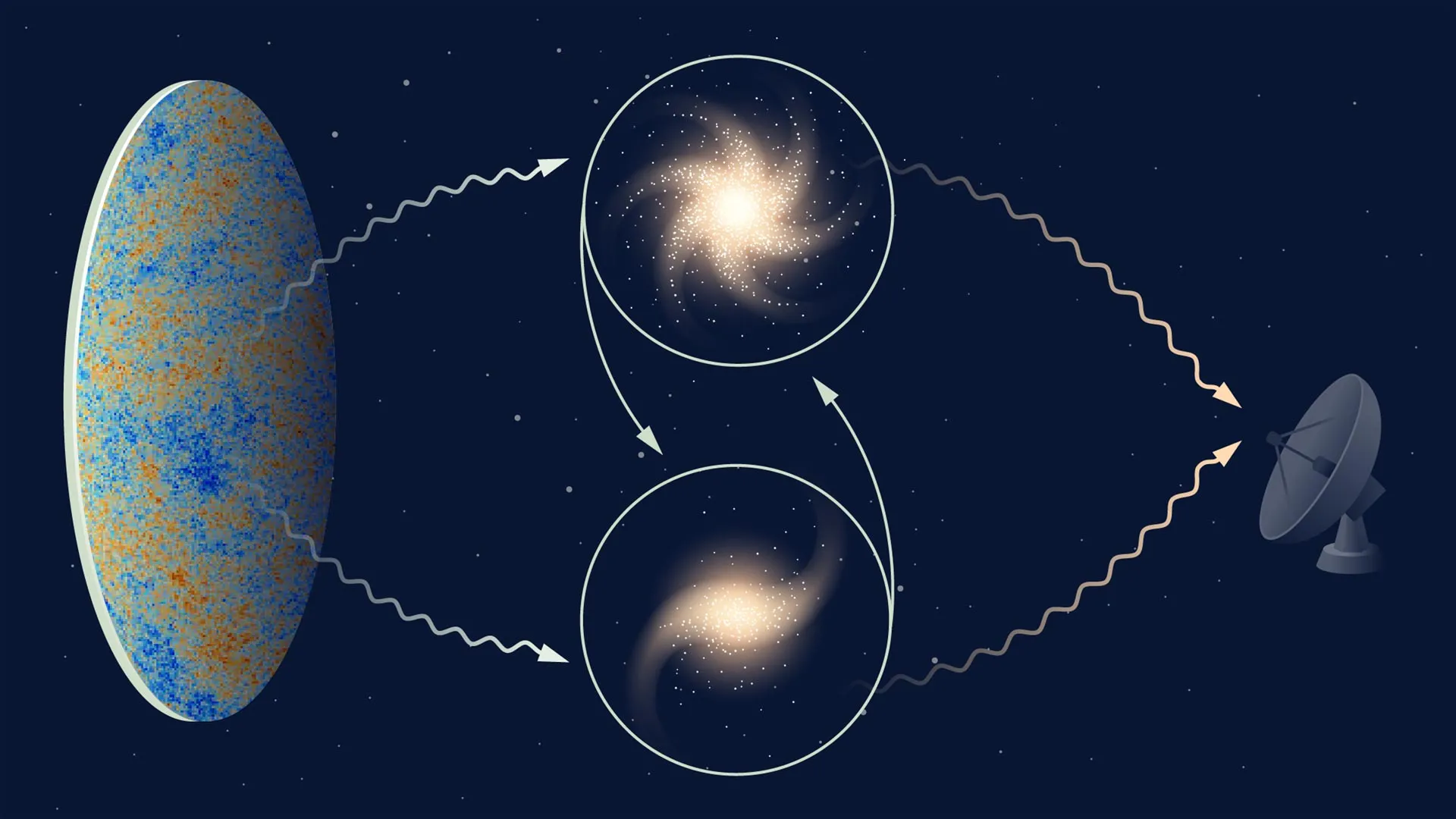
The test used large-scale structure surveys and gravitational lensing measurements. Gravitational lensing occurs when massive objects bend light from distant sources, allowing astronomers to map the distribution of matter regardless of whether it shines. By comparing predicted lensing patterns from Newton and Einstein's theories with actual observations across vast cosmic distances, researchers found agreement to unprecedented precision.
The work does not definitively prove dark matter exists, but it narrows the viable alternatives. If gravity itself operated fundamentally differently at large scales, as MOND suggests, the patterns observed in galaxy cluster interactions would differ measurably from predictions. The data matched predictions remarkably well, suggesting that gravity works as classical physics describes it, leaving dark matter as the leading explanation for missing mass.
Future observations from next-generation telescopes will push these tests even further. Projects like the Vera Rubin Observatory and the Euclid space mission will map billions of galaxies with unprecedented detail, potentially revealing whether gravity behaves precisely as Newton and Einstein calculated across the entire observable universe. This research represents another chapter in humanity's quest to understand the invisible architecture holding the cosmos together.