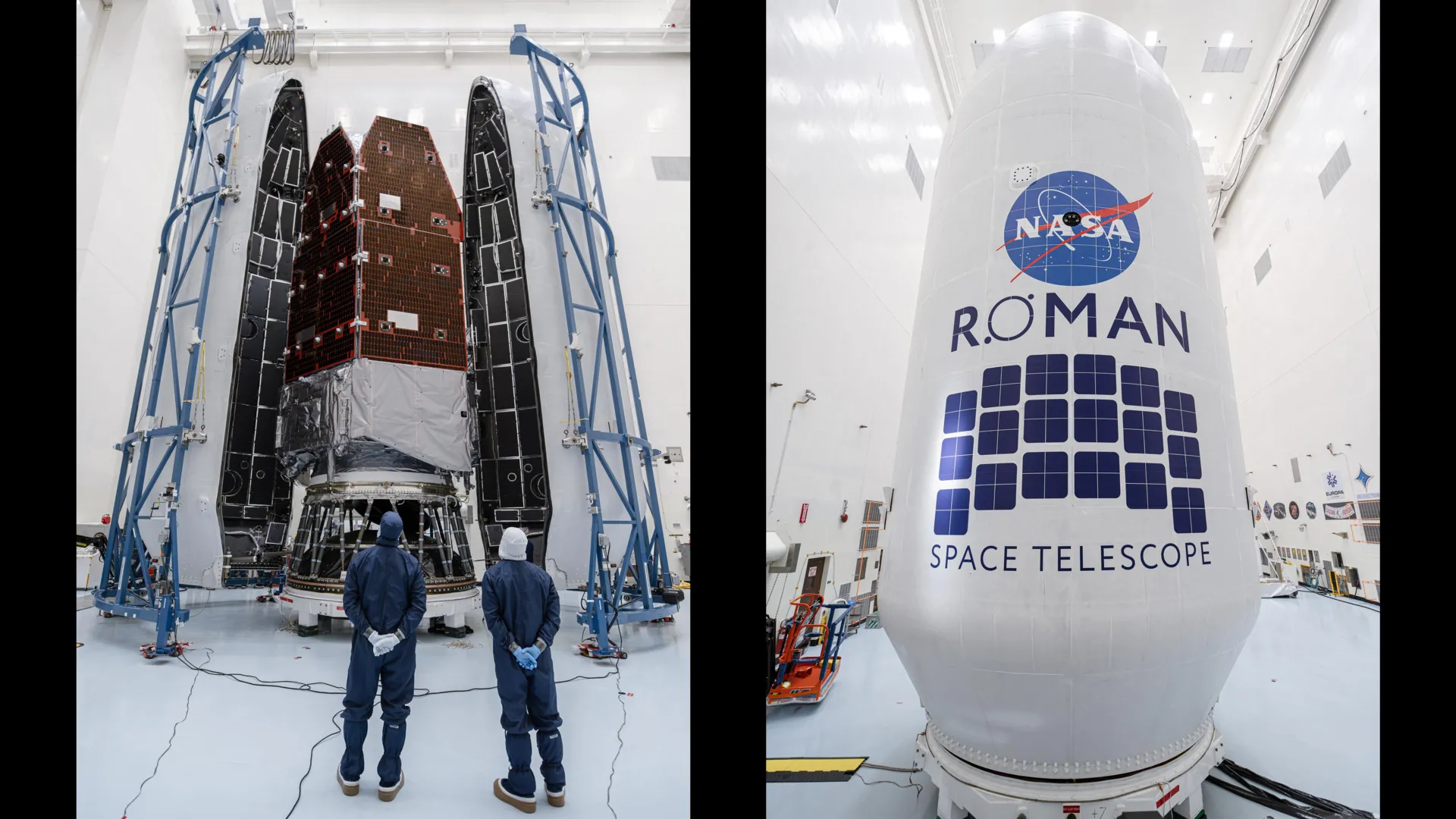
NASA's Roman Space Telescope has reached a major milestone in its path to launch. The observatory now sits enclosed inside a SpaceX Falcon Heavy rocket's payload fairing, moving closer to deployment into space. The mission represents a watershed moment for exoplanet detection and cosmological research.
Roman will search for thousands of exoplanets using a technique called microlensing, which exploits how gravity bends starlight around massive objects. When a star passes in front of a distant star, the foreground star's gravity acts as a lens, magnifying light from the background star. If planets orbit the foreground star, they create detectable signatures in this magnified light. This method excels at finding planets at large distances from their host stars, a region where other detection methods struggle. Roman's infrared sensitivity will allow it to see planets around distant, faint stars that ground-based telescopes cannot easily observe.
The exoplanet hunt represents only part of Roman's scientific portfolio. The telescope will also tackle two of astronomy's deepest mysteries: dark matter and dark energy. These invisible substances comprise roughly 95 percent of the universe's total mass-energy content, yet their nature remains unknown. Roman will measure how dark energy drives the universe's accelerating expansion by observing supernovae across billions of light-years. The telescope will also map dark matter's distribution by studying how its gravity distorts the shapes of galaxies, a phenomenon called weak gravitational lensing.
The Falcon Heavy fairing enclosing Roman protects the telescope during launch and the early stages of deployment. The 3.2-billion-dollar mission represents a collaboration between NASA, the European Space Agency, and the Canadian Space Agency. Roman is named after Nancy Grace Roman, a pioneering astrophysicist who helped establish the Hubble Space Telescope program in its early stages.
Roman's technology builds on lessons learned from Hubble and the James Webb Space Telescope. The observatory carries a 2.4-meter primary mirror, identical in size to Hubble's, but it provides a field of view roughly 100 times larger. This vast area allows Roman to survey huge swaths of sky efficiently, essential for finding rare objects like planets around distant stars.
The microlensing technique offers distinct advantages over radial velocity and transit methods. While those techniques favor planets close to their stars, microlensing reveals planets at distances similar to Jupiter's orbit around the Sun. Roman should detect thousands of exoplanets, including some in habitable zones where liquid water could exist. The resulting catalog will help scientists understand planetary system architecture across the galaxy.
Launch timing remains fluid, but the Falcon Heavy fairing enclosure marks concrete progress. Once deployed at the second Sun-Earth Lagrange point, roughly one million miles from Earth, Roman will begin its five-year primary mission. The telescope's observations will reshape understanding of how galaxies populate the universe, how planets form, and what comprises the cosmos's basic architecture. The data Roman collects will influence exoplanet research and cosmology for decades.