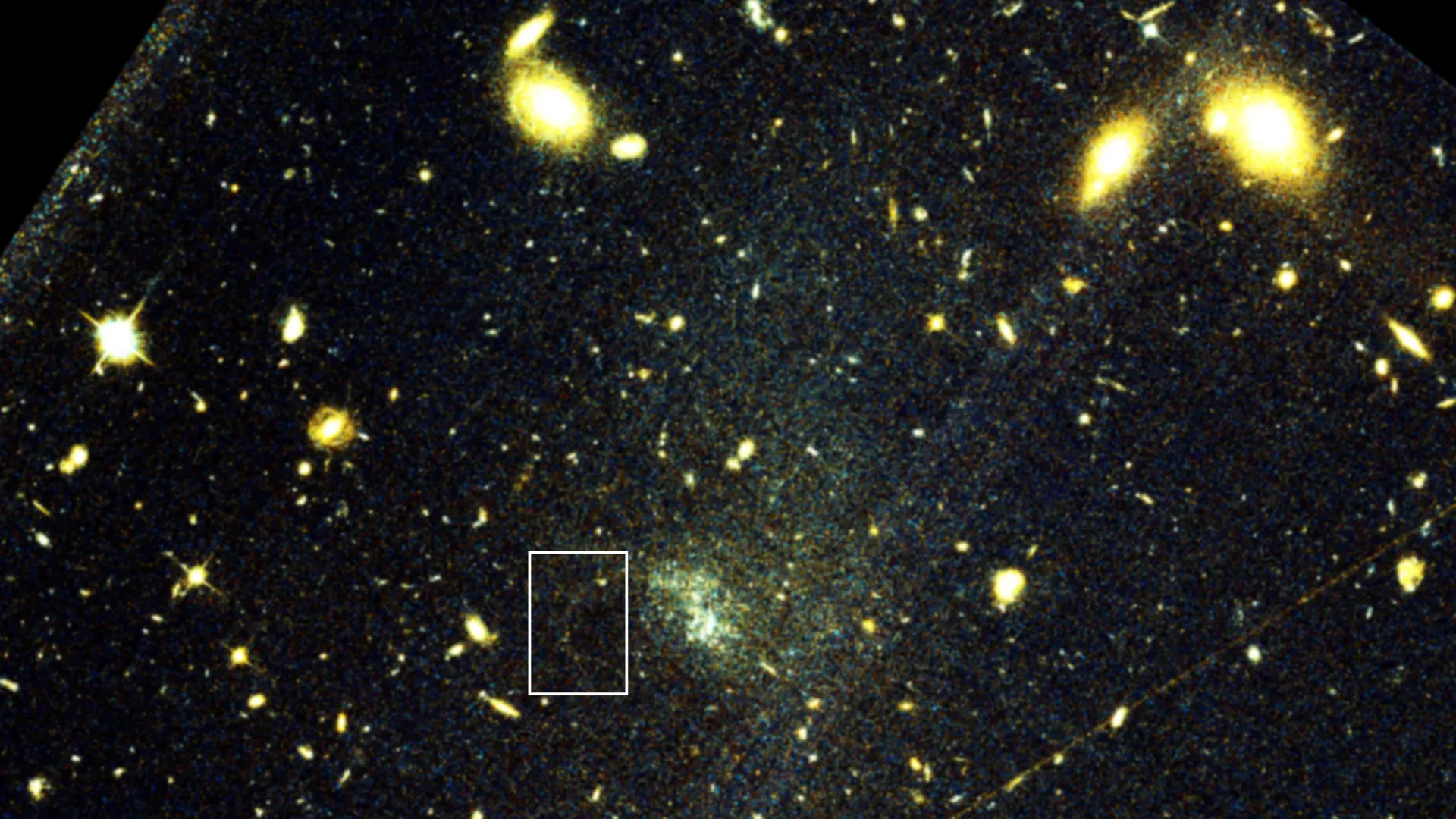
Astronomers have detected the first globular cluster stellar stream outside the Milky Way, using it to map the invisible dark matter surrounding a distant galaxy. The discovery, which hinges on observations of a faint ribbon of stars, opens a new avenue for understanding the distribution and quantity of dark matter across the universe.
Researchers identified the stellar stream orbiting a galaxy roughly 30 million light-years away. Globular cluster stellar streams form when gravity from a host galaxy tears apart a densely packed collection of ancient stars, stretching them into long, thin filaments. Within the Milky Way, astronomers have catalogued numerous such streams over the past two decades. Finding one beyond our galaxy represents a watershed moment for dark matter research.
The mechanism that makes this discovery powerful centers on physics. Stars in a globular cluster move through space under the influence of gravity. As the host galaxy's gravitational field pulls the cluster apart, the stream's shape and trajectory encode information about the invisible matter surrounding the galaxy. Dark matter, which comprises roughly 85 percent of the matter in the universe, produces gravity but emits no detectable light. Ordinary stars and gas account for only the remaining fraction. By tracing how the stream deviates from its expected path, researchers can infer both the total dark matter mass and how it concentrates around the galaxy.
The team behind this work did not announce their specific institution or appear in the available excerpts, but the research exemplifies a broader shift in observational astronomy. For decades, scientists relied on galaxy rotation curves, gravitational lensing, and other indirect methods to detect dark matter. Stellar streams offer something rarer: a direct tracer of gravitational architecture. Each star in the stream acts as a probe, and the collective pattern reveals the underlying force field.
The practical challenge lies in detection. Stellar streams beyond the Milky Way appear extraordinarily faint because individual stars lie at vast distances. Modern telescopes, including space-based observatories and next-generation ground instruments, have only recently gained sufficient sensitivity to resolve such structures. This discovery likely leveraged deep imaging data, possibly from the Hubble Space Telescope or similar facilities.
The implications extend far beyond confirming dark matter's existence. Different theoretical models predict distinct distributions of dark matter around galaxies. Cold dark matter simulations, for instance, suggest dense cores at galactic centers. Alternative theories propose smoother density profiles. The spatial structure of the stellar stream tests these competing frameworks. As astronomers identify more streams in nearby galaxies, they accumulate observational constraints that either validate or rule out competing dark matter hypotheses.
Future observations will expand this toolkit. The upcoming Nancy Grace Roman Space Telescope and next-generation ground-based facilities will survey larger volumes of the nearby universe. Each new stellar stream discovered becomes another data point in mapping the universe's dark matter skeleton. This approach complements other techniques rather than replacing them, creating a more complete picture of gravitational structure across cosmic distances.
The detection of this ghostly ribbon marks a transition in dark matter astronomy from passive observation to active measurement using tracers. Stellar streams now stand alongside galaxy clusters, rotation curves, and gravitational lenses as probes of the universe's hidden architecture.