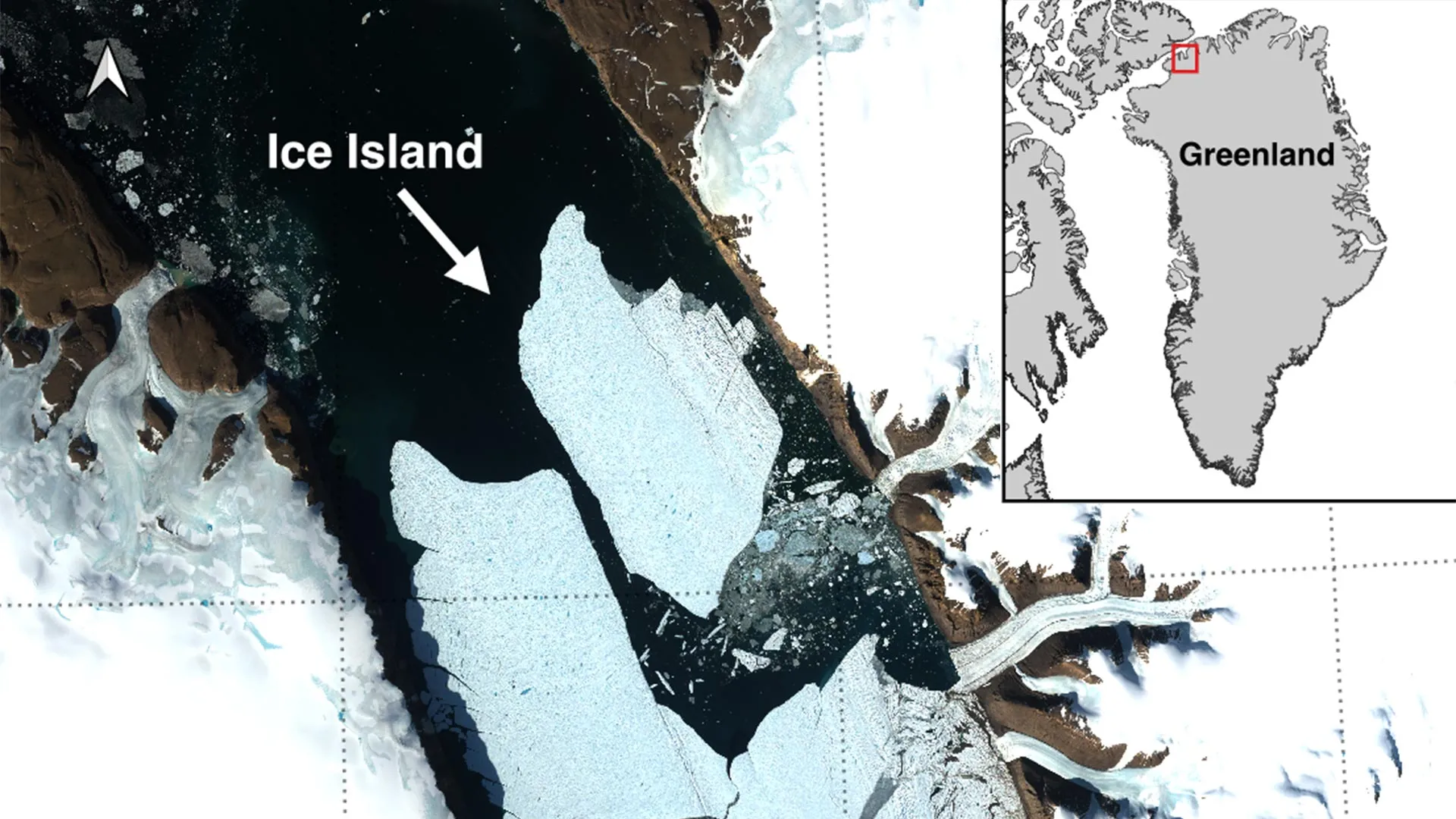
# Manhattan-Sized Ice Island Breaks Off Greenland's Petermann Glacier
A massive ice island roughly the size of Manhattan has calved from Greenland's Petermann Glacier, marking the latest in a series of dramatic structural failures at one of the Arctic's most closely monitored ice formations. The event follows years of expanding fractures that destabilized the glacier's floating ice tongue, the narrow extension of ice that juts into the ocean.
Scientists monitoring the Petermann Glacier documented the progression of cracks across the ice tongue before the break occurred. These fractures developed gradually, widening and lengthening until the ice structure could no longer hold together. The collapse represents a continuation of vulnerability patterns observed at Petermann over the past decade, when the glacier has demonstrated repeated susceptibility to large-scale calving events.
The detachment removes a substantial amount of floating ice from the system. What makes this event more concerning for researchers is the assessment that approximately two additional massive sections remain poised to break away. If both of these predicted calving events occur, they would together account for roughly 22 percent of the remaining ice tongue. Such losses would fundamentally alter the glacier's geometry and dynamics in ways that could accelerate future ice discharge into the ocean.
Petermann Glacier drains one of Greenland's major ice sheets and has been a focal point for glaciological research due to its sensitivity to climate change. The glacier terminates in a floating ice tongue extending roughly 70 kilometers into Nares Strait. Previous major calving events at Petermann occurred in 2010 and 2012, establishing a pattern of increasing instability.
The mechanisms driving these collapses involve both surface melt and ocean-driven warming. Warm Atlantic water circulating beneath the ice tongue erodes it from below, reducing its structural integrity. Simultaneously, surface meltwater percolates through cracks and reaches the ice-ocean interface, lubricating the base and reducing friction that anchors the glacier.
Ice island calving itself does not directly raise sea level because the ice is already floating. However, the loss of ice tongues removes a buttressing effect that slows the flow of grounded ice upstream. When the ice tongue retreats, the glacier behind it accelerates, increasing the rate at which land-based ice flows into the ocean. This inland ice, when it reaches the sea and melts, contributes directly to sea level rise.
The Petermann Glacier system remains under continuous satellite surveillance by researchers worldwide. Understanding the mechanics of ice tongue failure at Petermann informs broader predictions about other Greenland glaciers facing comparable climate pressures. Many major outlet glaciers across Greenland display similar warming signatures in the surrounding ocean and show comparable patterns of ice loss.
The timing and frequency of ice island production at Petermann appears coupled to both atmospheric and oceanic cycles operating at multi-year timescales. Researchers continue refining models that predict when subsequent calving will occur and how rapidly the glacier will respond to the loss of its protective ice tongue, with implications for Greenland's contribution to global sea level rise in coming decades.