# Scientists Create First Complete 3D Image of a Molecule's Quantum Shape
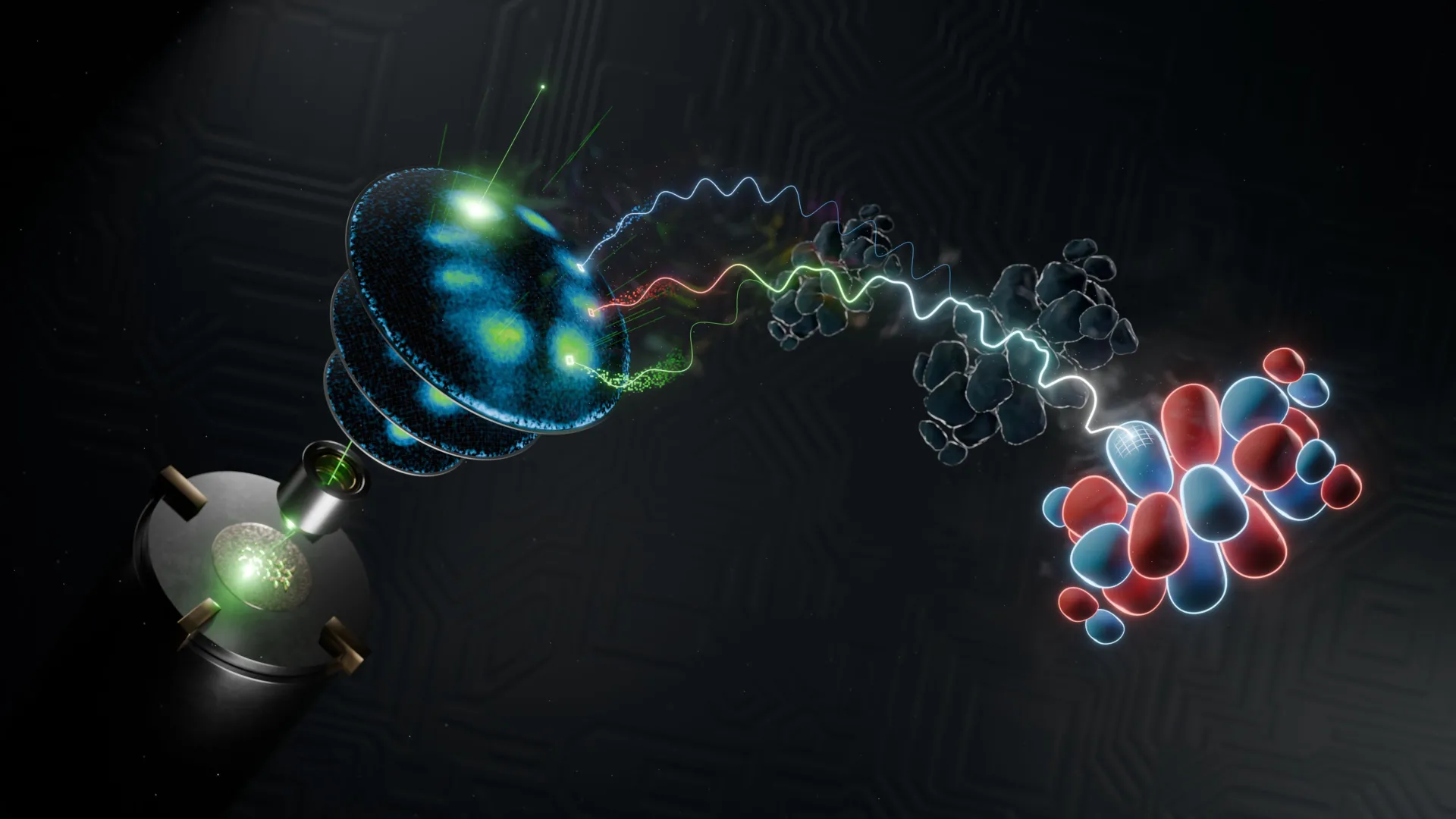
Researchers at the University of Göttingen have achieved an unprecedented visualization of quantum mechanics' most fundamental yet invisible feature: a molecule's wavefunction. The team used advanced photoelectron spectroscopy combined with custom algorithms to reconstruct a complete three-dimensional image of a molecular orbital in an organic molecule, revealing structural details at a scale smaller than the spacing between individual carbon atoms.
A wavefunction represents the quantum state of an electron in an atom or molecule. It does not describe a fixed path or position. Instead, it quantifies probability. Where the wavefunction amplitude is high, the electron has a greater chance of being found. Where it is low, detection becomes unlikely. Wavefunctions have never been directly imaged before. Scientists have inferred their shapes through indirect measurements and theoretical calculations, but visual confirmation remained out of reach until now.
The Göttingen team's method builds on photoelectron spectroscopy, a technique that ejects electrons from molecules using ultraviolet or X-ray light and measures the energy and angular distribution of those ejected particles. By collecting this data across many different angles and energies, researchers gathered enough information to reconstruct the full three-dimensional orbital using newly developed algorithms. The process resembles computed tomography scanning in medicine, where multiple two-dimensional X-ray images combine to form a complete 3D picture.
The molecular target was an organic molecule with a size measured in nanometers. The researchers resolved features within the wavefunction that were smaller than the carbon-carbon bond length, roughly 1.4 angstroms or 140 trillionths of a meter. This level of detail surpasses what previous indirect methods could achieve.
Wavefunctions encode the chemical and physical properties of molecules. Understanding their actual shapes provides insight into chemical bonding, reactivity, and electron behavior in ways that calculations alone cannot fully convey. Visualizing these quantum states helps bridge the gap between abstract mathematical descriptions and experimental reality. This work validates quantum mechanical predictions at unprecedented resolution.
The technique carries practical implications for materials science and chemistry. Researchers studying organic semiconductors, catalytic molecules, and drug compounds could use wavefunction imaging to understand why certain molecular structures exhibit desired properties. Electron transfer in solar cells, reaction pathways in chemical synthesis, and the effectiveness of pharmaceuticals all depend on wavefunction properties. Direct visualization accelerates hypothesis formation and testing.
The Göttingen team's breakthrough required not just better experimental equipment but smarter data interpretation. Modern computing power and machine learning enable algorithms to extract maximum information from photoelectron measurements. As these computational methods improve, imaging molecular wavefunctions becomes faster and more routine.
Future work will likely focus on imaging larger molecules and more complex systems. Polyatomic molecules with dozens of atoms and multiple electron interactions present the next frontier. Real-time imaging of wavefunction changes during chemical reactions represents an even more ambitious goal. The technology could eventually reveal how electrons redistribute during bond formation, breaking, or energy transfer events.
This breakthrough demonstrates how advances in measurement and computation combine to unlock mysteries previously confined to mathematical models and theoretical speculation.