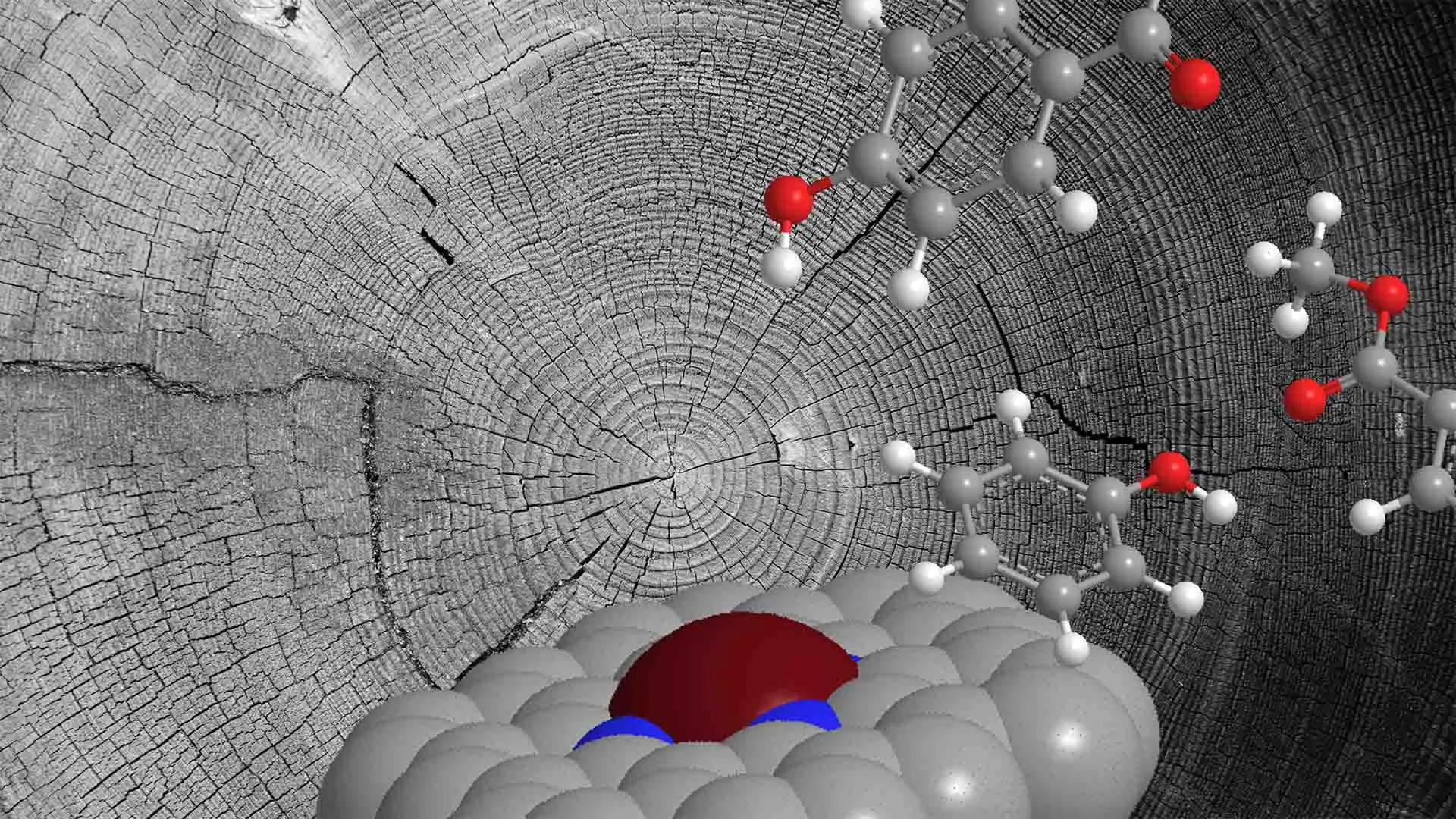
# Atomic Catalyst Unlocks Hidden Value in Plant Waste
Researchers have developed a breakthrough catalyst that efficiently converts lignin—a stubborn polymer found in plant waste—into valuable chemicals under moderate conditions. The discovery reveals the precise atomic mechanisms driving this transformation and opens pathways to convert forestry and agricultural byproducts into renewable feedstocks for fuels, plastics, and industrial materials.
Lignin represents roughly 25 to 30 percent of plant biomass but remains largely underutilized despite comprising one of the most abundant organic polymers on Earth. Its complex three-dimensional structure makes it resistant to conventional breakdown methods, which typically require harsh conditions, high temperatures, or expensive enzymes. This inflexibility has kept billions of tons of forestry residues and agricultural waste from reaching their economic potential.
The new catalyst operates at relatively mild temperatures and pressures, a critical advantage over existing approaches that demand severe reaction conditions and generate substantial energy costs. Researchers identified the exact atomic-level mechanisms that enable this efficiency, providing a molecular blueprint for how the catalyst selectively breaks lignin's bonds while preserving desirable chemical structures.
Understanding catalytic function at the atomic scale allows chemists to predict how modifications to the catalyst's composition and structure will influence its performance. This level of mechanistic insight transforms lignin conversion from an empirical guessing game into a rational design process. Scientists can now engineer more selective catalysts that target specific bonds within lignin's complex network, improving yields and reducing unwanted byproducts.
The implications extend across multiple industries. Lignin breakdown produces aromatic compounds that serve as precursors for bioplastics, paints, adhesives, and pharmaceutical ingredients. Converting agricultural and forestry waste into these building blocks creates economic value from materials currently burned for heat or left to decompose. This shift reduces waste management costs while generating renewable alternatives to petroleum-derived chemicals.
Forestry operations produce an estimated 2 billion tons of residual biomass annually. Similarly, agricultural sectors generate enormous volumes of crop stalks, husks, and processing byproducts. Current practice often involves low-value applications like animal bedding or direct combustion. The new catalyst technology promises to monetize these waste streams while reducing dependence on fossil fuel feedstocks for chemical manufacturing.
The research advances biorefinery concepts that extract maximum value from plant material. Biorefineries process renewable biomass into multiple products simultaneously, mirroring petroleum refineries but operating on plant carbon instead of fossil deposits. Efficient lignin conversion strengthens the economic viability of these facilities, making them competitive with traditional petrochemical operations.
Commercialization timelines remain uncertain, but the atomic-level understanding positions this discovery for rapid optimization. Researchers can now systematically test variations in catalyst composition, predict performance improvements, and identify the most commercially viable configurations. Scaling laboratory results to industrial volumes presents standard engineering challenges rather than fundamental scientific barriers.
Beyond lignin processing, this catalytic approach may inform strategies for upgrading other abundant but difficult-to-utilize biomass components. The mechanistic insights developed here provide a template for designing catalysts that selectively break complex polymers under mild conditions. This opens research directions for valorizing cellulose, hemicellulose, and other plant-derived materials that currently command limited commercial value.