# Physicists Create Tiny "Big Bang" with Surprisingly Small Atomic Nuclei
Researchers at CERN have recreated conditions from the earliest moments of the Universe by smashing unexpectedly small atomic nuclei together at nearly the speed of light. The collisions generated quark-gluon plasma, a state of matter physicists believe dominated the cosmos mere microseconds after the Big Bang.
The discovery adds a surprising dimension to our understanding of both nuclear physics and the Universe's birth. For decades, scientists assumed only massive gold or lead nuclei could produce quark-gluon plasma when collided at extreme velocities. The new findings reveal that far smaller nuclei accomplish the same feat, opening new avenues for studying both subatomic behavior and cosmic history.
When nuclei collide at relativistic speeds inside CERN's particle accelerators, the energy becomes so concentrated that protons and neutrons essentially melt into their constituent quarks and gluons. This exotic state of matter exists nowhere in the present-day Universe but filled all space in the first fractions of a second after the Big Bang. By recreating it in the lab, physicists gain direct observational access to fundamental forces and properties that shaped everything that exists today.
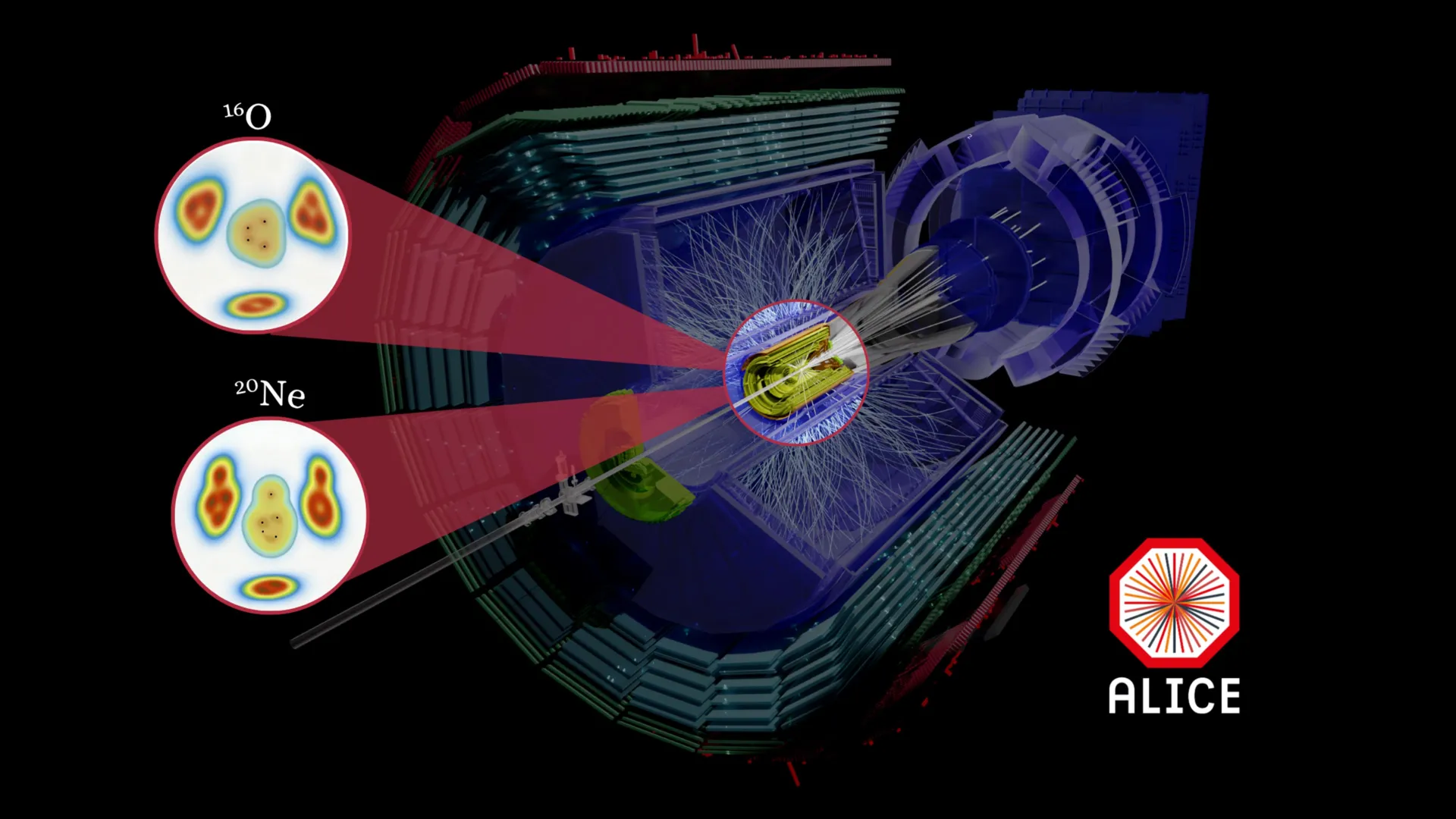
What makes this result particularly elegant is what the researchers found in the debris. The particles produced by these collisions carry imprints of the shapes of the colliding nuclei themselves. This unexpected sensitivity offers a novel diagnostic tool. By analyzing the momentum and angular distribution of particles emerging from the collision, physicists can essentially "see" the geometry of the nuclei that created them, much like studying a footprint to understand the foot that made it.
This technique reveals information at scales where direct visual observation remains impossible. Nuclear shapes vary considerably. Some nuclei are roughly spherical, while others adopt elongated or deformed configurations depending on their proton and neutron arrangements. The collisions encode this structural information into the final particle patterns, allowing researchers to map nuclear shapes with precision previously unavailable.
The implications extend in two directions. On the practical nuclear physics side, this gives researchers an entirely new method for studying exotic nuclei and their properties without requiring additional experiments specifically designed for shape measurements. On the cosmological side, it confirms that quark-gluon plasma formation is more robust and universal than theoretical predictions suggested. If tiny nuclei can trigger plasma formation, it indicates the phenomenon depends less on specific collision conditions and more on fundamental physics.
The findings also hint at connections between the microscopic and macroscopic scales. Nuclear geometry influences how particles scatter through quark-gluon plasma, which in turn reflects the fundamental symmetries and forces governing both atomic nuclei and the early Universe. This layering of information suggests nature encodes details at one scale into signatures observable at another, a principle that guides modern physics toward deeper unification.
Future research will likely exploit this new diagnostic capability to study more exotic nuclear species and extract additional information about quark-gluon plasma properties. Each collision becomes not just an opportunity to recreate Big Bang conditions, but a window into the shapes and structures of the atomic nuclei themselves. This convergence of nuclear physics and cosmology demonstrates how laboratory experiments on the smallest scales illuminate some of the largest questions about our Universe's origin and evolution.