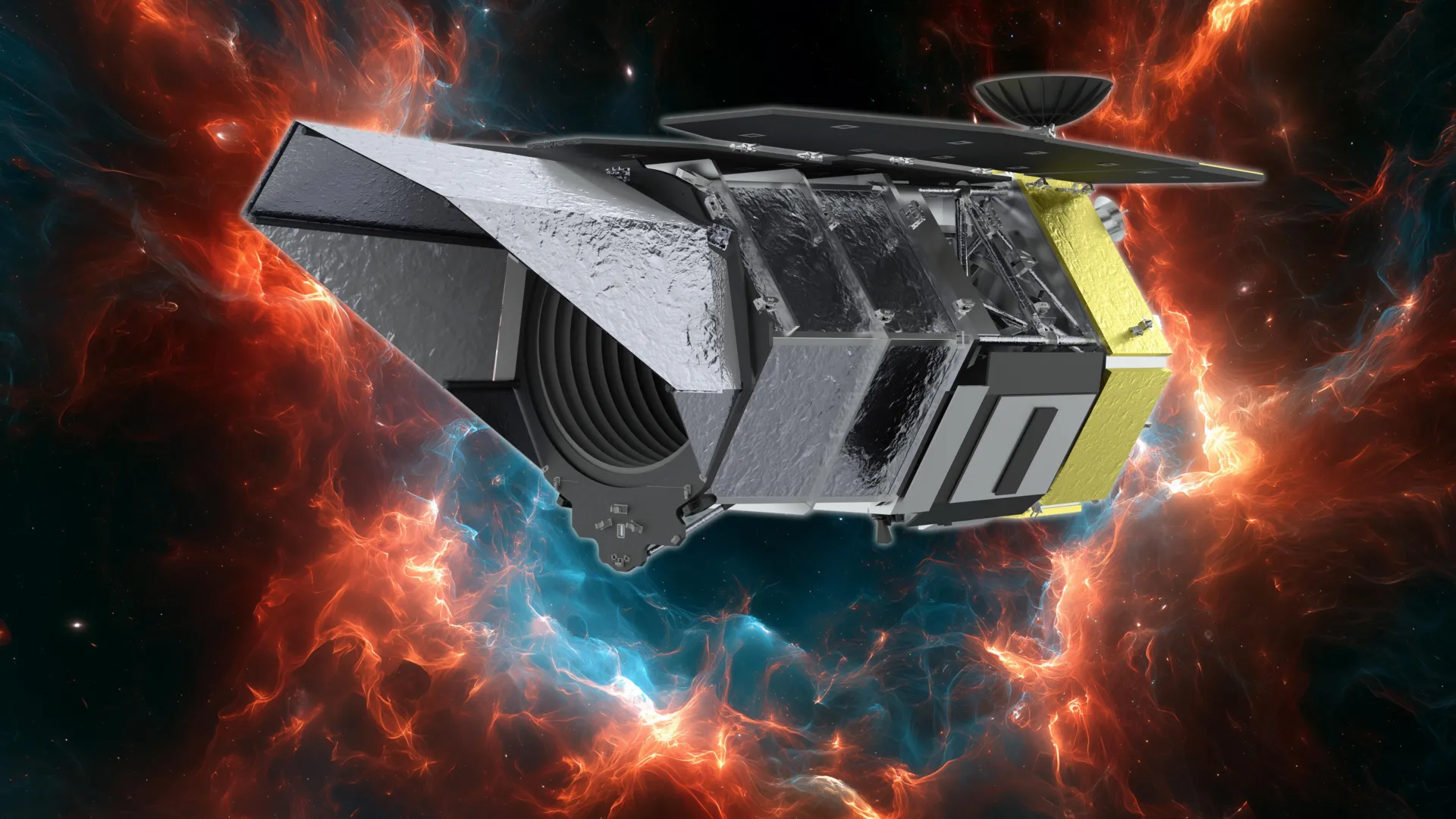
# NASA's Roman Space Telescope Clears Path for August Launch
NASA has formally approved the Roman Space Telescope for final launch preparations, with liftoff now targeted for August 30 aboard SpaceX's Falcon Heavy rocket. The clearance marks a critical milestone for the mission after years of development and construction.
The Roman Space Telescope, named after Nancy Grace Roman, NASA's pioneering astrophysicist who revolutionized space-based astronomy, represents a generational leap in observational capability. The mission will carry a 2.4-meter mirror, matching the Hubble Space Telescope's primary mirror size but with dramatically improved instruments and capabilities that position it as a successor to Hubble and a complement to the James Webb Space Telescope.
The observatory's science goals span three major areas of cosmic inquiry. First, it will measure the expansion history of the universe with unprecedented precision, collecting data that directly addresses one of modern physics' deepest mysteries: dark energy. By observing Type Ia supernovae across billions of light-years, Roman will refine measurements of how the universe's expansion rate has changed over cosmic time.
Second, the telescope will construct detailed maps of dark matter distribution across the cosmos. Roman's wide field of view and sensitivity will enable weak gravitational lensing studies that reveal where dark matter clumps throughout the universe. These observations could help bridge gaps between theoretical predictions and observational evidence.
Third, Roman will conduct systematic surveys for distant exoplanets using gravitational microlensing techniques. This approach detects planets orbiting other stars by measuring the subtle brightening of light from background stars as foreground stars and planets pass in front of them. The method reaches far beyond the distances accessible to direct imaging or transit methods, potentially discovering planets in Earth-mass ranges around distant host stars.
The mission's design emphasizes versatility. Roman carries two imaging instruments and a coronagraph optimized for direct imaging of exoplanets and debris disks around other stars. The telescope's 0.28-square-degree field of view dwarfs Hubble's capabilities, allowing Roman to survey cosmic volumes more rapidly than previous telescopes.
Development timelines have extended considerably since Roman's initial conception in the mid-2000s. The mission faced technical challenges, budget pressures, and schedule adjustments typical of flagship astronomy missions. The decision to standardize on SpaceX's Falcon Heavy rocket reduced launch costs and simplified logistics compared to earlier plans involving NASA's Space Launch System.
The August 30 target date assumes no additional delays during final integration and testing. Following launch, Roman will require approximately three months to reach its operational orbit at the Sun-Earth L2 Lagrange point, 1.5 million kilometers from Earth. Commissioning activities will occupy several additional months before science operations commence.
Astronomers anticipate that Roman's observations will fundamentally reshape understanding of cosmic expansion, dark matter physics, and planetary demographics across the galaxy. The mission's ten-year baseline provides ample time for surveys and follow-up studies, though the extended mission potential extends that window further. Success hinges on flawless execution through launch, deployment, and initial operation.