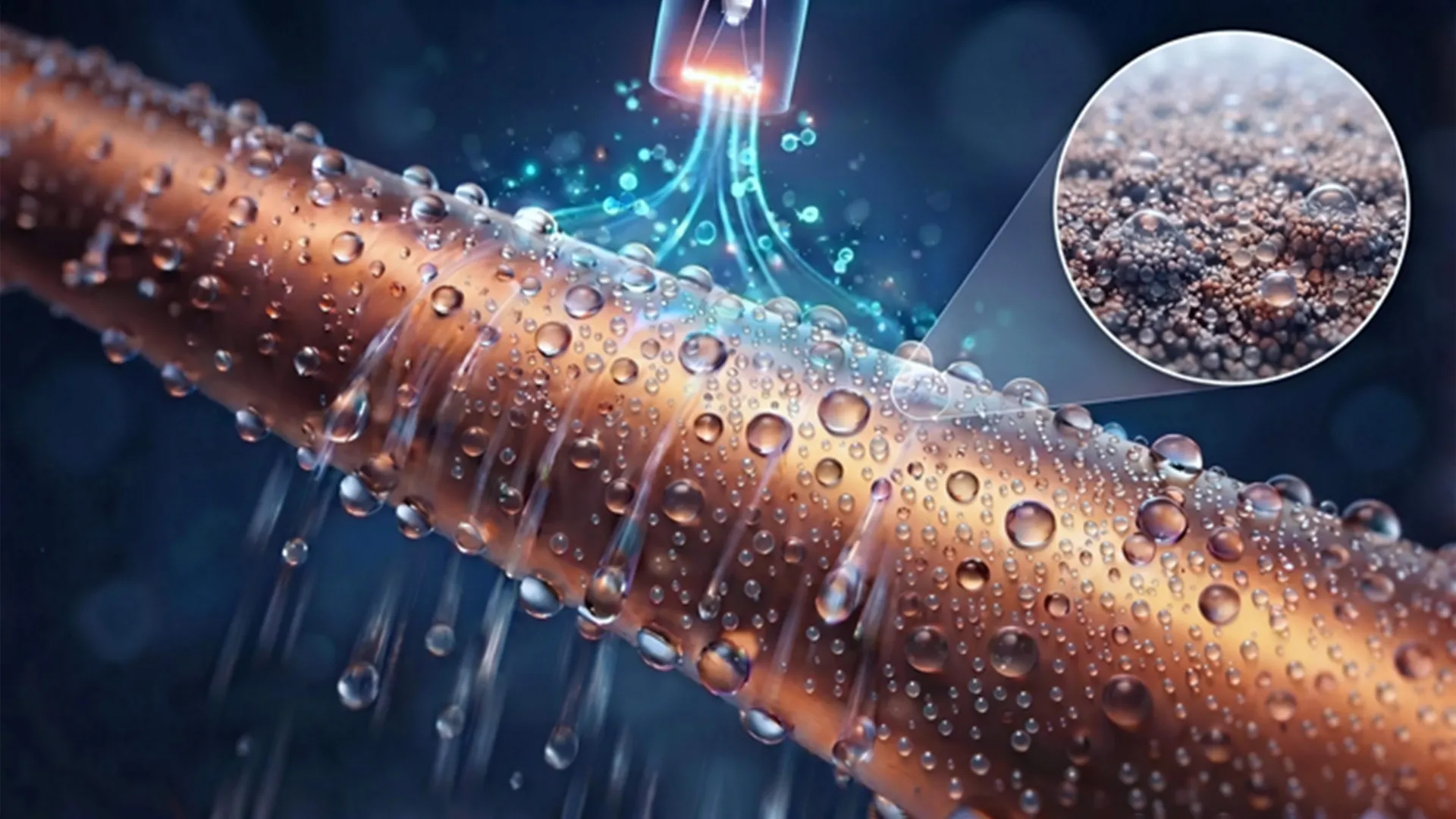
Researchers have engineered an ultrathin polymer coating that exploits microscopic surface defects to achieve a fivefold improvement in heat transfer efficiency during condensation. The breakthrough transforms what engineers once viewed as manufacturing flaws into functional features that accelerate dropwise condensation, a process where water vapor converts directly into discrete droplets rather than a continuous film.
The team applied their coating to copper tubes and measured heat transfer rates against two benchmarks. Compared to bare copper, the new surface transferred heat 5.5 times more efficiently. Against hydrophobic surfaces designed to repel water, the coating performed 50% better. This performance leap addresses a persistent challenge in thermal engineering: traditional surfaces accumulate water films that insulate and block fresh condensation, reducing heat exchange rates.
The mechanism works in two stages. First, the polymer coating contains intentional microscopic structures that act as nucleation sites where water droplets preferentially form. Second, the coating's surface chemistry allows droplets to detach and shed rapidly, continuously exposing bare areas underneath for new condensation to occur. This cycle maintains high heat transfer rates across the surface without the thermal resistance of standing liquid films.
Ultrathin coatings offer practical advantages for industrial application. Unlike bulk materials or thick layers, a thin polymer film adds minimal weight and cost while preserving the underlying copper's structural properties. Copper tubes already appear throughout condensing heat exchangers, cooling systems, and power generation plants, making retrofit compatibility straightforward.
The research team did not specify their institution or publish date in the available information, limiting verification details. The work references comparison against "standard water-repelling coating," likely superhydrophobic surfaces that shed water but paradoxically reduce heat transfer because droplets detach too readily without long contact time. The new coating appears to optimize the tradeoff between droplet adhesion and shedding.
Potential applications span HVAC systems, refrigeration units, and thermal power plants where condensation heat exchangers operate continuously. A 5.5x improvement translates to either dramatically smaller equipment for equivalent heat removal or much higher efficiency from existing installations. Data center cooling and industrial waste heat recovery systems could benefit substantially.
Limitations remain undocumented in the available summary. Durability under repeated thermal cycling, resistance to fouling from dissolved minerals in cooling water, and long-term stability of the polymer coating require investigation. Real-world performance depends on whether the structures maintain their nucleation properties and whether droplets continue shedding after months of operation. Cost analysis and scalability to larger surface areas also merit examination.
The work exemplifies how nanotechnology and materials science reframe manufacturing defects as opportunities. Rather than eliminating microscopic flaws, engineers increasingly embed them with purpose. This approach appears across diverse fields, from solar cells with deliberate grain boundaries to battery electrodes with controlled porosity.
Future studies should clarify the polymer composition, coating thickness, maximum operating temperatures, and whether this approach works on materials beyond copper. Testing under real industrial conditions with actual cooling water containing minerals and organic contaminants will determine whether laboratory results transfer to field deployment.