# Stars Survive Repeated Encounters With Supermassive Black Holes, But Their Light Shows Fade
Astronomers have discovered a remarkable class of stars that make repeated close approaches to supermassive black holes, surviving each tidal encounter while emitting brilliant flares of energy. These encounters happen regularly in some systems, yet the intensity of the resulting light bursts declines with each pass. New research suggests that rapidly rotating stars hold the answer to this mystery, explaining both the progressive dimming of flares and how these stars ended up trapped in such extreme orbits.
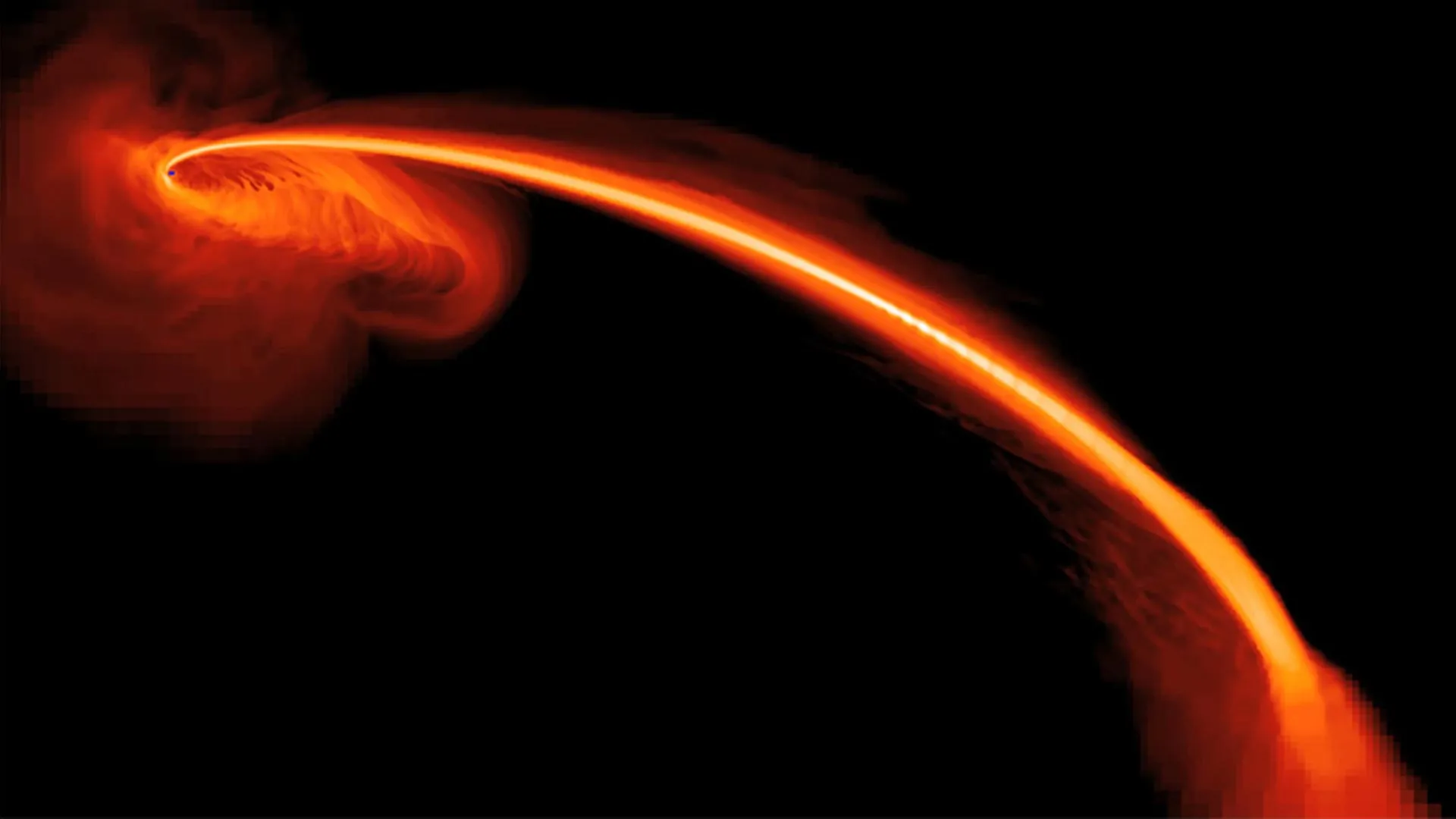
The phenomenon represents an unusual subset of "tidal disruption" events, the violent processes that occur when stars venture too close to black holes. Typically, a star approaching a black hole experiences spaghettification, torn apart by extreme tidal forces. But these newly studied systems defy that expectation. Stars return repeatedly, streaming material back toward the black hole and generating visible outbursts each time.
The key difference appears to be stellar rotation. Stars spinning extremely rapidly before their capture by black hole gravity may resist complete disruption more effectively than slower stars. This rapid spin generates internal pressure that helps hold the star together against the black hole's crushing tidal forces. Paradoxically, the same rapid rotation that enables survival may also explain why successive flares grow dimmer.
Each encounter strips material from the star's outer layers. A rapidly spinning star sheds its exterior more readily than a slower rotator might. With each pass, the star loses gas preferentially from its equatorial region, where rotation velocity reaches maximum. This progressive loss reduces the star's mass and gradually lowers its capacity to generate bright flares. The remaining stellar material becomes increasingly lean and exhausted, producing weaker light shows at each return.
The trapped orbits themselves likely result from this same pre-existing rapid rotation. Stars spinning fast enough to survive black hole encounters probably achieved those spins earlier in their evolution, possibly through stellar mergers or mass transfer from companion stars. These extremely fast rotators end up in tight, repeating orbits around black holes more easily than their slower counterparts, perhaps through processes involving accretion disks or dynamical interactions within crowded stellar environments near galactic centers.
This research connects several previously puzzling observations into a coherent framework. Astronomers have long wondered why some tidal disruption events repeat while others represent one-time violent encounters. The rotation explanation accounts for the variation. It also predicts that repeat-flare systems should show progressive dimming, a pattern now recognized in actual observations.
The work carries implications for understanding black hole demographics and stellar populations in galactic cores. Rapid rotation rates may determine survival odds for stars venturing near massive black holes. Over cosmic time, this process could segregate fast and slow rotators into different dynamical environments around galactic nuclei, leaving detectable signatures in current stellar populations.
Future observations promise to test these predictions more rigorously. Monitoring campaigns tracking flare brightness across multiple encounters can verify whether fading occurs consistently. Spectroscopic analysis of these events should reveal whether stripped material shows the chemical and kinematic signatures expected from equatorial stripping of spinning stars. Space-based telescopes capable of resolving rapid X-ray variability will help constrain orbital parameters and stellar properties with unprecedented precision.