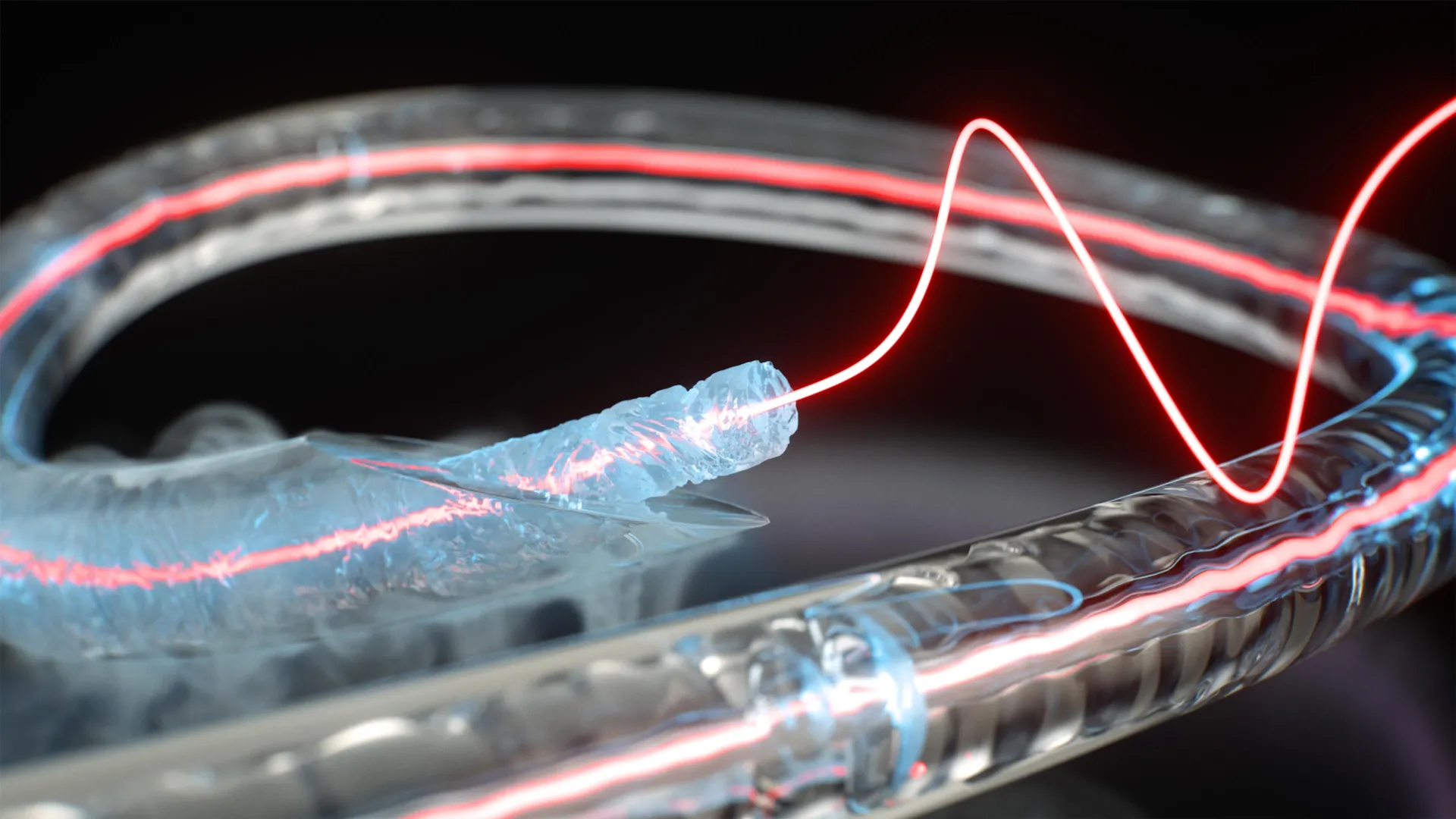
Researchers have discovered a way to dramatically amplify the interaction between light and sound by freezing the liquid core of an optical fiber, creating conditions where these two phenomena couple together 1,000 times more powerfully than in conventional fibers. The finding opens pathways toward more efficient photonic computers and quantum technologies that require less energy to operate.
The work centers on optoacoustics, the field studying how light and acoustic waves interact. In standard optical fibers, this coupling remains relatively weak because the materials involved do not naturally favor strong interactions between photons and phonons, the quantum units of sound. The research team identified that by cooling the liquid core of a specialized fiber to freezing temperatures, they could create an extreme environment where the two phenomena became tightly interwoven.
By exploiting this thousandfold enhancement, the researchers constructed what they call optoacoustic memory. This system stores information in the form of coupled light and sound waves, with the frozen fiber serving as the storage medium. The approach differs fundamentally from conventional electronic or photonic memory, which relies on electrons or photons alone. When light and sound interact this strongly, energy can transfer between them with remarkable efficiency.
The practical applications stem directly from this efficiency gain. Photonic computers process information using light rather than electricity, offering potential speed and energy advantages over traditional processors. However, current photonic systems consume substantial power. By leveraging the enhanced light-sound coupling, computers built on these principles could perform the same operations while consuming significantly less energy. This addresses one of the major barriers to widespread adoption of photonic computing.
The development also intersects with quantum technology. Quantum systems rely on precise manipulation and storage of quantum information. The optoacoustic memory demonstrated here provides a new mechanism for this task, one that could be more robust or more efficient than existing approaches. Researchers working on quantum computers, quantum sensors, and other quantum devices may find applications for this frozen-fiber technology.
The mechanism enabling this breakthrough relates to how freezing changes the physical properties of the fiber's core material. As temperatures drop, the material's density increases and its acoustic properties shift. These changes alter how sound waves propagate through the medium and how strongly they couple with light waves traveling alongside them. The frozen state essentially creates an optimal environment for optoacoustic interaction that does not exist in room-temperature fibers.
This research represents progress in the broader field of integrated photonics, where researchers continuously seek ways to make light-based systems more efficient and capable. Previous work in optoacoustics focused on gases or other media, but achieving a 1,000-fold enhancement in a fiber geometry offers distinct practical advantages. Optical fibers already form the backbone of global telecommunications infrastructure, making any advances compatible with existing fiber systems particularly valuable.
The next steps involve scaling the optoacoustic memory concept and testing it in practical computing environments. Researchers must verify that the memory cells operate reliably, can be manufactured consistently, and integrate well with other photonic components. These engineering challenges remain substantial, but the fundamental physics now demonstrates clear promise.