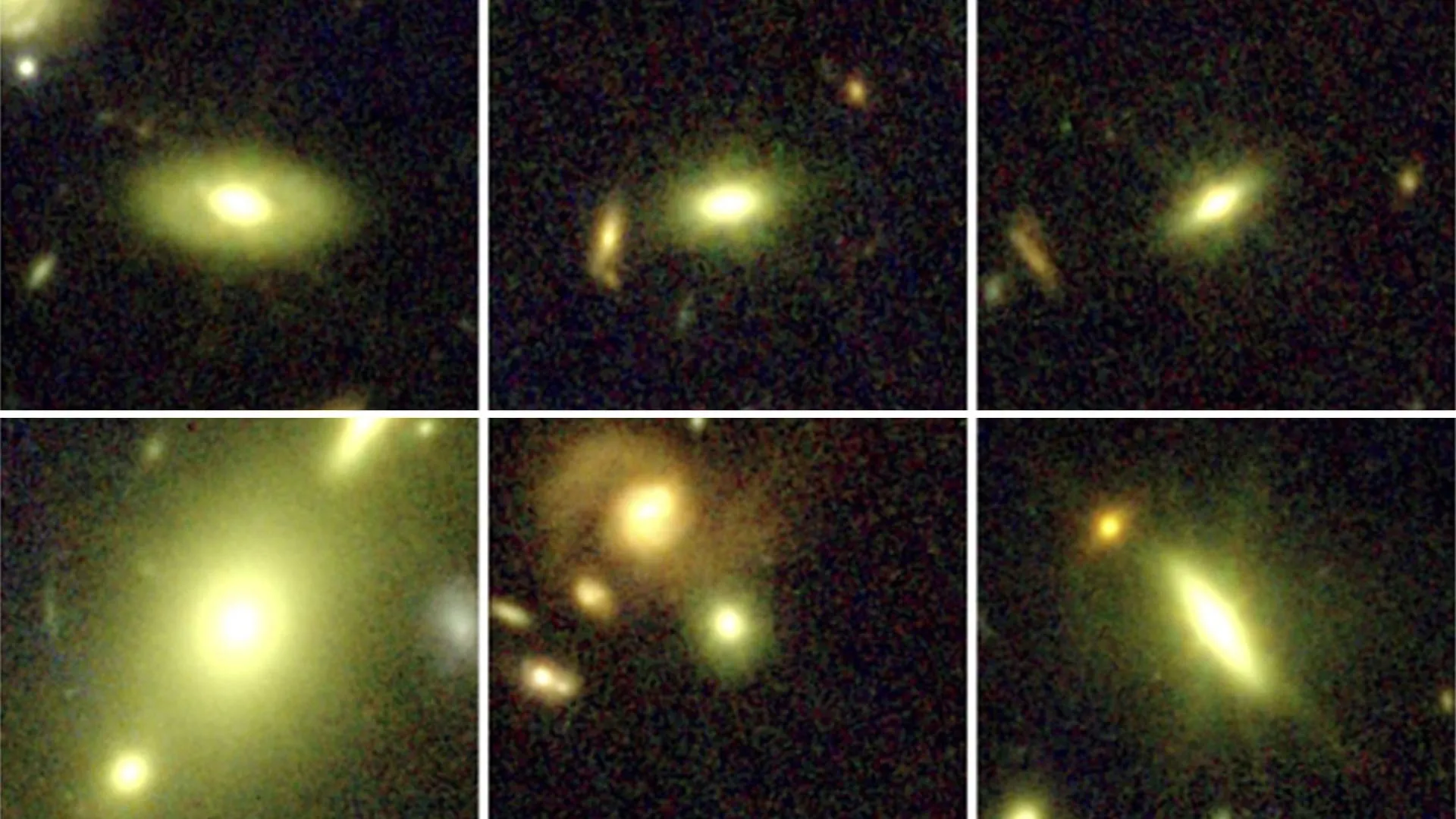
# JWST Discovers Early Galaxies Are Far Heavier Than Astronomers Thought
The James Webb Space Telescope has revealed a hidden population of faint stars in massive early galaxies, forcing astronomers to revise their understanding of the universe's infant years. Researchers found that these ancient galaxies contain three to four times more stellar mass than previous observations suggested, deepening one of cosmology's most vexing puzzles: how did the universe build enormous galaxies so quickly after the Big Bang.
The discovery centers on a population of small, dim stars that earlier telescopes could not detect. These low-mass stars contribute far more total mass to early galaxies than scientists anticipated. JWST's infrared sensitivity proved powerful enough to resolve individual stars in galaxies formed less than a billion years after the Big Bang, revealing a stellar census that dramatically exceeded models.
This finding intensifies an existing crisis in cosmology. Astronomers have long struggled to explain how galaxies could grow to such enormous sizes in such a short cosmic timeframe. Previous observations already hinted that galaxies formed faster than theory predicted. The new mass estimates make this timeline problem worse. If these galaxies truly contain three to four times more mass, they must have assembled their stars even more rapidly than the already-perplexing rates researchers had measured.
The implication cuts both ways. Either galaxy formation physics operates differently than current models assume, or the universe's early decades harbored conditions far more conducive to rapid stellar assembly than scientists believed. Either scenario demands fundamental revisions to theories developed over decades.
The research also hints at consequences for planetary systems. A higher abundance of low-mass stars in the early universe suggests that planets orbiting red dwarfs and similar small stars were more common than previously estimated. This affects the potential prevalence of life-bearing worlds in the early cosmos. If low-mass stars dominated the early galaxy population, then habitable zones orbited these common stars far more frequently than astronomers thought.
The JWST observations build on the telescope's core strength: detecting extremely faint sources across vast cosmic distances. By studying galaxies at redshifts above 10, corresponding to periods less than 500 million years after the Big Bang, the instrument can resolve stellar populations invisible to its predecessors. The Hubble Space Telescope and other earlier instruments lacked the infrared sensitivity and spatial resolution to distinguish these dim stars individually.
This discovery represents a watershed moment in extragalactic astronomy. Astronomers must now reconcile observations with theory. Some possibilities include revising star formation efficiency models, reconsidering how supermassive black holes influence galaxy growth, or accepting that unknown physics governed the early universe's first billion years.
Future JWST observations will likely extend these findings to larger galaxy samples. The telescope's remaining operational lifetime offers opportunities to map the masses and stellar populations of hundreds more distant galaxies, building a clearer picture of cosmic assembly history.