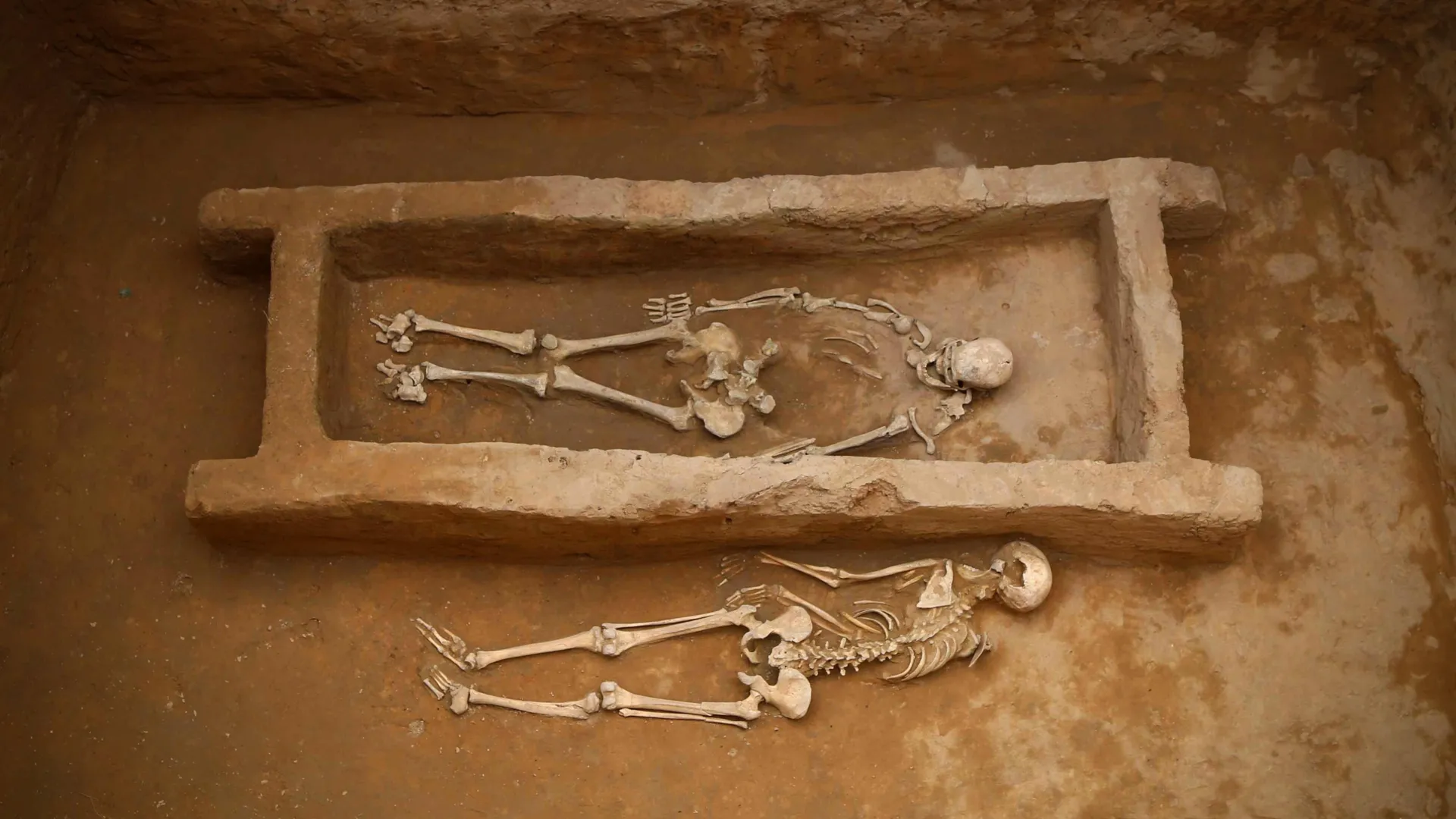
Researchers analyzing ancient DNA from Shimao, a massive 4,000-year-old settlement in China, have uncovered evidence of how one of East Asia's earliest complex societies organized itself and connected with distant populations.
The study shows that Shimao's inhabitants descended primarily from local Yellow River farming communities, establishing the settlement's roots in established agricultural traditions. However, the genetic data also reveals meaningful ancestry from southern and steppe populations, indicating extensive prehistoric trade networks and migration patterns across vast distances.
Shimao itself covers roughly 6.2 square kilometers and features massive stone walls, making it one of the largest known Neolithic settlements in East Asia. The site dates to around 2300 BCE during China's late Neolithic period, a time when complex social hierarchies and monumental architecture were beginning to emerge.
The DNA analysis likely examined skeletal remains from burials at the site, a standard approach for reconstructing ancient population movements and genetic ancestry. By comparing the genetic profiles of Shimao residents with other ancient populations, researchers could trace ancestral lineages and identify which groups contributed to the settlement's gene pool.
The discovery of genetic ties to steppe populations is particularly revealing. These distant connections suggest that despite geographic separation, early Chinese societies maintained contact with nomadic herding communities to the north and west. Similarly, southern genetic contributions point to interaction with more distant agricultural societies in what is now central or southern China.
Understanding Shimao's genetic composition helps scholars reconstruct how East Asia's earliest urban centers developed. Rather than emerging in isolation, these complex societies arose through interaction with neighboring populations, suggesting trade, intermarriage, and cultural exchange shaped the region's early history.
The research provides a window into the Bronze Age world before written records became common in China. While the specific nature of interactions remains unclear from DNA alone, the genetic evidence establishes that Shimao served as a nexus connecting diverse East