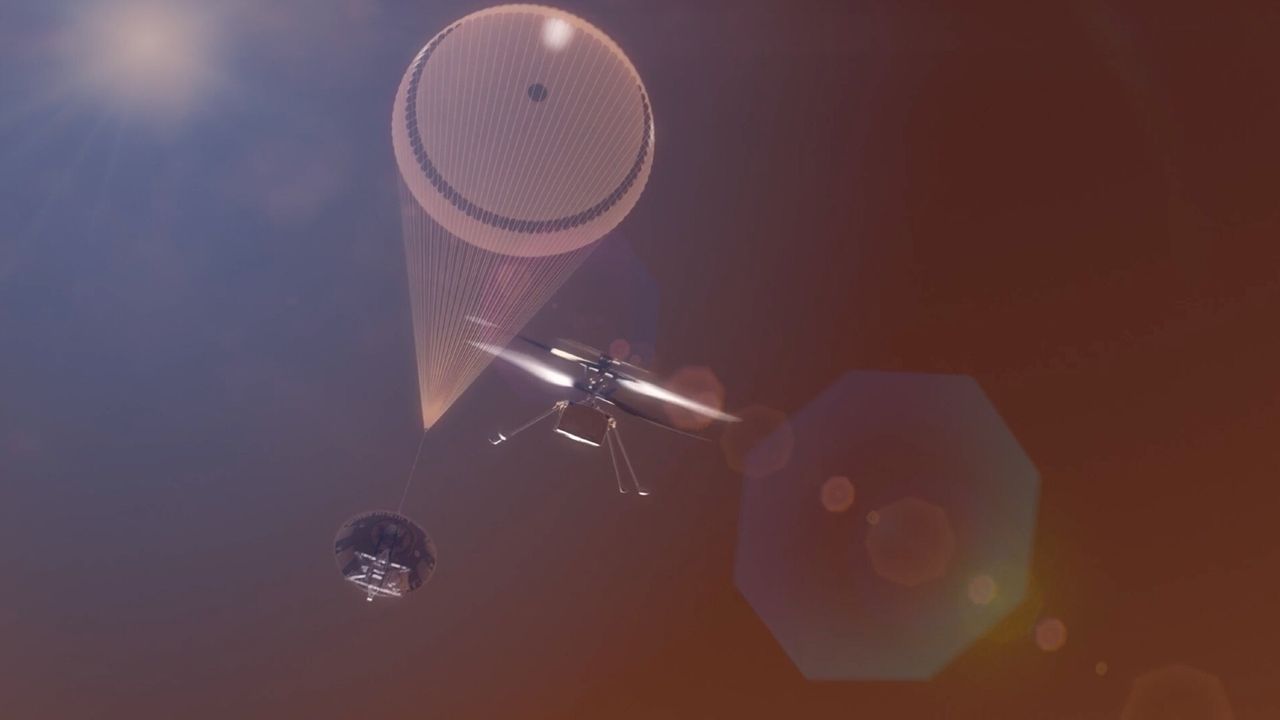
NASA celebrates fifty years since Viking 1 became the first spacecraft to successfully land on Mars on July 20, 1976. The agency now directs its attention skyward, focusing exploration efforts on Mars' atmosphere rather than its surface.
Viking 1 deployed two instruments to study the Martian environment, including atmospheric sensors that gathered data about wind, temperature, and pressure. Those early measurements established a foundation for decades of atmospheric research. The lander functioned for over six years, transmitting images and scientific data that transformed human understanding of Mars from a distant point of light into a tangible world with geology, weather systems, and chemical composition.
The shift toward atmospheric studies reflects evolving priorities in Mars exploration. Current NASA missions pursue questions about Mars' thin air, its circulation patterns, dust storms, and water-ice clouds. The Perseverance rover carries atmospheric instruments alongside its surface equipment. Orbiting spacecraft like the Mars Reconnaissance Orbiter and MAVEN gather continuous data about how the Martian atmosphere behaves across seasons and latitudes.
Understanding Mars' atmosphere carries practical importance for future human missions. Astronauts landing on Mars must account for thin air that provides minimal parachute drag during descent. Dust storms can damage equipment and reduce solar panel efficiency. Temperature swings between day and night can stress systems. Wind patterns affect rover operations and site selection.
The atmospheric focus also addresses fundamental planetary science questions. Mars once possessed a thicker atmosphere capable of supporting liquid water on its surface. Studying the current thin atmosphere helps scientists understand how Mars lost most of its air to space over billions of years. Solar wind interaction with the upper atmosphere strips away gas molecules, a process that MAVEN specifically monitors.
Viking 1's legacy extends beyond its direct discoveries. The mission proved that soft-landing technology could work on Mars, enabling all subsequent surface missions. Its atmospheric measurements provided benchmarks against which modern instruments are calibrated