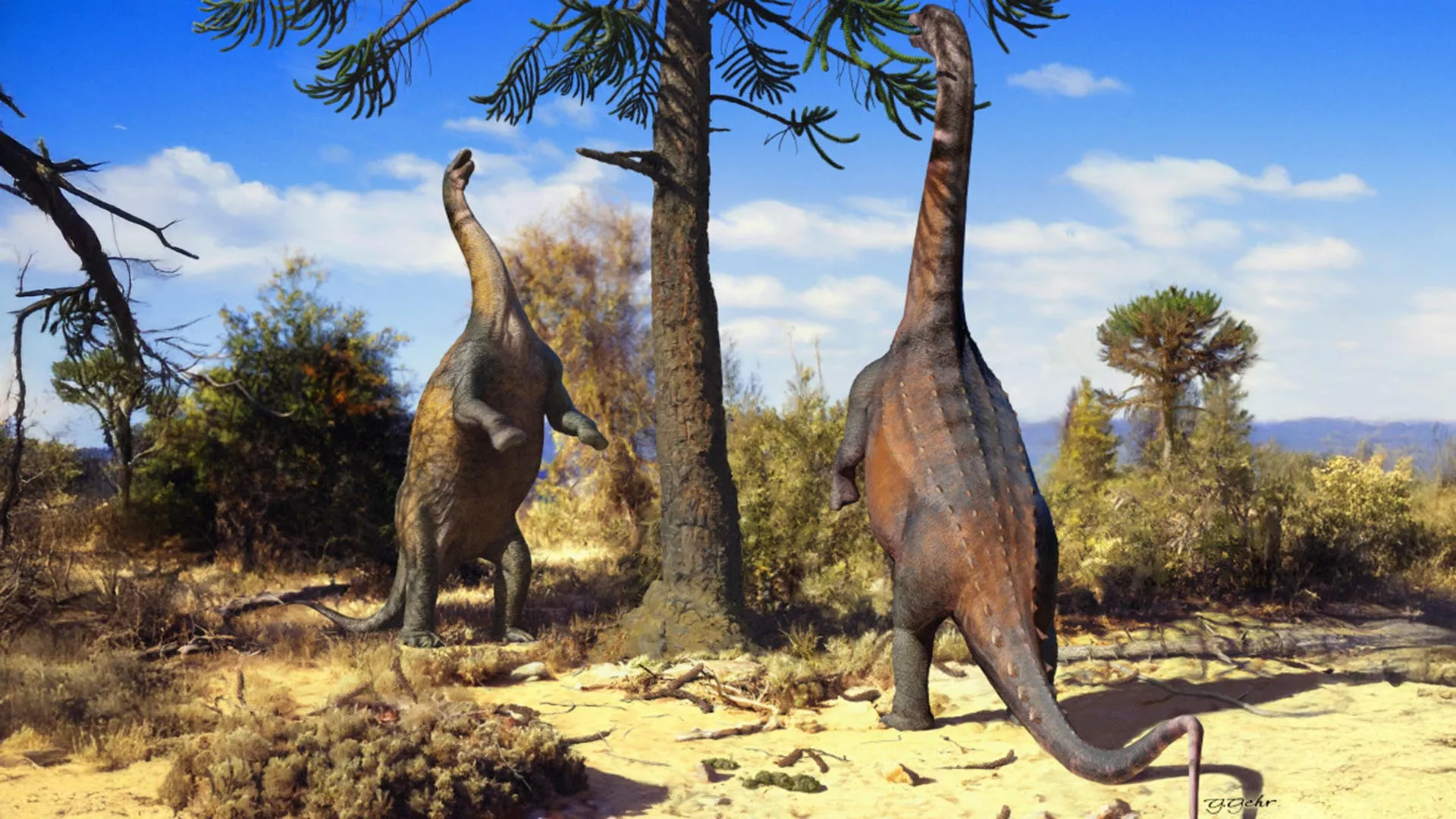
Scientists testing the biomechanics of two South American sauropods discovered that these elephant-sized dinosaurs possessed skeletal structures uniquely suited for rearing up on their hind legs. Researchers created digital models of the femurs, or thighbones, from two medium-sized sauropod species and found that their robust bone architecture could withstand the enormous forces generated during bipedal posturing, particularly when the animals were younger and lighter.
The study reveals that these sauropods likely exploited this anatomical advantage during specific life stages. Their ability to stand upright may have served multiple purposes: reaching high vegetation in the forest canopy, displaying intimidating postures to deter predators, or engaging in competitive displays to attract mates.
The research highlights a critical constraint in sauropod evolution. As these dinosaurs matured and gained mass, their skeletal strength became insufficient to support vertical postures safely. Larger species in the sauropod lineage lost this capacity entirely, forced into permanently quadrupedal locomotion by their sheer size. The transition from bipedal-capable juveniles to obligately quadrupedal adults represents a dramatic shift in behavioral ecology driven by scaling physics.
This work employed computational finite element analysis, a technique that simulates stress distribution across bone surfaces. By varying body mass parameters in the models, researchers identified the precise threshold where rearing became biomechanically infeasible. The findings demonstrate that dinosaur behavior did not remain static throughout development, but rather shifted dramatically as animals grew.
The research underscores how physical constraints shape evolution. Sauropods represent some of Earth's largest terrestrial animals, yet their anatomy reveals trade-offs between size and versatility. The discovery that intermediate-sized species retained capabilities lost to their giant relatives opens new perspectives on sauropod ecology and social behavior. Understanding these biomechanical transitions provides insight into how body size influenced