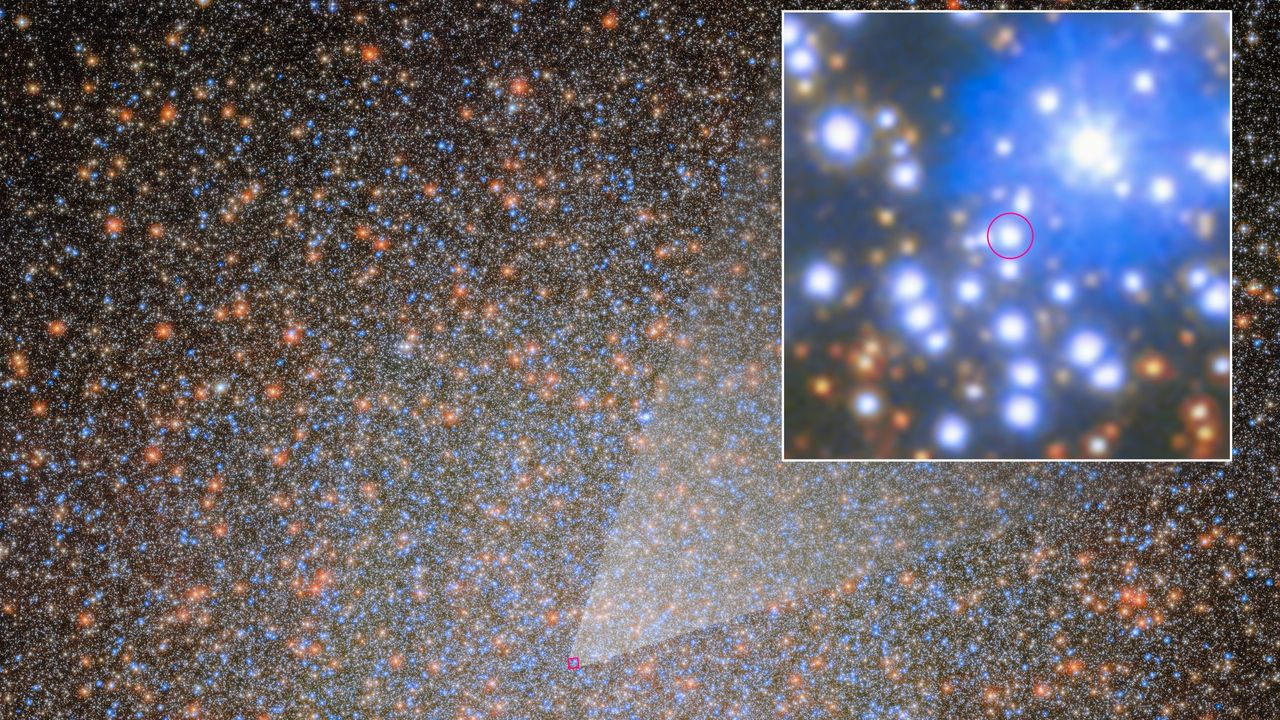
Astronomers using NASA's Hubble and James Webb space telescopes have discovered the first black hole in a hunt for thousands of hidden compact objects within Omega Centauri, one of the largest globular clusters orbiting the Milky Way.
The detection marks a breakthrough in accounting for "missing" black holes. Theory predicts that Omega Centauri should contain roughly 10,000 black holes based on its stellar mass and age, yet astronomers had found virtually none until now. The newfound black hole joins only a handful of previously confirmed black holes in any globular cluster.
The combined power of Hubble and Webb proved essential. Hubble's ultraviolet and optical observations identified candidate black holes by detecting X-ray emission from gas spiraling into them, while Webb's infrared capabilities helped confirm the nature of the source and rule out other explanations. This complementary approach allowed researchers to overcome the challenge of distinguishing black holes from other violent astronomical phenomena in crowded stellar environments.
Omega Centauri, located roughly 15,800 light-years away, contains millions of stars packed into a region only about 150 light-years across. The density makes identifying individual black holes extraordinarily difficult. Black holes themselves emit no light, so astronomers must detect their gravitational influence on surrounding material or radiation from hot gas falling toward them.
The discovery suggests that thousands of black holes remain hidden throughout Omega Centauri, lurking in the cluster's densely packed core. Many likely exist in binary systems with stellar companions, making them even harder to spot. The research demonstrates the value of deploying both space telescopes simultaneously on the same target, combining their distinct observational strengths to solve astrophysical mysteries.
Future observations with these telescopes should accelerate the hunt for the remaining missing black holes, potentially revolutionizing understanding of how black holes form, evol