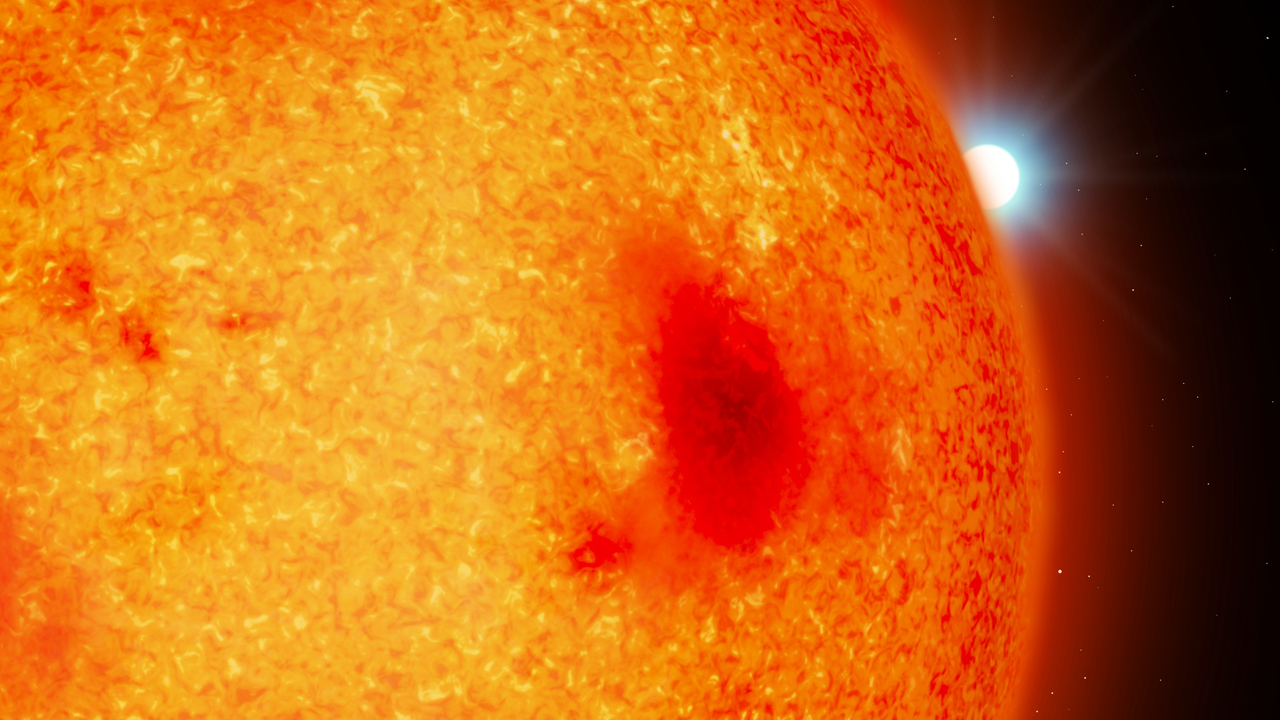
Astronomers have discovered four white dwarfs orbiting red dwarf stars in our cosmic neighborhood, despite their stellar companions blocking direct observation. The research team detected these superdense stellar remnants indirectly through gravitational effects and other telltale signatures rather than through direct visual detection.
White dwarfs represent the dense cores left behind after sun-like stars exhaust their fuel and shed their outer layers. A white dwarf typically compresses a star's mass into an Earth-sized object, creating matter so dense that a teaspoon would weigh tons. Finding them requires careful observation, particularly when they orbit companion stars that outshine them.
The research team overcame the obscuring red dwarfs by analyzing orbital dynamics and detecting the gravitational pull exerted by the white dwarfs on their companions. Red dwarfs, smaller and cooler than our sun, normally emit less light, yet even their modest glow can overwhelm the faint signature of a hidden white dwarf behind them.
This discovery matters because white dwarfs serve as cosmic laboratories for understanding stellar evolution. Every star roughly the mass of our sun will eventually become a white dwarf. Studying systems where white dwarfs orbit red dwarfs reveals how these extreme objects interact with living stars and how binary systems evolve over billions of years.
The team's methodology, using indirect detection techniques rather than relying solely on direct observation, expands the toolkit for finding hidden stellar objects. As telescopes improve and detection methods become more sophisticated, astronomers expect to catalog many more white dwarf-red dwarf pairs currently escaping notice.
These four nearby systems represent just a fraction of such binaries likely residing within a few hundred light-years of Earth. The discovery underscores how much of our stellar neighborhood remains incompletely mapped, even with modern astronomical surveys. Future observations may reveal whether these white dwarfs show unusual properties or follow