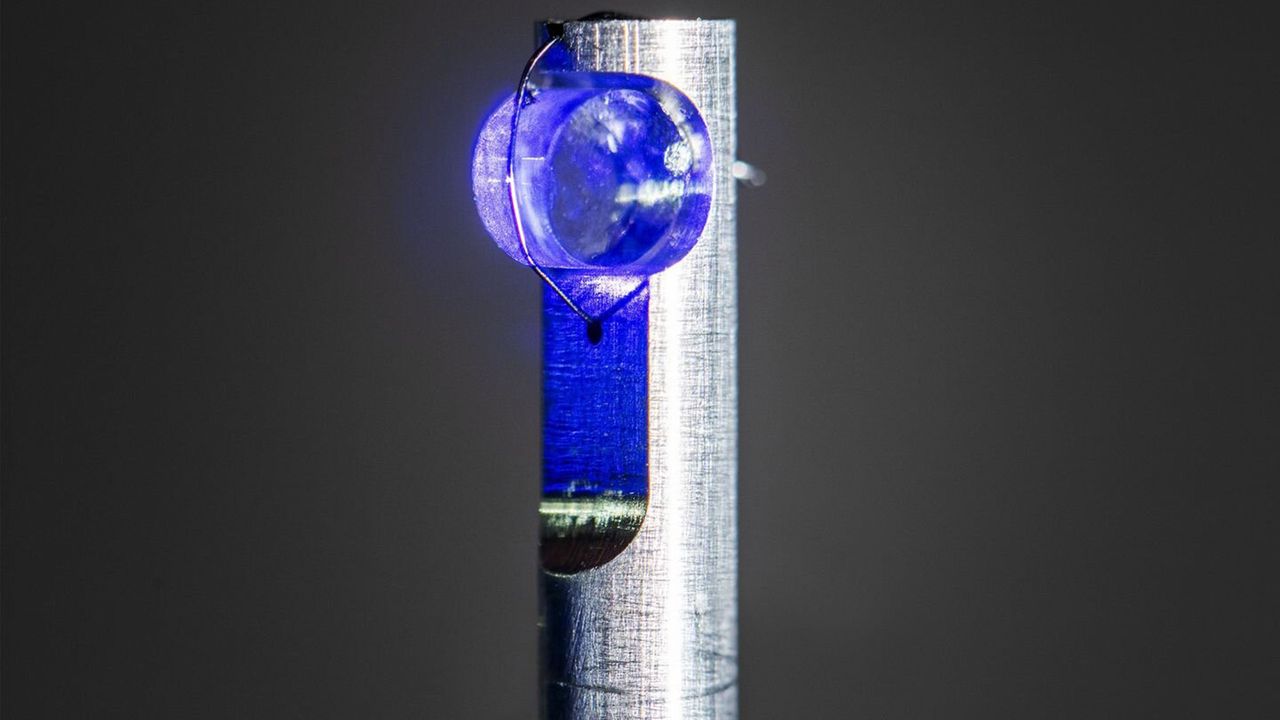
Physicists have built and operated the world's first nuclear clock, using a rare thorium nucleus as its timekeeping mechanism. The breakthrough, achieved by researchers working with thorium-229, demonstrates a device that operates with unprecedented precision and opens pathways for detecting dark matter and searching for undiscovered fundamental forces in nature.
Traditional atomic clocks measure time using electrons orbiting atomic nuclei. Nuclear clocks instead harness transitions within the nucleus itself, where energy levels are far more tightly spaced. This allows them to tick at frequencies billions of times higher than conventional atomic clocks, potentially delivering accuracy far beyond current technology. Thorium-229 became the target because it has a uniquely low-energy nuclear transition, making it accessible with laboratory lasers and equipment.
The functional nuclear clock represents a technical achievement that physicists have pursued for decades. Thorium-229's nucleus transitions between two energy states so close together that they were only theoretically predicted until experimental confirmation came recently. This narrow energy gap makes the isotope exceptionally useful for precision timekeeping while remaining experimentally manageable.
The implications extend well beyond timekeeping. More precise clocks enable tests of fundamental physics that current instruments cannot probe. Researchers can use such clocks to hunt for variations in fundamental constants, including the fine-structure constant that governs electromagnetic interactions. Deviations from expected values would signal new physics. This sensitivity also makes nuclear clocks powerful tools for dark matter searches, as certain dark matter models predict interactions that would subtly alter atomic and nuclear behavior in detectable ways.
A fifth fundamental force, beyond gravity, electromagnetism, and strong and weak nuclear forces, remains theoretical but would leave signatures detectable by sufficiently precise measurements. Nuclear clocks could reveal such a force through their exceptional sensitivity to subtle shifts in nuclear energy levels.
The demonstration validates decades of theoretical work and engineering effort. While current nuclear clocks remain