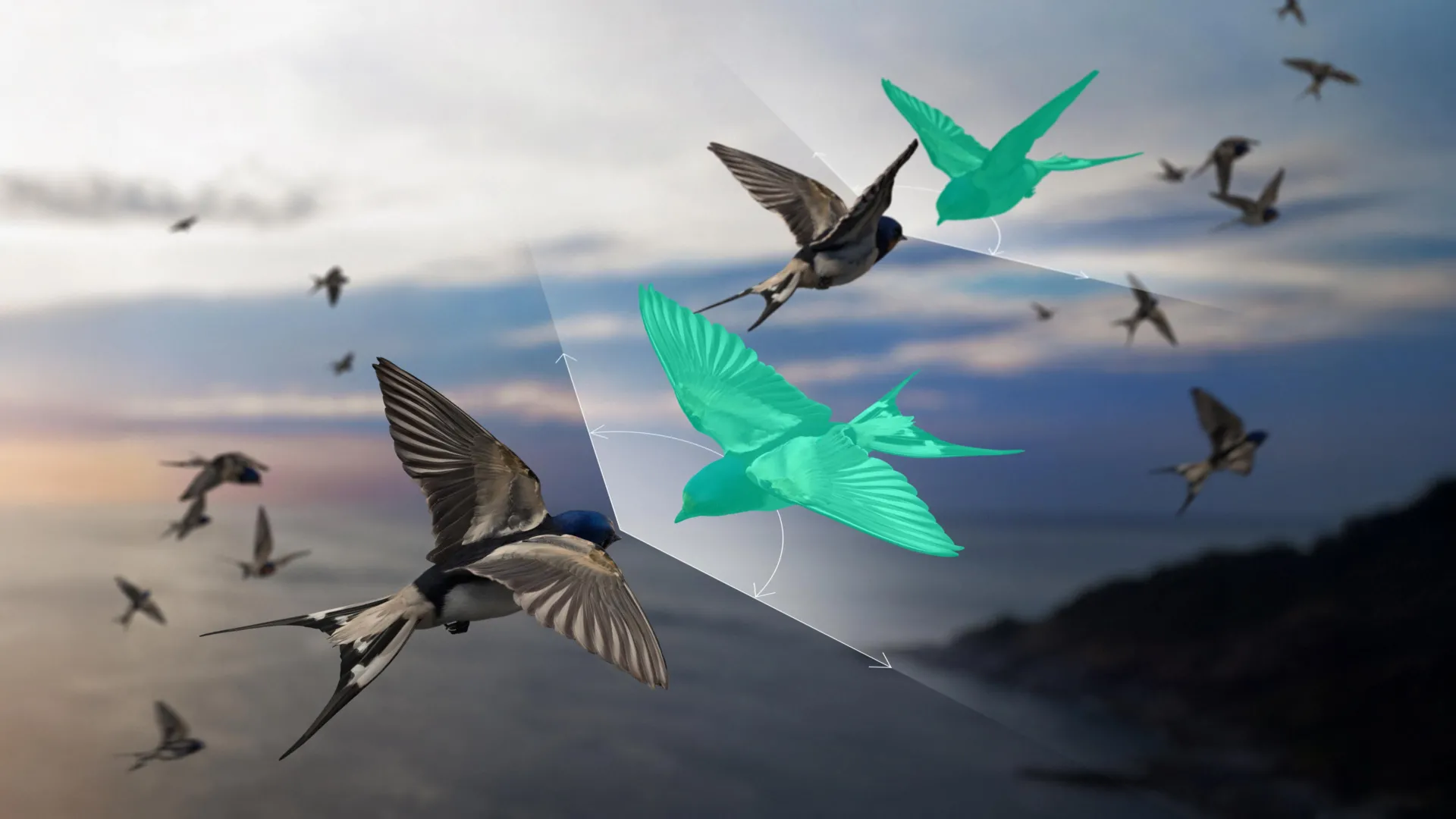
Researchers have cracked a decades-old puzzle about why bird flocks and bacterial swarms seem to break Newton's third law, which states that every action produces an equal and opposite reaction.
The team discovered that these biological systems operate differently than traditional physics predicts. In a flock, individual birds don't just respond to forces from their neighbors. They anticipate movements and coordinate in ways that create net forces without corresponding equal reactions. The same pattern appears in swimming bacteria and other collective organisms.
To solve this, physicists introduced "imaginary partners" into their mathematical models. These hypothetical entities represent hidden degrees of freedom within each organism that aren't directly observable but influence group behavior. When researchers added these invisible components to their simulations, the models suddenly matched real flock movements with far greater accuracy than before.
This approach bridges a gap between classical mechanics and biology. Newton's laws remain valid in isolated systems, but living creatures exist in open systems where energy constantly flows in and out. The imaginary partners mathematically account for internal biological processes that generate motion without requiring equal opposite forces from outside.
The research has practical implications beyond understanding animal behavior. The method applies to any non-reciprocal system where particles or organisms interact asymmetrically. This includes certain types of synthetic materials, robotic swarms, and active matter systems that physicists are developing for nanotechnology.
The team's work appears in peer-reviewed physics literature and represents a breakthrough in complex systems modeling. Rather than treating apparent violations of Newton's third law as exceptions, scientists can now incorporate them into predictive frameworks. The imaginary partners serve as mathematical tools that capture the internal dynamics organisms use to generate collective motion.
This framework doesn't contradict Newton's laws but extends them to accommodate biological reality. The research suggests that many natural systems long dismissed as anomalies actually follow deeper physical principles when examined through the right mathematical lens.